In the early stages of running a business, things often move quickly. Sales go up, new customers come in, and the team feels excited. But after a few years, usually around year two to five, this steady growth can slow down.
This is known as a growth plateau.
A plateau happens when the usual ways of growing, like online ads, word of mouth, or just working harder, don’t lead to better results anymore. Sales stay flat. New customer leads are becoming fewer. The team feels like they’re putting in effort but not seeing progress. This can be frustrating, but it’s also a common stage many businesses go through.
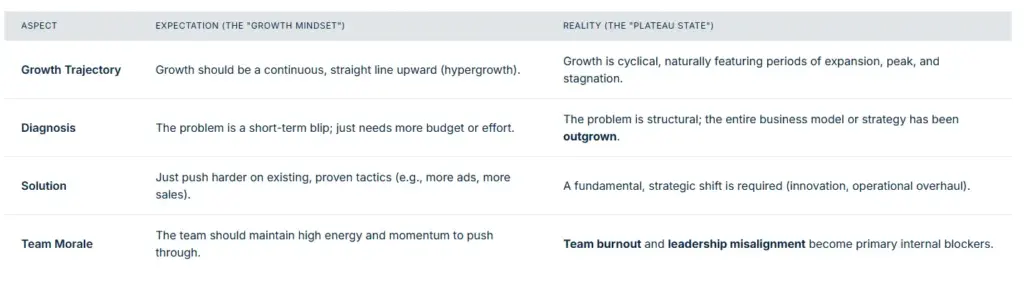
The growth gap: expectation vs. reality
Many business owners think growth will keep going up smoothly, maybe even very quickly. But studies show something different.
In a study of over 140,000 startups, many founders believed they would grow revenue by 500% in their first year. Most of them didn’t make more than that first-year revenue even five years later
Less than 10% of small businesses reach £1 million in yearly revenue
Even companies with strong funding and early success often slow down after their first big push.
This difference between what people hope for and what really happens is sometimes called the “growth gap.” The business grows well for a while, then it stops moving forward.
In our own work, we’ve seen this happen in different ways. Some businesses miss their goals again and again. Others notice that each new campaign or idea brings in less than before. Teams start to focus on quick fixes rather than long-term plans.
This stage can surprise many leaders. Early wins can make it seem like things will always keep moving, which makes it hard to see when it’s time to make bigger changes.
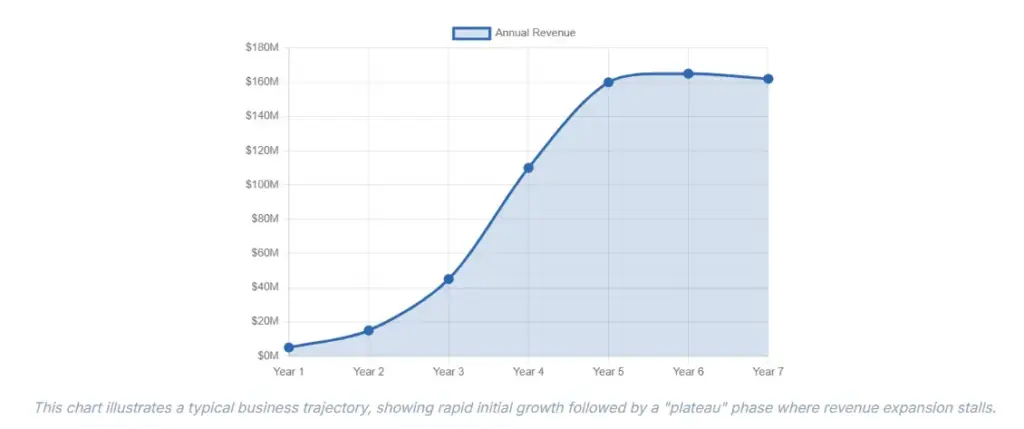
To help show this idea, we’ve included a simple chart:
It shows a path many businesses follow, early growth, then a slowdown in the middle, and with the right changes, a chance to grow again.
Diagnosing the stall: external and internal root causes
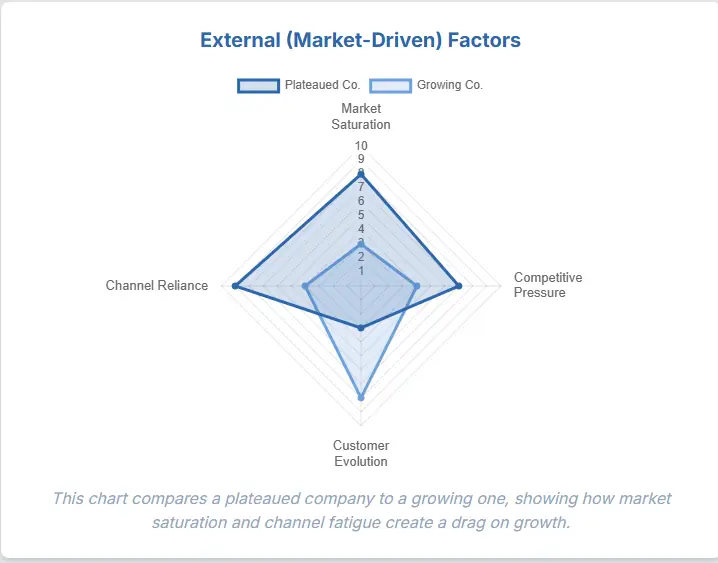
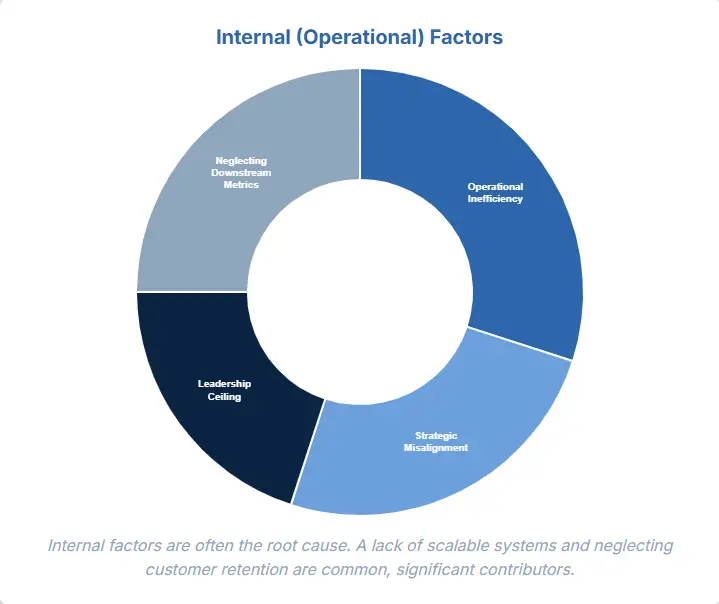
When growth slows down, there’s usually more than one reason. It often comes from a mix of outside challenges and inside roadblocks. A drop in leads or a rise in ad prices might seem like the problem, but these things are often just signs of something deeper.
Here are some of the usual causes:
External factors (market)
Market saturation: The easiest customers have already signed up. Getting new ones now takes more time, effort, and money.
More competition: Other businesses enter the market with similar offers or lower prices. It becomes harder to stand out, and the cost to get new customers (called CAC – Customer Acquisition Cost) goes up.
Changing customer needs: What people wanted before might not be what they want now. Even small shifts can make a product or service feel outdated.
Tired channels: If most growth came from one place, like social media ads or word of mouth, it may not work as well anymore. People get used to it, and results drop.
Internal factors (operations and leadership)
Slow processes: Systems that worked at the beginning may now be too messy or too slow. Manual tasks, unclear roles, or no clear process can cause delays.
Too much reliance on the founder: When one person makes most decisions or holds key relationships, things slow down when that person gets too busy.
Lack of clear direction: Without a clear plan, teams start reacting to problems instead of planning ahead. Messages become confusing. Team spirit drops.
Customer drop-off: When all the focus is on getting new customers, it’s easy to miss issues with current ones. Poor support or confusing onboarding can make customers leave without saying much.
These causes can be hard to see. Meetings are still happening. Revenue may look steady. But inside, things feel stuck. Progress slows, teams feel tired, and leaders spend more time solving problems than moving forward.
This kind of situation can happen in many types of businesses. A software company might grow fast with new users but struggle to keep them. A service business might find its old way of working can’t handle new demand. Often, the problems only become clear when everything feels heavy and progress stops.
The leaky bucket effect
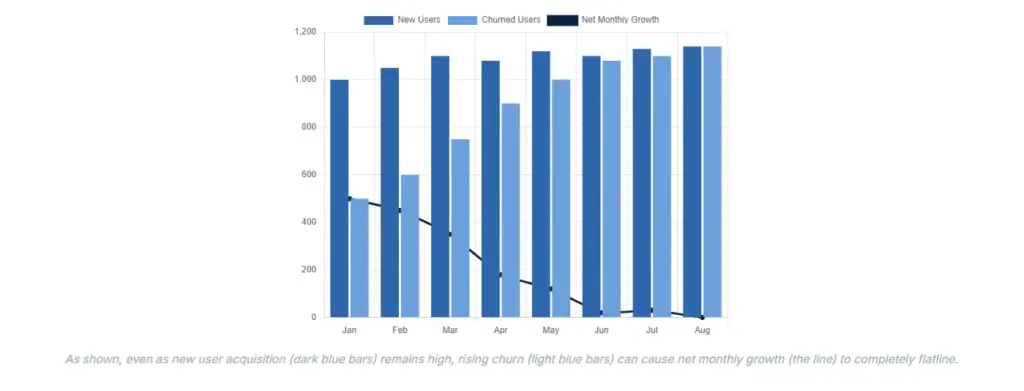
Sometimes, even when a business is working hard to bring in new customers, the total number of customers doesn’t grow. This can happen because people are leaving at the same time new ones arrive. It’s like filling a bucket with holes in it; water goes in, but it also leaks out.
This kind of drop-off, called “churn, ” can be hard to notice at first. If you’re not looking closely at things like how customers start using your service, how quickly they get help, or whether they’re getting value, the signs can slip by. The money coming in might look steady, but the team can feel like every win is harder than the last. It can feel like there are small problems behind the scenes that are growing bigger.
This also affects how the team feels. Marketing might be asked to keep bringing in new leads, while the support team is busy fixing problems that customers don’t always talk about clearly. Leaders might think they need more customers when, actually, the issue is that the ones they already have are slowly leaving.
When customers leave, it doesn’t always happen loudly. They may stop replying to emails, delay payments, or use the service less. This slow fade can be just as serious as someone clearly saying they’re unhappy. And it can cost the business both money and energy.
Some businesses believe they have a problem finding leads, when really, they have a problem keeping the customers they already have. Until this is looked at properly, the business might feel like it’s always running just to stay in place.
Breaking through the plateau
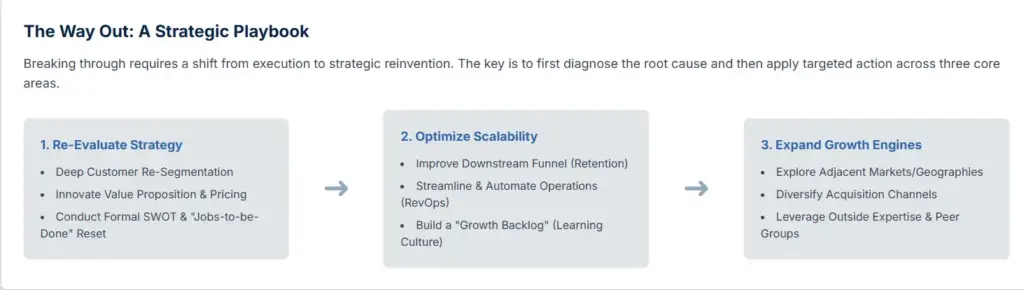
Getting back to steady growth after things slow down doesn’t usually happen by just working harder. Many businesses only start to move forward again when they stop and look closely at what’s changed, both inside the business and in the outside world. This often means looking again at the systems and habits that guide how things get done, rather than just adding more new tasks.
Here are three helpful steps seen in case studies and research:
1. Look at your customer groups and messaging again
Try to find smaller customer groups that are easier to reach or stay longer
Update your messages to better fit what customers want now
Think about changing your prices or offering new pricing levels
Sometimes businesses slow down because they’ve already reached most of the people in their original market. Looking at different customer groups or adjusting your message can help find new opportunities. You may not need to switch to a new industry, just understand your current one better. This can bring better results without changing everything.
2. Improve the way things work inside the business
Use tools to make repetitive tasks automatic
Make it easier for new customers to get started and stay happy
Write down clear steps and roles so everyone knows what to do
As a business grows, it can become harder to keep everything running smoothly. Systems that used to be quick can start to feel messy. Making things clearer and using tools to help with daily work can save time and reduce stress. This helps the team work better together and makes it easier to grow in a steady way.
3. Try new ways to grow
Test one new way of finding customers
Offer your services in a nearby market or to a different group of people
Talk to an outside expert or join a group of other business owners
Sometimes, trying something new can open the door to new growth. You don’t have to stop what’s already working, but adding another way to grow can help. Getting fresh ideas from someone outside the business can also help spot things you might not have noticed.
These steps are not just small fixes, they often bring up bigger questions about how the business has been running. Businesses that take the time to look and adjust often find stronger and more lasting ways to grow.
A note from Serenichron
We often work with founders who are going through this stage in their business journey. It’s the point where plans don’t feel as clear, the usual tools don’t show what’s really going on, and there’s pressure to keep things moving without tiring out the team.
What we do is help make sense of what’s happening under the surface. Many business owners already have a sense that something needs to change, but it can be hard to explain or organise those thoughts. We help turn those feelings into a clearer picture so action becomes easier.
When a business hits a plateau, it’s usually because something has changed. The way things worked before no longer fits the business as it is now. Processes that felt quick and flexible might now feel messy or confusing. Getting things moving again often means looking at where time and effort go, what systems are in place, and whether old habits are still useful.
This article includes ideas based on research, our own work, and insights shared by other business owners and experts. We’ve looked at many sources to spot the patterns that come up again and again at this stage. These include:
I recently undertook the project of revamping my business partner (Vlad Tudorie) LinkedIn profile and transforming it into a stronger business asset. For a long time, Vlad’s LinkedIn profile was “fine.” Not broken, but not doing him any favours either.
That changed when we brought in Tripti Agarwalla. She supported the project end-to-end, from helping articulate his services and positioning to designing beautifully branded visuals that elevated the whole profile. Her mix of creative direction and strategic messaging made all the difference.
However, a significant shift occurred from the process itself. As we worked through each section, I realised how many features LinkedIn offers, especially for Premium users, and how much more effective a profile can be when used strategically. Some of these features are easy to miss, while others are just misunderstood or underused, but together, they create a profile that doesn’t just say “what you do” – it shows what makes you valuable.
That’s why I decided to break it all down, section by section. In this article, I’ll walk you through the main areas of a LinkedIn profile, explain what features are available (especially those easy-to-miss perks), and share practical tips on how to make the most of them. Whether you’re updating your profile for visibility, credibility, or new opportunities, I hope this guide makes your next steps easier.
TL/DR
Updating the LinkedIn profile wasn’t just a design refresh, but a strategy shift. Along the way, I learned:
Messaging and visuals should align across your profile.
LinkedIn has hidden features that can boost visibility and engagement, especially for Premium users.
Every section, from About to Services and Experience, can reinforce your value proposition.
With the right tools and structure, your profile becomes more than a CV; it becomes a true business asset.
Start with consistency: Messaging meets design
Before we get into specific sections, let’s talk about the foundation of a strong LinkedIn profile: congruency and consistency. Your visuals and your messaging should work together to tell the same story clearly, confidently, and repeatedly.
This means repeating design elements like colours, fonts, and graphic styles across your profile banner, featured visuals, and even your content thumbnails. It also means making sure your tone and messaging are aligned, from your headline to your About section, to the way you describe your services.
Doing this well requires two key skills:
Copywriting with brand messaging: the ability to clearly explain what you do and why it matters.
Digital design: creating polished, cohesive visuals that reflect your brand.
Some people have both skills, some teams split the work. Or, like I did, you can work with a professional. AI is also helpful if you know some prompt engineering for content writing.
And if you don’t have access to those skills right now, no problem. This guide will still help. Many of the improvements you can make don’t require writing flair or design tools. There are features built into LinkedIn that just need a little attention to unlock.
The top section: First impressions that work
Your top profile section is prime real estate; it’s what people see before they scroll. Let’s break it down into three parts:
Banner and profile image
Your visuals speak before your words do. Your profile picture should be a high-quality headshot that aligns with how you show up professionally and be clear, friendly, and up to date.
Your banner? That’s your billboard, and one of the most powerful visual assets on your profile.
Tips:
Use a high-quality headshot that aligns with how you show up professionally.
Use the banner space to clearly state your value proposition. This is the first moment where strong messaging really counts. Sum up the core value you offer in just a few words. Add social proof like “As seen in Forbes / Business Insider,” client metrics, or a short testimonial. Keep design clean and sized correctly (1584×396 for banner, 400×400 for profile photo).
Include your brand logo for visibility and client logos to build authority and trust.
Design your banner with consistent brand fonts and colours so it complements the rest of your visual identity.
Keep it clean. Avoid cluttered backgrounds or too much text.
Keep the content aligned in the right two-thirds of the banner. The left third is risky. On mobile, the profile image overlaps much more than on desktop. You can use the top left corner for a subtle call-to-action, like “Book a discovery call.”
👉 Mobile preview:
Personal information
Right below your name, LinkedIn allows you to edit a variety of details via the “Edit intro” pop-up. These might seem minor, but they boost visibility, add credibility, and make it easier for the right people to reach you.
Here’s what you can add or update:
First name and last name
Current position (linked to your Experience section)
Industry
Education (optional, but visible here if filled in)
Location (city and country)
Contact info, which includes:
Email address
Phone number (optional)
Address (optional)
Birthday (you can control who can see this)
Tips:
Use your city and country – especially useful for local networking.
Add your business email or website for direct access.
Consider adding your phone number if you’re comfortable with inbound contact.
Headline and custom buttons
This part of the profile has more functionality than meets the eye. It’s where you can guide visitors with links, buttons, and a short but impactful headline. Let’s break it down:
Websites (in Contact info): LinkedIn allows you to add multiple websites under your contact info. This is a great opportunity to direct visitors to key destinations beyond just your main homepage.
Navigate to: Edit intro → Edit contact info → Websites
Add multiple URLs—these will appear in the Contact Info pop-up as plain links
Use this area for your main website, Linktree, social media, etc.
Even though LinkedIn lets you add multiple websites here, I’ve consistently run into errors when trying to add more than three, so make sure to highlight your most important links first.
Custom Website with link text: Separate from the Contact Info section, this feature lets you create a clickable link with custom text. It’s subtle but powerful if used right.
Found in: Edit intro (not Contact Info)
Lets you create a clickable link with custom text (up to 30 characters)
Premium feature
Perfect for CTAs like “Book a Discovery Call” or “Download the Guide”
Premium custom button: If you’re using LinkedIn Premium, you unlock the option to add a custom call-to-action button directly to your profile.
Available only to Premium users
Choose a button label from a preset list (e.g., “Schedule an appointment”)
Add any URL, or use LinkedIn’s built-in scheduling tool (powered by Calendly)
Great for directing traffic to conversion pages
Headline: This is one of the most important text fields on your profile. It appears right under your name and shows up in search results, comments, and messages.
Use it to clearly state who you help and how you help them. This is not the place to over-explain your job title or pile on self-praise. Instead, think of it as a short, sharp positioning line that signals value to your ideal audience.
It appears right under your name and shows up in search results, comments, and messages.
Tips for a strong headline:
Max 220 characters (but aim for 120–130)
Use to state who you help and how you help them
Avoid repeating banner text; make this complementary
Make it clear and benefit-driven
Mention your role and what problem you solve
Use keywords your audience might search for
Consider including your brand name
Once you’ve got these details nailed, your top section will clearly communicate who you are, what you do, and how people can take action, without needing to scroll.
Bonus: Instant Messaging options. In the Contact info section, you can also connect your profile to messaging platforms like Skype, Google Hangouts, WeChat, and others. If you use one of these services for business communication, it’s a quick way to make yourself reachable through more than just emails or DMs. It may feel a bit old-school, but it adds another layer of accessibility.
The About section: Tell a clear, human story
Most profiles fall short in the About section, usually a vague paragraph or two that doesn’t really say much. That’s how Vlad’s used to be as well: short, generic, and missing a clear message.
Now, instead of just tossing in a few lines about his role, I treat it like an elevator pitch, crafted with intention, structure, and personality. And once you realise how much room LinkedIn gives you, it becomes clear that this is a huge opportunity to communicate who you are and how you help.
The About description: A story with strategy
The About section gives you up to 2,600 characters to describe yourself, and that’s a lot of space. Most people barely use 500 characters, which means this area is an open opportunity to stand out.
Think of this as your mini-landing page. But don’t oversell. Write with brand messaging in mind. Instead of simply listing credentials, focus on:
Your value proposition
Your target audience
Your services and expertise
Your brand tone
The pain points you solve
Yes, it supports emojis 😊, but don’t overuse them.
Important: Only the first 3-4 lines are visible on desktop before someone has to click “See more.” That means your intro needs to hook attention fast. This is where brand messaging becomes crucial. Lead with clarity, empathy, and purpose.
About section on page load:
About section expanded:
Tips to craft a powerful About section:
Start with a hook in the first 3 – 4 lines. These are the only ones visible before someone clicks “See more.”
Make it about your audience, not just your resume. What problems do you solve for them?
Keep it conversational and human, as if you’re talking to a new connection.
Tie in your business, your team, your services, and your values.
End with a simple, clear call to action (like “Let’s talk” or “Check out my latest project”).
Skills section: Just five, so make them count
You can select up to 5 skills to appear on your profile. That’s not a lot, so choose them wisely based on what’s most relevant to your target audience and the services you offer.
These skills help reinforce your positioning and increase profile discoverability.
Services: A focused, flexible showcase
The Services section is a useful feature, one that gives you a dedicated space to highlight what you do, who you help, and how you deliver results. That said, if you ask me, it’s not LinkedIn’s best-designed section. It has quirks, like clunky media handling and limited layout options. Still, when used thoughtfully, it becomes a valuable touchpoint for credibility and conversation.
Here’s what you can do:
Select up to 10 services from a predefined list. Take your time and choose everything that reflects what you actually offer.
Add a description (up to 500 characters) where you can restate your value proposition and explain how you deliver it. Only the first 2 lines are visible until viewers click “See more,” so front-load the good stuff.
Set pricing information if you’d like, though this is totally optional.
This section also allows you to add up to 8 media items, displayed in a carousel above your service list. These include:
Images: Great for visual testimonials, FAQs, infographics, and branded service breakdowns. (Note: Images cannot contain clickable links.)
Videos: These could be demos, case study reels, or anything you think adds value, though LinkedIn doesn’t give much customisation here. (I haven’t explored this enough myself!)
Links: You can link to any page, such as your website’s services page, scheduling page, lead magnet, or landing page. LinkedIn will automatically pull the page’s featured image. You cannot customise the image preview here, so make sure your web pages have strong thumbnails.
While you can’t associate media with specific services individually, you can still use this “media gallery” to create a strong first impression and reinforce your expertise across the board.
One thing to note: if you’re on a free account, visitors will only see your list of services on the main profile. The description and media show up only when someone clicks into the Services page. Premium users, on the other hand, get the bonus of having everything (services, description, and media) displayed right on the profile.
Pro tip: Keep your visuals on brand. The images you upload here, the banner in your top section, and even the preview thumbnails from your links should follow a consistent design style. Using the same fonts, colours, and visual tone across assets helps create a polished, professional look. Think of it like a mini style guide for your LinkedIn profile, one that builds trust and shows you’re intentional about your brand.
Hidden bonus: Open messaging channel. When your Services section is active, it quietly opens up a way for anyone on LinkedIn to message you, even if they aren’t connected and don’t have InMail. It might not drive tons of leads, but it’s still a low-friction way to stay open for new conversations.
Featured content: Spotlight your most clickable assets
This is one of the most flexible and creative sections of your profile, and a great spot to spotlight key links, posts, and content.
You can:
Pin posts and articles already published
Feature your LinkedIn newsletters
Add media like images, documents, PDFs, or presentations
Add external links (with a custom image, title, and description!)
That last one is the most visually customizable. Unlike other sections, you can upload your own thumbnail image for each link, and write a short, compelling title and description. This makes the Featured section feel polished, complete, and aligned with your brand.
Use it to showcase:
Your company presentation
Your scheduling link
Case studies or lead magnets
Special offers or events
Projects you’re involved in
A few notes to keep in mind:
You can reorder items, so put your most important links first
The image appearance and cropping can vary depending on how many items are featured and the length of each description. You’ll need to play around to find the best fit and avoid awkward cuts or framing.
You can’t change a link URL once posted. If you need to update the URL, you’ll have to create a new item and delete the old one
This is another area where consistent messaging and visuals really matter. Your featured content should echo the same tone, style, and design approach as your banner, services section, and other visuals. That consistency helps your profile look intentional, polished, and professional.
Tips:
Start with 3-4 featured items that create a clear, high-level overview of what you do.
Use custom-designed images with intentional text overlays (e.g., “Case Study,” “Free Guide,” “Book a Call”).
Write short, benefit-driven titles and descriptions that invite clicks.
Refresh this section regularly to keep it aligned with your current focus or campaigns.
Use visual hierarchy: your most important content first, followed by supporting pieces.
Experience reimagined: Go beyond your CV to tell your brand story
Here is where you add your past and present roles, complete with company name, position title, start and end dates, and location. On the surface, it’s the most CV-like part of the profile. But if you’re a founder, entrepreneur, or consultant, this is more than a timeline; it’s another space to strengthen your brand message.
Here are two underrated opportunities this section offers:
1. Up to 2,000 characters per role. Most people drop in a few lines or skip the description entirely. But you can write a mini sales page here, especially for your current role. Go beyond what you do and talk about what your company does, for whom, and why. Think of it as another chance to speak to your audience using brand messaging.
Just like other description areas, only the first two lines are visible on page load. The rest is hidden until the viewer clicks “See more,” so make those opening lines count.
Job experience section on page load:
Job experience section expanded:
2. Media and links. Each position lets you upload media or add links. You can:
Upload images, documents, or presentations (like certifications or brochures).
Add links to your website, lead magnets, landing pages, or case studies. You can customise each link’s title, description, and featured image.
Design tip: Link preview images in this section are smaller than in the Featured section. Make sure your visuals are legible even at a reduced size.
Final thoughts: Sharpening your profile, step by step
Optimising your LinkedIn profile doesn’t have to be overwhelming, and you don’t need to do it all at once. A few smart updates in the right places can lead to more visibility, stronger connections, and better opportunities.
This revamp helped me understand just how many tools LinkedIn offers, and how much more effective a profile can be when you combine good messaging with strong visuals.
A big thank you to Tripti Agarwalla for her help with both the visual assets and the messaging strategy, and her focus on social media presentation.
Social media is just one piece of the puzzle. At Serenichron, we focus on the full picture: your website, funnels, messaging, and operational assets. If you want your digital presence to work like a well-oiled machine, we can help you build the systems that connect and convert.
👉 Reach out and let’s elevate your digital presence together.
You’re doing all the things: launching campaigns, refining your offer, improving your product. But despite your effort, something still feels… off. Growth is happening, but it’s heavy. Teams are misaligned. Tools overlap. Customers slip through cracks.
Most business advice doesn’t help because it’s fragmented.
“Fix your sales funnel. Tighten your messaging. Add automations. Fire up more content.”
It focuses on isolated tasks, without considering how they work together as a whole. And so we keep solving in silos: marketing here, operations there, tech somewhere else, hoping the puzzle will solve itself.
The Systems Thinker confirms what many business owners suspect: conventional wisdom shows that 70% or more of business change efforts fail to meet their objectives precisely because they focus on a single dimension of business. Whether it’s fixing the sales funnel or improving operations, these isolated efforts often make things worse by creating misalignment elsewhere.
Understanding a business means looking beyond individual problems and recognizing the dynamic systems at play.
Research backs up this system’s approach brilliantly. Harvard Business Review highlights that W. Edwards Deming, the father of continuous quality improvement, found that 94% of workplace issues are actually systemic, not individual problems. This means when your business feels “off,” it’s probably not because someone’s dropping the ball. It’s because the system itself needs attention.
“Nothing exists in a vacuum. Everything is interrelated.”
When you start looking at your business as an integrated whole, everything changes. You see how each piece influences the others: how a weak onboarding flow undercuts strong lead gen, or how internal chaos prevents your brand promise from being fulfilled.
You notice that fixing a tech issue without considering your team’s workflow only creates friction somewhere else. That launching a new campaign without syncing with operations leads to customer service chaos.
Seeing the business as a living system
So, how do you make sense of it all?
Start by shifting your view. Instead of thinking in terms of departments, think in terms of flow.
Everything your audience sees (your website, your content, your user experience) depends on things they don’t see: the tools you use, the handoffs between team members, the processes happening behind the curtain.
If the connections are weak, even the best tool won’t save you.
Holistic thinking means mapping these relationships. Understanding that every customer-facing action is supported by internal capabilities, and that every internal system either reinforces or undermines your external promise.
Instead of optimising one piece at a time, you begin to optimise the relationships between them. That’s where the leverage is.
And that’s where your business becomes more than the sum of its parts.
What does holistic alignment actually look like?
It looks like a business where front and back are fully synced.
Where the marketing campaign your audience sees reflects the delivery experience they actually get. Where your sales process flows smoothly because it’s supported by operations and informed by data.
In practical terms:
Your brand message is consistent across your site, your content, your emails, and your team interactions.
Well-designed funnels do more than convert; they guide leads smoothly into a sales process that’s ready to follow through.
Operations aren’t overwhelmed because what’s promised up front is built on what the team can deliver behind the scenes.
Data flows between systems, so the insights you act on reflect what’s actually happening.
“Growth happens when the systems work together, not in isolation.”
Alignment is less about creating the perfect plan and more about fostering coherence across everything your business does.
This comprehensive approach isn’t just good theory, but proven practice. Research on organisational change shows that true alignment must encompass three elements: goal (what we want), role (what we contribute), and soul (the meaning it has for us). It’s not enough to align your systems and processes; you need alignment that extends from your market strategy right down to individual team members. A shared rhythm that keeps the front and behind the business moving in sync.
That’s when friction fades. That’s when momentum builds.
What’s in front and behind the business
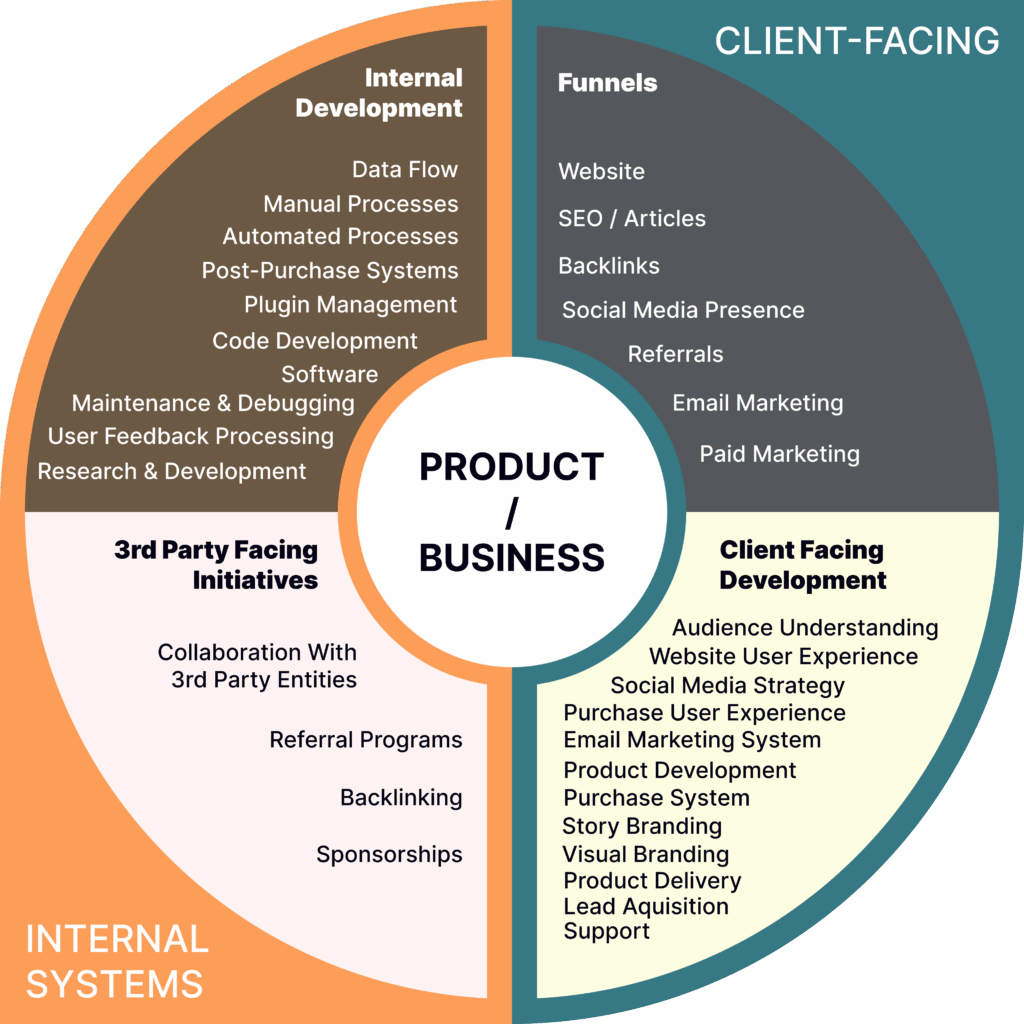
In front: What your audience sees
Every business has a public face. And a private engine room.
In the diagram we often use at Serenichron, there are two layers around the core of a business. The top layer, what sits in front of the business, is everything your audience sees and experiences:
Your brand presence
Funnels and marketing content
Your website and social media
The purchase journey and product delivery
These are your client-facing developments. They create the impression, expectation, and reputation of your business.
“Your audience only sees the front. But what sustains you is what’s behind.”
Behind: What holds it all up
Behind the scenes, what’s underneath the business, are the systems and operations that actually make it run:
Internal development
Automation and processes
Feedback loops, technical infrastructure, and maintenance
Team coordination, software, and code
This is your internal backbone. It doesn’t get applause, but it determines how well the visible parts actually perform.
Both sides matter. But here’s the trap:
If your front is polished and your back end is weak, you’ll impress people, but fail to deliver. If your back end is strong but your front is disjointed, you’ll be invisible.
Competing on alignment
And if you ignore both, your competitors won’t.
“If you don’t figure out your flow, the competition will.”
Customers today compare not just your product, but the total experience, from first impression to final delivery. They don’t care if your tools don’t talk to each other or if your internal systems are overloaded.
They just want it to work.
So ask yourself: Is the front of your business in sync with what’s behind it?
When these layers are aligned, when your audience-facing efforts are backed by real operational capacity, your business doesn’t just grow. It thrives sustainably.
Spotting misalignment in your business
Now that you’ve seen the relationship between the front and back of your business, it’s easier to recognise when things aren’t lining up.
Misalignment isn’t always dramatic. Sometimes it’s subtle, like small delays, confusion, or inconsistent experiences. But over time, those symptoms add up.
Here are some common signals:
Your website and content say one thing, but your delivery tells another story
Your sales team isn’t getting the right leads, or has to spend too much time qualifying them
Support tickets pile up after a new campaign goes live
Leaders work hard, but still feel like they’re constantly playing catch-up
“Most businesses grow in parts. The smartest ones grow in sync.”
The more of these symptoms you notice, the clearer it becomes: the challenges often lie in the way systems are structured and interact, not necessarily in individual performance. And it can be fixed by bringing the front and back of your business into alignment.
How to start thinking holistically
Holistic thinking begins with looking at the full picture, how everything connects and where alignment can unlock better results.
You don’t need a five-year plan or a complete rebuild. You just need to understand how your front-facing and behind-the-business elements interact.
Here’s how to get started:
Map what your audience sees. Look at your website, marketing, and onboarding experience. What promises are you making?
Trace those promises backward. Identify what internal tools, systems, and teams support that experience. Are they equipped and aligned?
Find the breaks. Look for where things fall apart, slow handoffs, redundant work, and unclear ownership.
Fix the flow, not just the function. Instead of just patching a tool or department, fix the connection between them.
Get outside insight. Sometimes you’re too close to the system to see the misfires. That’s why many businesses bring in Serenichron, to help see and redesign the whole picture.
“You don’t need more hustle. You need better harmony.”
Holistic growth focuses on building clarity across your systems so that complexity doesn’t spiral into confusion. When your front-end experience and back-end engine align, everything moves smoother, and faster.
A real example: alignment in action
We recently worked with a certification business that was thriving publicly, but privately was struggling to keep up.
Their audience loves the brand. Their overall audience, accounting for social channels, email and website search engine visitors, numbered in the hundreds of thousands..
But behind the scenes, the manual processes associated with identifying the student, validating their exam scores and issuing their certificate were stretching the team to the limit – the employee carrying out the certifications had not been able to take a vacation in over a year, and if he ever got sick or something came up, the business owner had to be pulled in to cover the process directly.
The business looked polished in front, but behind the scenes it was buckling under pressure.
So we zoomed out.
Alongside the business owner, over many hours of calls, we pinpointed every single step, every click, every operation across every tool in their process:
The certificate request forms
The score checks
The exam scores
The customer’s history
The spreadsheets, emails, naming schemes, storage folders and other minutiae…
Rather than focusing solely on fixing individual processes, we focused on restoring flow and coherence across the system:
We picked out an appropriate tool that worked with the existing tool stack of the business, to make integration easy and avoid significant changes to processes
We picked out every wasted click, every window switch, every action that did not require a decision to be made
We set up all the logic to run automatically în the back-end…
And then we automated it all.
Whereas before, the business struggled to certify ~100 students per day, by stretching everyone’s work schedules…
After, the single employee could comfortably process 700 and have time to look at other improvements.The bottleneck that prevented the business from processing more 100
“Alignment didn’t just improve performance but it created the space for sustainable momentum.”
Sometimes what looks like a performance issue is really a flow issue. When the front and behind of the business connect smoothly, the team can finally move forward with clarity, energy, and less resistance.
So, what can you do right now?
Start by stepping back.
Don’t just look at your funnel or your tech stack or your next campaign. Look at the whole system, what’s visible to your customers, and what’s working behind the scenes.
Ask yourself:
Is the experience we promote externally actually supported internally?
Are my team and systems ready to deliver on the brand promise?
Do our processes help the customer journey—or add friction?
“Successful businesses pay attention to both what the audience sees and the systems that support it behind the scenes.”
One simple exercise: print out a version of your business system. Mark the areas in front (marketing, brand, sales) and those behind (operations, tech, data).
Then trace a full customer journey, from ad click to product delivery. Where does the flow break down? Where does energy get lost?
You don’t need to have everything figured out right away. Taking the time to explore the full picture is the first meaningful step.
When to bring in a holistic consultant
Sometimes you can spot the flow problems, but you’re too deep in the day-to-day to untangle them. That’s okay. Business isn’t something you have to figure out alone.
If you’re feeling overwhelmed, scattered, or stuck in an endless loop of fixes that don’t last, this is when a holistic consultant can help.
Not to take over. Not to hand you a pre-made template.
But to walk alongside you. To help you zoom out, connect the dots, and rebuild a flow that fits your business.
A great holistic consultant helps you identify patterns, connections, and opportunities across your business, supporting the way each part contributes to the whole, from the brand your audience sees to the infrastructure that makes it real.
Whether it’s for a strategy reset or a long-term collaboration, bringing in fresh eyes could be the simplest way to restore clarity.
“Working with a consultant doesn’t mean giving up control. It means gaining another set of eyes, someone who can help you see the patterns, ask better questions, and find opportunities you may have missed.”
The goal isn’t to replace your vision, but to help sharpen it. With the right support, you can move forward more confidently and more cohesively.
Final thought: business isn’t linear
Designing a business involves building systems that can grow, adapt, and respond, more like an ecosystem than a fixed path.
A strong strategy brings together all the moving parts of your business into a flow that adapts, scales, and supports what your business stands for.
And if you’re ready to make that shift, you don’t have to do it alone.
Let’s redesign your business for flow, not friction.
Not long ago, the big questions for business leaders were about going digital, building a social presence, or setting up an e-commerce channel. Those shifts defined an era of modernisation. Today, the conversation has shifted again. It’s no longer just about presence or process, it’s about how AI fits into everything, from hiring and operations to strategy and daily communication.
Some teams are already deep in it. They’re using AI tools to plan campaigns, write proposals, answer customer questions, and organise dashboards. And they’re not just experimenting anymore. According to Forbes research, businesses are already applying artificial intelligence in high-impact areas like customer service (56%), cybersecurity and fraud detection (51%), customer relationship management (46%), and digital personal assistants (47%). These aren’t future plans, they’re live systems making work faster, safer, and more efficient today.
Others are experimenting, trying out AI tools to brainstorm ideas, summarise documents, or generate initial drafts. The leader, meanwhile, is often just trying to keep up, nodding along in meetings, half-comfortable with the terms, quietly Googling acronyms afterwards.
The changing rhythm of leadership
You don’t need to engineer the tools. That said, when the people around you are automating tasks, refining prompts, or discussing AI hallucinations and embeddings, you want to be part of that conversation, and guide it. Leadership in 2025 looks different: it’s not about being the tech genius, but the guide who understands what’s possible and helps others navigate smartly.
Because leadership is shifting. Instead of deciding if AI will be used, the real role is helping the team decide how it should be used, and what matters most in terms of quality, efficiency, and ethics. Whether it’s marketing, operations, or HR, these conversations are happening everywhere.
That starts with a baseline fluency. Enough to ask the right questions. Enough to trust what’s being built, or to challenge it.
Understanding just enough to lead well
Think of it like learning the basics of finance or operations. You don’t do the books or run the supply chain yourself, but you understand enough to:
Ask smart questions
Weigh trade-offs
Spot risks and red flags
Encourage good decisions
Follow conversations without needing translation
The same applies to AI. Knowing the difference between a prompt and a model, or a fine-tune and a hallucination, can make a big difference in how you respond to a pitch, approve a project, or allocate resources. And the benefits stack up quickly, because clarity builds momentum.
AI fluency helps leaders:
Make better technology calls
You don’t have to evaluate every tool on the market. But if a supplier says they’re using “fine-tuned language models with real-time embeddings,” you want to at least understand what you’re buying, or avoiding. When you’re confident asking clarifying questions, you also protect your team from shiny tool syndrome.
Spot actual opportunities
In many businesses, AI use starts at the edges, writing emails, summarising meetings, sorting survey responses. Leaders who recognise those patterns can help expand them strategically. When you understand the potential, you can connect the dots across departments that might not see how their efforts align.
Build teams with the right mindset
AI-literate leaders can ask better hiring questions, onboard faster, and ensure team members know when to trust the machine and when to pause. That mindset becomes part of your culture: experiment, evaluate, and evolve.
Guide cross-functional collaboration
AI touches marketing, ops, HR, and IT differently. When leaders understand the basics, they can help different teams align on goals and tools. Conversations stop being siloed and start becoming integrated.
Shape stronger, smarter conversations
Whether it’s strategy meetings or performance reviews, AI is changing the inputs and the language. Leaders who get the context are better positioned to interpret what they hear and say what matters. Instead of defaulting to surface-level questions, they dig into workflows and metrics in ways that move things forward.
A few real scenarios
Picture a customer service lead automating ticket tagging. Or a marketing manager using GPT to generate variations of ad copy. Or a sales rep summarising discovery calls using AI. These are small changes that ripple across workflows. Now picture the executive team trying to make decisions around these changes, without understanding how the tools work, what their risks are, or how the results are being validated.
That gap leads to delays, mismatched expectations, and even risk. It also puts pressure on teams who feel like they have to teach upward, or worse, justify every improvement they’ve made. It erodes trust instead of building it.
Now imagine the same team with a leader who’s not an expert, but curious and competent. Someone who can ask, “How did you review that output?” or “Where’s the data coming from?” or even, “Do you think we should automate this yet?” That kind of presence shifts the dynamic. It creates room for honest conversation and better decisions.
That’s a different kind of leadership. It feels more human, more aligned, and more capable of navigating change.
And it’s not just theory. Forbes research backs up these practical applications. Almost all business owners, 97%, believe tools like ChatGPT will help their business. One in three plans to use it to write website content, and nearly half, 46%, are already using AI to craft internal communications. These tools are changing the way teams work together, communicate, and build momentum across departments.
Less friction. More forward motion.
When leaders are AI-literate, they:
Speed up approvals because they understand the value and risks
Encourage the team to explore tools safely and with boundaries
Set clearer expectations around quality, oversight, and performance
Create space for continuous improvement and iteration without fear
And maybe more importantly, they reduce the anxiety many teams feel when navigating AI for the first time. Instead of guessing how much to say or simplify, teams can speak clearly and get support. That lowers stress, increases collaboration, and ultimately helps the entire organisation build trust in its own innovation process.
The future of trust and decision-making
AI has implications for privacy, accuracy, and reputation. Teams are using these tools to generate content, surface insights, and even make recommendations that influence business decisions. Leadership means helping everyone ask the right questions:
Does this reflect our voice and values?
Who checks this before it goes out?
What data is being shared, and with whom?
Are we confident in how this output was produced?
Harvard Business research makes this role even clearer. They describe “AI-First Leadership” as the ability to connect technological potential with strategic outcomes. It’s about fostering a culture that sees AI not as a replacement for human input, but as a powerful tool that enhances creativity, strengthens decision-making, and fuels innovation.
Being part of that conversation builds trust. Not being part of it creates blind spots. And over time, those blind spots become risks, whether legal, reputational, or cultural. Staying engaged is about protecting your people and your business.
The global perspective
It’s not just happening in one country or one industry. AI adoption is taking root everywhere, across borders, across sectors, and across roles. And the speed at which it’s spreading is staggering.
But it’s not just an American story. In Europe, the momentum is undeniable. The UK saw a 2.3x increase in job postings that reference AI. In Germany, it jumped by 2.6x. France followed closely at 2.1x. From logistics and law to retail and recruitment, AI is no longer a specialised tool, it’s becoming a core part of how modern organisations function.
Beyond hiring signals, the way we talk about work is changing too. Global conversations about AI on LinkedIn grew by 70% in less than a year. In parallel, hiring for AI technical talent is growing 30% faster than overall hiring, while the supply of such talent is only growing by 16%. That gap tells you everything: demand is outpacing readiness.
And this isn’t a minor adjustment. More than half of LinkedIn members globally, about 55%, are expected to see their jobs change in some way due to generative AI. That means the shift isn’t just affecting coders or data scientists, it’s touching everyone.
The opportunity? LinkedIn estimates that AI could unlock $6.6 trillion in productivity gains across major economies. But to seize even a portion of that, businesses need leaders who understand what’s changing.
Forbes’ 2025 AI 50 List echoes this momentum. More than two years after the launch of ChatGPT, artificial intelligence remains the white-hot centre of venture capital and business innovation. The hype around model releases is evolving. The focus now is on real-world value, startups are shifting from racing to build the next model to creating practical tools that automate tedious work across industries like engineering, healthcare, legal services, and sales.
Because the people you hire, the tools you adopt, and the workflows you build are already being shaped by AI. The question is whether leadership is equipped to guide that evolution, or just catch up to it.
The bigger picture
It’s not about mastering the tech. It’s about being able to lead the people who use it. It’s about listening with more context and giving direction with more clarity. When your team knows you understand the terrain, even just the basics, they can move faster, communicate more openly, and solve problems more confidently.
It also makes them more likely to bring you into the loop earlier, share ideas more openly, and engage with you as a thought partner, not just a decision-maker.
Harvard Business Review research by Rasmus Hougaard and Jacqueline Carter, authors of ‘More Human,’ reinforces this perspective: “AI has the power to transform leadership for the better, the key is in how leaders use it.” Their focus on “human-centred leadership” aligns perfectly with this message that effective AI leadership feels more human, more aligned, and more capable of navigating change.
And in a world that’s moving this quickly, that kind of leadership matters more than ever.
You’ve probably heard “QA” tossed around in dev meetings. Maybe it sounded like tech-speak. Quality Assurance goes beyond technical checklists, it plays a powerful role in shaping resilient, trustworthy, and competitive businesses.
Quality Assurance is evolving from a technical necessity to a strategic business advantage. Research shows that 45% of organizations now have dedicated QA budgets, with the testing market projected to expand through 2030. This growth reflects a fundamental truth: QA goes beyond bug detection; it contributes to shaping stronger, more resilient businesses.
QA is thinking ahead, not just looking around
At its core, QA is short for Quality Assurance, but a better name might be Risk Radar + Future-Proofing + Curiosity Engineering. It’s the discipline that quietly keeps your business reputation intact, your customers happy, and your tech team sane.
It’s about thinking ahead and predicting issues before they arise. QA is proactive. It’s about preventing regret, not just catching bugs. This proactive approach delivers remarkable ROI, as the cost of detecting and fixing defects increases exponentially the further you move through the development lifecycle. Fixing bugs in the field is often costlier by one or two orders of magnitude compared to addressing them during development.
QA is logic meets chaos (on purpose)
Great QA explores expected behaviours and challenges the unexpected to uncover hidden vulnerabilities.
It involves designing test cases not only for logical user experiences but also for scenarios nobody has ever thought of. That means asking things like:
What if a user pastes 300 emojis into a form?
What happens when a button is double-clicked during a network timeout?
Can we crash this thing, and what does that teach us?
QA professionals are ready to tackle repetitive tasks with passion and curiosity, always pushing the same product or task to new lengths. This is curiosity at work. QA engineers are part explorer, part troublemaker, part detective. This exploratory approach helps overcome one of the top challenges in QA testing: the “one size fits all” mindset. Personalised testing methods that match your customer profile’s needs result in far more effective outcomes.
QA is a business strategy in disguise
QA plays a vital role that spans beyond product development, it’s an integral part of the overall business strategy. One that saves time, money, and brand trust.
It means creating risk lists for shareholders, revealing the weak links, and working together with development and production to strengthen the product. When baked into the process, not slapped on at the end, QA becomes a consistent accelerator, helping teams move forward with greater clarity and fewer setbacks.
Here’s what great QA adds to the table:
Early discovery of high-risk issues
Clear risk reports for stakeholders
Feedback loops with product and development
Foundation for automation scripts and scalable testing
Faster release cycles with fewer emergency patches
Research confirms that although QA requires effort in initial setup, it saves significant time and effort by identifying both current and future issues early. That means fewer late-night scrambles and more time focused on what really matters.
The business case for quality assurance
The financial impact of QA extends far beyond just preventing bugs. Research identifies multiple ways QA directly impacts the bottom line:
Cost efficiency
Prevention costs less than cure. The cost structure for fixing defects escalates dramatically the later they’re discovered:
Requirements phase: Inexpensive to fix
Design phase: Still affordable
Construction phase: Moderate cost
Acceptance testing or post-implementation: Very expensive, often requiring major rework
QA supports customer priorities, compliance, and smooth user experiences. In a world where small glitches can drive users away, strong QA is your brand’s insurance policy.
Competitive advantage
With markets more saturated than ever, consistent quality is a differentiator. QA helps businesses exceed industry standards and attract long-term customer loyalty.
The challenges of modern QA
Even with all these benefits, QA is not without hurdles:
Skilled workforce shortage
There’s a high demand for qualified testers, and it’s growing. Finding talent with both technical chops and business insight is tough.
Human error in manual testing
Mistyped entries, assumption errors, or lack of test coverage can derail manual QA efforts. A structured, mixed approach is essential.
There’s a lot of noise about AI replacing QA. Spoiler: it won’t. It can help, sure. But it’s still just following instructions.
Many in QA fear AI will take over their roles, but spontaneous human thinking can’t be matched by an AI, even one following the best written script.
QA is instinctual. It’s knowing when something “feels” wrong. It’s asking why users drop off at step 3, even when the flow is technically fine. This human edge is what makes QA irreplaceable, especially when real-world context and customer empathy are on the line.
QA grows with the product (and helps it grow)
QA isn’t static. The process evolves. The tools shift. Test cases become automation. Expectations rise.
It involves developing test cases that eventually turn into automation after several trials of perfecting the script. And it means always adapting to the new tools and technologies the business adopts or integrates. This adaptability is crucial as companies face growing demands in cybersecurity and regulatory compliance.
QA helps scale. It’s the blueprint behind automation, and the lens that constantly asks: how can we make this better?
QA is the bridge, not the blocker
Some (many) teams and leaders still treat QA like a delay. “Can we skip testing this one time to launch faster?”
You could skip testing to speed things up, just like you could skip checking your parachute before a skydive. But let’s be honest, it’s probably not going to end well.
When QA is fully integrated into the workflow, it:
Speeds up releases long term
Reduces customer support headaches
Builds user and investor trust
Uncovers repeatable patterns for automation
Research shows that organisations with a strong QA culture face fewer business disruptions, fewer system crashes, and a stronger brand perception overall. QA helps you prevent downtime and protect your business from costly reputational hits.
Final thoughts: QA is where curiosity meets care
QA isn’t about nitpicking. It’s about building something stronger. It’s a mindset.
In the end, QA is about loving the product enough to challenge it relentlessly.
If you’re a founder or decision-maker, don’t think of QA as the final hurdle. Think of it as your co-pilot, the one who’s scanning the horizon for turbulence while you fly the plane.
The data is clear: organisations that invest in quality assurance build more resilient products, foster greater customer loyalty, and enjoy healthier profits. QA plays a cross-functional role that supports both technical execution and strategic growth.
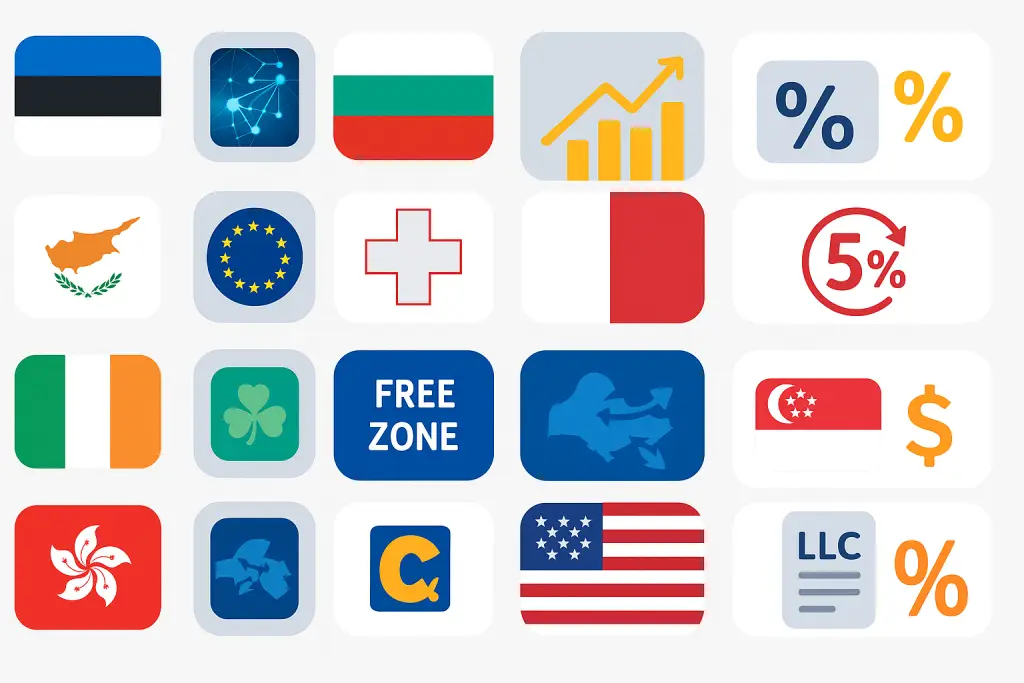
When choosing where to open a secondary company for an IT consulting business, the goal is to minimize corporate taxes while ensuring the jurisdiction is stable, reputable, and operable entirely online. For us, operating as a Romanian company with a portfolio of clients who maintain operations in and out of Romanian, our criteria in looking at options include:
an English (or Romanian) operating environment
easy remote incorporation
access to payment processors (Stripe, Revolut)
availability of banking/fintech services
ability to invoice EU clients (with or without VAT as appropriate)
and ideally tax treaties to avoid double taxation.
Below we analyze top jurisdictions – both within the EU and outside – that best fit these requirements, detailing their corporate tax regimes, VAT implications, incorporation process, financial infrastructure, stability, and language accessibility.
Low-Tax Options Within the EU
Several EU countries offer favorable tax regimes for small businesses. Operating within the EU can simplify VAT handling for EU clients and ensure broad acceptance by EU banks and payment providers. We focus on jurisdictions with low or unique corporate tax structures:
In other words, as long as profits are kept in the company (not paid out as dividends), zero corporate tax is due – allowing you to reinvest earnings tax-free.
Once profits are distributed (or used for non-business expenses), a flat 22% tax applies (this rate increased from 20% starting 2025).
Notably, dividends to non-residents incur no additional withholding tax in Estonia.
Estonia ranks highly for tax competitiveness and ease of business, thanks in part to its e-Residency program. Through e-Residency, foreign entrepreneurs can establish and manage an Estonian company 100% online.
The process is streamlined: one must first obtain an e-Residency digital ID (state fee ~€150), then register a private limited company (OÜ) online (state fee €265 for registration). If no board member resides in Estonia/EU, a local contact person service is required (≈€200–€400/year).
Apart from that, ongoing costs are low (accounting services can start ~€50/month). No physical presence is needed – even the digital ID can be picked up at an Estonian embassy. The business can be run remotely via Estonia’s advanced e-government portals.
VAT:
As an EU company, an Estonian OÜ can obtain an EU VAT number. Estonia’s standard VAT is 20%. If you strictly provide B2B services to EU clients with their own VAT numbers, you can apply the reverse-charge mechanism (no VAT charged on invoice).
VAT registration in Estonia is compulsory only if annual local taxable turnover exceeds €40,000. Below that, you may remain VAT-exempt unless you voluntarily register to use the reverse charge for cross-border B2B. For digital B2C services into the EU, Estonia’s EU membership means you could use the One Stop Shop (OSS) if needed. In summary, invoicing EU clients is straightforward – B2B services are usually zero-rated (with reverse-charge), and you can elect to handle VAT for B2C if applicable.
Financial infrastructure:
Estonia is very fintech-friendly. Stripe is supported for Estonian businesses (Estonia is on Stripe’s list of supported countries), and Estonian companies can easily open EU business bank accounts or use services like Wise. Revolut Business also supports companies registered in Estonia (and the owner being an EU resident). This means you can collect payments globally and pay contractors or expenses seamlessly.
Stability & Language:
Estonia is politically stable and a member of the EU (and Eurozone). Government services are highly digital. English is widely used in business and official e-services, so language is not a barrier. The legal system is predictable and business-friendly. Estonia also has an extensive network of tax treaties, which can help avoid double taxation on distributed profits.
Pros:
Zero tax on reinvested profits, allowing unlimited growth without corporate tax until you take dividends.
Ultra-modern e-government: fully online incorporation and management via e-Residency.
Low incorporation cost (≈€265 state fee) and modest annual fees.
EU member: easy EU client invoicing, access to EU payment processors (Stripe, etc.).
Widespread English usage; highly stable, transparent business environment.
Cons:
22% tax due once profits are distributed as dividends (deferred, not eliminated).
Requires an appointed local contact agent if no local directors (minor extra cost).
Annual reporting and accounting required (as with any EU company, though compliance is fully digital).
No special reduction for small profits – the benefit is primarily the tax deferral (unlike some countries with near-zero rates for small revenues).
Bulgaria (EU) – Lowest Corporate Tax in EU
Bulgaria offers a flat 10% corporate income tax, the lowest rate in the EU. This 10% rate applies to all corporate profits (no tiered rates) and has been stable for years. For a consulting business under 1M revenue, a 10% CIT ensures minimal tax leakage at the corporate level.
Moreover, Bulgaria’s personal tax is also a flat 10%, and dividends distributed to individuals are subject to a low 5% withholding tax (and 0% if paid to an EU corporate parent).
This means if you ever take profits out, the additional tax can be as little as 5% (or potentially eliminated via EU directives). Overall, the combined effective tax on profits + dividends can be ~14.5% at most – very competitive for EU.
VAT:
Bulgaria’s standard VAT rate is 20%. VAT registration becomes mandatory once annual turnover exceeds BGN 100,000 (≈€51k) in 2024, with the threshold rising to BGN 166,000 (~€85k) in 2025.
This relatively high threshold means a small consultancy might operate initially without VAT if serving local Bulgarian clients under that cap. However, for invoicing EU clients, one would likely voluntarily register for VAT earlier: cross-border B2B services are typically zero-rated via reverse charge (both you and the client need VAT numbers).
If not VAT-registered, an EU business client cannot easily account for VAT, so getting a VAT number is advisable once you have EU B2B sales (even below the threshold). Fortunately, EU reverse-charge and VIES reporting is standard procedure.
Bulgarian VAT returns are filed monthly (more frequently than some countries), which is an administrative consideration. For B2C services into the EU, a Bulgarian company could use OSS as well. Overall, Bulgaria, as an EU member, allows smooth EU VAT handling, with the added benefit of a high registration threshold for flexibility.
Incorporation & Administration:
Setting up a Bulgarian LLC (OOD/EOOD) is relatively straightforward. The process involves preparing incorporation documents (Articles, etc.), which for foreigners usually means working with a local lawyer or formation agent. In-person notarization of some documents (like specimen signatures) is needed, but this can be done via power of attorney if you cannot travel.
In practice, many foreign owners incorporate remotely by authorizing a local attorney. There is no requirement for a local resident director – you can be the sole owner and director. The minimum capital is low (typically ~€1). Formation can be completed in days once documents are signed.
Bulgaria does not impose hefty government fees for incorporation or annual business licenses – costs are mainly legal/agency fees, which are modest (often a few hundred Euros). Ongoing compliance is also relatively light: no annual franchise tax or fixed fees, just corporate tax returns and, if applicable, monthly VAT filings. Local accounting services are affordable (due to low labor costs).
Notably, no audit is required for small LLCs under certain size thresholds, reducing compliance burden.
Banking & Payments:
Being an EU company, a Bulgarian entity can open accounts in Bulgaria or anywhere in the EU. Local Bulgarian banks operate in English and online banking is available, though opening an account might require one visit. Alternatively, one can use fintech solutions: for example, Stripe supports Bulgaria, allowing you to accept card payments.
Revolut Business accounts are available for Bulgarian companies (Bulgaria is in Revolut’s supported country list).
Wise (formerly TransferWise) and similar fintechs also support Bulgarian business accounts, which can provide EUR IBANs.
In short, receiving client payments via SEPA, Stripe, or other gateways is fully feasible. If Bulgarian banking proves slow, you have the option to open the company’s bank account in another EU country as well (EU companies can bank anywhere in the Union).
Stability & Language:
Bulgaria is an EU member with a reasonably stable economy (classified as upper-middle income). While it has a higher perceived corruption index than Western Europe, it maintains a consistent pro-business tax policy (flat taxes) and is not subject to OECD or EU blacklists. Politically it’s stable as an EU/NATO member.
Language can be a consideration – Bulgarian (Cyrillic script) is the official language, so corporate documents and communication with authorities will be in Bulgarian. However, many service providers (lawyers, accountants) speak English and can handle translations. The cost of hiring local help is low.
All in all, a foreign owner can manage with English by relying on local professionals for filings.
Only 5% withholding on dividends to individuals (0% if holding company in EU) – very low total tax on extracted profits.
Low costs: incorporation and annual maintenance are inexpensive (no high state fees; accounting is affordable).
EU member: full access to Stripe, Revolut, SEPA payments; easy to trade with EU clients (can use EU VAT system).
No local director or substance requirements by law – can be fully foreign-managed.
Cons:
Administration in Bulgarian language – need local agent/accountant to navigate filings (adds minor complexity).
Monthly VAT returns if registered, meaning more frequent paperwork than jurisdictions with quarterly filings.
Banking, while accessible, may require initial paperwork or visit (though fintech alternatives mitigate this).
Perception: Some Western clients may be less familiar with Bulgarian companies (though it’s an EU jurisdiction with EU VAT, mitigating concern).
Political/legal system is stable but not as robust as Ireland/Cyprus; one must ensure compliance to avoid bureaucratic hurdles.
Cyprus (EU) – Flexible Low-Tax EU Hub
Cyprus is a popular jurisdiction for international consulting and holding companies due to its favorable 12.5% corporate tax and flexible legal system. The standard corporate tax rate is 12.5% on net profits, similar to Ireland. This rate has been in effect for years and makes Cyprus very competitive within the EU. (There are proposals to increase it to 15% in the coming years to align with global minimum tax trends, but as of early 2025 it remains 12.5% for small and medium companies.)
In addition, Cyprus offers certain tax exemptions: for example, foreign dividends and capital gains from the sale of securities are generally exempt from corporate tax. These rules mean a Cyprus company can be advantageous if you ever hold investments or other income in the company.
In the context of an IT consultancy, the 12.5% flat rate would apply to your service profits.
Importantly, Cyprus imposes no withholding tax on dividends paid to non-resident shareholders. So if you own the Cyprus company, it can distribute profits up to you with 0% Cypriot tax on the dividend. This zero WHT policy is a big plus for avoiding double taxation. Cyprus also has a wide network of tax treaties and benefits from EU directives (Parent-Subsidiary, etc.), making international tax planning smoother.
VAT:
Cyprus’s standard VAT rate is 19%, slightly lower than most EU countries. The VAT registration threshold is only €15,600 annual turnover – quite low. In practice, any active consulting business will likely need to register from the start or soon after (above ~€15.6k revenue in 12 months).
Once registered, Cyprus uses quarterly VAT returns (less frequent than monthly filings in some countries). For B2B services to EU clients, Cyprus follows the EU rules: no VAT charged on cross-border services if the client has a VAT number (you’ll just zero-rate and list it in EC Sales List). B2C digital services would require charging VAT based on the customer’s country via OSS. Cyprus participates fully in the EU VAT system, so EU clients will find it familiar (they can verify your VAT on the VIES system, etc.).
One attractive aspect: if your consulting services are performed for clients outside the EU (say US or other regions), those services can be considered out of scope or zero-rated for VAT, meaning you might not charge VAT on exports. Also, if structured carefully, a Cyprus company could avoid VAT registration if it has exclusively foreign clients and minimal local presence – but this should be confirmed with a tax advisor.
Overall, invoicing EU clients from Cyprus is seamless, with the option to not charge VAT on many cross-border services and full EU VAT compliance when needed.
Incorporation & Remote Management:
Cyprus is known for its efficient company formation procedures, but note that local involvement is required. By law, incorporation documents must be filed by a licensed Cypriot lawyer. Thus, you’ll need to engage a Cyprus corporate service provider or law firm to set up the company. This is typically handled remotely by granting power of attorney to the lawyers.
The process includes getting a company name approved (which can be done online in a couple of days), preparing the Memorandum & Articles, and registering with the Companies Registrar. It usually takes about 1–2 weeks to fully incorporate a Cyprus private limited company (Ltd).
A Cyprus company must have a registered office in Cyprus and usually a company secretary based in Cyprus (often your law firm provides this service). Directors can all be foreign, but management & control is a key concept: to be treated as a Cyprus tax-resident company (and thus benefit from treaties and Cypriot tax law), it’s advisable to have a majority of directors in Cyprus or hold board meetings in Cyprus.
Many international entrepreneurs appoint a Cypriot resident director (or board member) as part of service packages to bolster the local substance (though it’s not strictly mandatory by law, it’s a common practice). This can increase costs slightly but ensures the company is clearly Cyprus-managed.
Speaking of costs: Incorporation packages range roughly €1,500–€3,000 (including first-year registered address, secretarial, filings). Annual maintenance (registered office, secretary, agent) might be a few hundred euros in subsequent years. Cyprus does require annual audited financial statements for all companies (even small ones), which is an extra compliance step (audit fees depend on activity but for a small consulting firm can be moderate).
Accounting and audit are a well-developed industry in Cyprus, but fees are higher than in Bulgaria for example. Budget perhaps €200–€500 per month for complete accounting+compliance services for a small company. The timeline to maintain: annual corporate tax returns (due the year following the fiscal year) and the audit, plus VAT quarterly if applicable.
Banking & Payments:
Cyprus, being an international financial center, has many options. Traditional Cypriot banks (e.g. Bank of Cyprus, Hellenic Bank) can provide EUR accounts, but in recent years they have tightened compliance – opening an account might require a detailed review and possibly a visit. Many small foreign-run companies actually opt to open an account in another EU country or use an EMI (Electronic Money Institution).
Since a Cyprus company is EU-registered, it can open accounts across the EU. Fintech solutions are widely accessible: for instance, Stripe supports Cyprus – you can sign up with your Cyprus business and accept payments easily. Revolut Business is available for Cyprus companies.
Other options include Wise Business, which supports Cyprus entities and can provide EUR, USD, GBP accounts for receiving client payments. Thus, receiving payments from EU or US clients is not an issue. Cyprus is also not flagged by payment processors (unlike some offshore jurisdictions), so Stripe and PayPal treat it as a normal EU business.
Stability & Language:
Cyprus has a long-established reputation as an international business hub. It’s an EU member with a stable democratic government. The legal system is based on English common law principles. English is effectively the language of business in Cyprus: though Greek is the official language, almost all service providers, government forms, and even courts accommodate English.
You will find that you can correspond in English with your Cypriot accountants and lawyers comfortably. Political stability is good, although being a small country, Cyprus’s economy is somewhat narrower – however, it has recovered well from past financial crises and remains friendly to foreign investment.
Tax laws are stable; any changes (like the mooted 15% rate) will likely exempt small businesses or be phased in with notice. Cyprus is also known for strong legal protections and EU-compliant regulations, giving confidence for the long term.
Pros:
Attractive 12.5% flat corporate tax on profits; plus many exemptions (foreign dividends, most capital gains are tax-free).
No dividend withholding tax to non-residents – easy repatriation of profits without Cypriot second-layer tax.
Widespread English usage and familiar legal system (many lawyers trained in UK); straightforward to communicate and do business.
Well-integrated in EU systems: full access to Stripe, Revolut, SEPA; respected by EU clients (invoices from a Cyprus Ltd are commonplace).
Extensive tax treaty network and EU directives – reduces risk of double taxation if you’re also taxable in Romania (treaty can credit the 12.5% tax).
Cons:
Incorporation requires a local provider (legal fees) and ongoing local administration (registered office, etc.), making it costlier than some other jurisdictions.
Annual audit is mandatory, adding to compliance costs (even for small companies).
VAT registration threshold is low (€15.6k), so you’ll likely have to handle VAT paperwork early on.
To ensure tax residency and treaty benefits, you may need to establish management & control in Cyprus (e.g. appoint local directors or conduct board meetings there), which can complicate purely remote management.
Banking with local banks can be bureaucratic post-2013; many owners use alternative banking arrangements.
Malta (EU) – Effective 5% Tax via Refund System
Malta offers a distinct tax system where the statutory corporate tax rate is 35%, but refund mechanisms reduce the effective tax dramatically for foreign-owned companies.
In practice, a Malta trading company (Ltd) owned by non-residents can achieve an effective corporate tax rate of just 5% on distributed profits. This is because when the company pays 35% tax on profits, the shareholder (you, as a non-resident) can claim a 6/7 refund of the tax from the Maltese authorities, getting back 30 percentage points and leaving only 5% tax paid.
The refund process is built into Maltese law and is part of the full imputation system, which ensures that company profits aren’t taxed twice (the 35% corporate tax is imputed to the shareholder, then mostly refunded). Notably, Malta has no further tax on dividends to the foreign shareholder once this refund is given – meaning after the company’s 5% effective tax, the profits can be distributed free of Maltese tax.
This makes Malta’s system one of the lowest effective corporate tax regimes in the EU for small foreign businesses.
VAT:
Malta’s VAT rate is 18% (standard). As an EU member, Malta follows the same VAT rules for cross-border services. The VAT registration threshold in Malta is relatively low (around €30,000 for services). An IT consulting company in Malta would likely register for a VAT number to deal with EU clients. B2B services to EU clients can be zero-rated (client does reverse charge).
Malta participates in the EU’s OSS/IOSS for any B2C digital services. Since English is an official language, dealing with Maltese VAT authorities and filings is not too onerous. However, keep in mind, if your Malta company is essentially exporting services and you have no local Maltese clients, you might not hit the registration threshold and could delay VAT registration – but many opt to register voluntarily to have a VAT ID for EU trade.
Overall, EU invoicing is straightforward, analogous to Cyprus or Ireland in practice.
Incorporation & Maintenance:
Incorporating in Malta is somewhat involved. You will need a Maltese notary or service provider to draft the Memorandum & Articles and file with the Malta Business Registry. While you can incorporate a company remotely, it typically requires engaging a local corporate service firm.
There is a minimum share capital of €1,165 for a private company (only 20% must be paid up). A Maltese company also requires a local registered office and usually a resident company secretary. Most foreigners use a corporate service provider who provides the registered address and often acts as secretary.
The costs in Malta are higher than in Cyprus/Bulgaria: expect incorporation packages in the couple thousand euros range. Annual maintenance (registered office, secretarial, compliance) can also be a few thousand per year. Additionally, because of the tax refund system, to actually enjoy the 5% rate you must go through the refund process after each dividend distribution.
This means the company first pays 35% tax on profits, then upon paying a dividend, you apply for the refund which is usually paid out by Maltese authorities within a few months. This process often necessitates an accountant’s assistance and waiting for the refund cash, impacting cash flow. Malta has mitigated this for groups by allowing a fiscal consolidation regime, but for a single company you will be claiming refunds post-factum.
Compliance in Malta includes annual audited accounts (audit is mandatory regardless of size), and tax filings. Professional services in Malta (accounting/audit) are well-developed but can be pricier than Eastern Europe. It’s common to budget a higher ongoing cost to run a Maltese company, but the trade-off is the effective tax saved is significant if profits are substantial.
Banking & Payments:
Maltese companies are generally accepted by payment processors: Stripe supports Malta (it’s in the list of supported countries), and Revolut Business is available as well (Malta is EEA). Opening a local bank account in Malta might require due diligence interviews; however, many Malta companies simply use international banking options.
Since Malta is in SEPA, a Maltese IBAN is not strictly needed – you could use a Wise or Revolut EUR account in another country for your Maltese company. Some fintechs (like Wise) might not yet support Malta business registration, but others do, and Maltese service providers often help set up accounts.
The key is that Malta is not blacklisted or restricted by major financial networks, so receiving and sending payments is fine – the only slight concern is Malta’s past inclusion on a FATF grey list (it was briefly grey-listed for AML, but has since been removed as of 2022).
Now Malta is compliant with international AML standards, so confidence is restored. Clients in the EU will generally be comfortable paying a Maltese company, and you can issue invoices and accept payments in EUR easily.
Stability & Language:
Malta is politically stable and part of the EU. It’s a very small country but has built a specialty in finance, gaming, and IT services. English is an official language in Malta, so all legal and governmental matters can be conducted in English (a huge plus for foreign owners).
The Maltese legal system is a mix of common law and continental law; contract law and corporate law align closely with EU norms. Using Malta gives you the benefit of an English-speaking environment with EU single-market access. The regulatory environment is robust (sometimes to the point of being strict, due to EU and OECD pressure).
The tax system’s legitimacy (refund mechanism) is recognized by the EU, though it’s under the watch of global reforms. Malta’s network of tax treaties and EU membership ensures that if you’re paying that 5% effective tax, it’s typically creditable elsewhere if needed.
Pros:
Lowest effective corporate tax in EU (≈5%) for foreign-owned companies, via well-established refund system.
English-language jurisdiction – one of the EU’s only truly bilingual English states, easing communication.
Strong professional services sector (accounting, law) to support foreign investors; the system is designed to attract overseas business.
No tax on dividends to non-residents and relief from double taxation due to full imputation.
Access to EU market and financial services; compliant with EU law (not seen as a tax haven by EU since it adheres to directives, just offers refunds).
Cons:
Higher complexity and cost: administrative overhead is significant (mandatory audits, numerous filings, handling tax refunds) and professional fees are higher than most other jurisdictions.
You must pay 35% tax upfront and then claim refunds, which ties up cash and requires correct paperwork (though eventually reducing tax to 5%).
Need for local service providers for incorporation and secretarial roles; cannot fully DIY the setup.
International scrutiny: Malta’s system, while legal, is often under the lens of EU/OECD; future reforms could potentially alter the refund mechanism (though none imminent for small businesses).
If profits are low, the savings might not justify the costs – Malta’s advantages shine with higher profits that make the 5% effective rate worth the extra compliance effort.
Ireland (EU) – Moderate Tax with Start-Up Incentives
Ireland is an English-speaking EU country known for its 12.5% corporate tax on trading income. This rate is not as ultra-low as Bulgaria or Cyprus, but Ireland offers other benefits: it’s highly reputable, has no complexity in its tax (straight 12.5%), and provides certain tax reliefs for new companies.
In fact, Ireland has a start-up relief scheme (Section 486C) that can effectively make your corporate tax zero for the first 3 years if your tax due is ≤ €40,000 per year. That roughly corresponds to €320k profit at 12.5% rate. However, professional service companies are excluded from this start-up relief.
An IT consulting firm likely falls under “service company” (providing professional services), meaning you wouldn’t qualify for the 0% startup exemption. Thus, you should expect to pay the normal 12.5% rate on profits. (If your business were eligible, any tax due between €40k–€60k would get partial relief, but again IT consulting typically doesn’t qualify due to the exclusion for service companies.)
From 2023, Ireland’s corporate tax system has a new wrinkle for domestic companies: profits above €250k are taxed at 25% (with a sliding scale between €50k–€250k) – but this applies only to companies with Irish-controlled management. If you as a foreign owner manage it from abroad, the company might not be considered Irish resident for that rule, depending on circumstances.
In practice though, most small firms still pay 12.5% on trading income (the 25% is for passive/non-trading income, or for very large resident companies due to a recent tiered system). We’ll assume 12.5% as the relevant rate.
VAT:
Ireland’s standard VAT is 23%. Threshold for VAT registration for services is €37,500/year. If your consulting revenue stays below that and you only provide B2B services cross-border, you might not need to register initially. But many businesses register anyway to zero-rate B2B sales and claim any input VAT.
Invoices to EU clients: same EU rules (no VAT for B2B exports, collect Irish VAT for local sales or B2C EU until threshold, after which use OSS). Ireland uses the EU VIES system; being in Ireland means your EU clients can easily verify your VAT and do reverse charges. English-language invoices and legislation are a plus here.
Incorporation & Operation:
Ireland allows 100% foreign ownership and you do not need an Irish-resident director if you have an alternate bond or if one EEA-resident director is appointed. Incorporation can be done online through Ireland’s Companies Registration Office (CRO) system if you have an agent or by paper from abroad.
Many use formation agencies (cost ~€300–€500) to set up an LTD in a few days. The bureaucratic process is relatively simple, and being an EU country, compliance standards are high but straightforward (annual return to CRO, tax returns to Revenue). Ireland does require audited accounts only if your company exceeds certain size (small companies can claim audit exemption).
For a one-person consultancy under €1M, you’d qualify as a small company – meaning no mandatory audit.
The ease of doing business in Ireland is very high: corporate law is similar to UK, and everything is in English. Tax filings can be done online via ROS (Revenue Online System). If you don’t have a physical presence in Ireland, the company might be considered managed from abroad, but Irish law deems a company tax-resident by incorporation in Ireland (unless a treaty deems otherwise).
Professional services (accounting, legal) are more expensive than Eastern Europe but you might not need as much ongoing help once set up.
Banking & Payments:
Ireland is home to many international banks, but a small foreign-owned company might actually prefer fintech options. Stripe was founded by Irish entrepreneurs, and needless to say Stripe supports Ireland fully. Revolut Business accounts are available (Revolut has an Ireland-specific presence and of course supports EEA companies).
Traditional Irish banks (AIB, Bank of Ireland) can provide accounts, but they might require an initial meeting. There are also digital business banks like N26 or Bunq that accept Irish companies.
Given Ireland’s strong ties to the tech sector, payment processing and fintech integration is excellent – you shouldn’t face any roadblocks hooking your Irish company up to Stripe, PayPal, etc. Receiving EUR payments is straightforward via SEPA. Also, Ireland’s credibility means foreign clients (even outside EU) are very comfortable dealing with an Irish company.
Stability & Language:
Ireland is extremely stable politically and economically (it consistently ranks as a top destination for FDI in tech). English is the primary language, which is a major advantage.
The legal and regulatory environment is very transparent. Ireland has a robust treaty network and adheres to OECD standards.
One consideration: being in Ireland means being subject to any changes from the global tax reform. Ireland will implement the 15% global minimum tax, but only for multinational groups over €750M – irrelevant to your scale. Small companies will continue at 12.5%.
Pros:
English-speaking EU jurisdiction – no language barriers at all in administration.
Competitive 12.5% corporate tax rate, with potential startup tax relief (though not applicable to most consulting firms) that can eliminate tax in early years for qualifying trades.
Very high international reputation (an Irish Ltd is seen as a “normal” company, not an offshore structure).
Ease of setup and operation: straightforward legal system, audit exemptions for small companies, and no local director needed (EEA director suffices).
Excellent access to payment processors, banking, and tech-friendly environment (ideal if using Stripe, etc., and needing things like Stripe Atlas – which by the way usually creates a Delaware C-Corp, but you already have Ireland as an option natively).
Cons:
Corporate tax 12.5% – while low by Western standards, it’s higher than jurisdictions like Bulgaria, Cyprus, or zero-tax options. You’ll pay more in corporate tax here than in those low-tax havens (if minimizing tax is paramount).
No special IT incentives (Ireland’s famed IP and R&D credits mostly benefit large companies). The startup relief is likely not available to consulting services. So you may end up paying the full 12.5% from day one.
Costs: Local services (accountants, etc.) charge higher fees than Eastern Europe. Payroll costs if you hire locally are high.
If you remain non-resident and manage the company from your country of residence, there’s a slight risk local authorities might claim the company has effective management locally (could be mitigated by demonstrating board decisions in Ireland or having a nominee director). Generally not an issue for small scale, but a consideration in theory.
Low/No-Tax Options Outside the EU
Outside the EU, there are several jurisdictions known for zero or very low corporate taxes and business-friendly regimes. These can further minimize tax exposure, though one must consider factors like access to EU markets (VAT, etc.) and banking. Below are top choices:
United Arab Emirates (UAE) – 0% Tax in Free Zones
The UAE (e.g. Dubai, Abu Dhabi, or other emirates) has long offered a tax-free environment for companies. As of 2023, the UAE introduced a federal corporate tax of 9%, but it exempts income up to AED 375,000 (~$102k) and – crucially – maintains a 0% rate for companies registered in designated Free Zones on their foreign-sourced income.
In practice, if you set up your consulting business in a UAE Free Zone and only serve clients abroad (which would be the case for a secondary company serving EU clients while you live in the EU), you can enjoy a 0% corporate tax rate on all your profits.
Free zone entities that comply with the rules (no doing business in the UAE market, etc.) are considered “Qualifying Free Zone Persons” and are taxed 0% on qualifying income (foreign/source outside UAE). Any UAE-source income (if you took on a UAE client, for example) would be taxed at 9%, but you can easily avoid that scenario.
It’s worth noting the UAE’s new tax law still gives 0% on the first AED 375k of profit even for onshore companies. But since free zone companies already have 0% on all foreign income, that threshold doesn’t affect you unless you had some taxable local income.
Also, the UAE has no personal income tax.
VAT:
The UAE is not in the EU, so EU VAT rules don’t apply. The UAE does have a VAT (5% standard) but it applies to goods/services consumed in the Gulf. If your UAE company is providing services to EU clients, those services are outside the scope of UAE VAT (they are exported services). You would likely not charge any VAT on invoices to EU customers. Likewise, you wouldn’t charge EU VAT either since your company is outside the EU – your EU business clients would typically treat your service as an imported service and apply reverse charge on their end. For B2C services, the EU has rules requiring non-EU providers of digital services to register for the Non-Union OSS to collect EU VAT. If you plan to sell to EU consumers digital products, you’d need to handle that. But for B2B consulting, a UAE company can invoice without VAT, which is simple. One consideration: because you won’t have an EU VAT number, some EU corporate clients might ask for a tax residency certificate or proof you’re outside scope. But generally, invoicing from a UAE company to EU businesses is straightforward (no VAT on invoice, client self-accounts if needed).
Incorporation & Remote Management:
The UAE has numerous Free Zones (Dubai has over 30, other emirates like Abu Dhabi, Sharjah, Ras Al Khaimah, Fujairah have many as well). Popular ones for cost-conscious entrepreneurs include IFZA, SHAMS, RAKEZ, DMCC (though DMCC is pricier). These zones allow 100% foreign ownership and cater to international services. You would incorporate an FZ-LLC (Free Zone LLC) under the zone’s authority.
The process can often be done entirely remotely: you’ll submit documents (passport copies, business plan description, etc.), the free zone will issue incorporation papers and a license. In some cases, a one-time visit may be required for signing or opening a bank account – but many entrepreneurs have opened UAE companies without ever flying there by using agents and digital processes.
The incorporation typically comes as a package including a business license valid for 1 year, the registration fees, and sometimes a visa allotment (free zones often come with residence visa eligibility for owners, which you could use or not use).
Costs vary by free zone and license type. Some of the cheapest packages in 2025 are around AED 10k–20k per year. This covers the company setup and annual renewal of the license. For example, a Fujairah or Sharjah free zone might be on the lower end (around $4k/year all-in), whereas a Dubai free zone like IFZA or Meydan might be $5k/year, and premium ones like DMCC could be higher.
There’s usually a share capital requirement, but often it’s just a nominal amount that doesn’t have to be actually paid in (or can be as low as AED 1).
No local shareholder or director is required – you can be the sole shareholder and director. However, you will need a registered agent in the UAE or the free zone authority serves that role. Management is completely flexible; you manage your company from anywhere.
One benefit: you have the option (not obligation) to obtain a UAE residency visa as the company owner, which can be useful if you ever want to spend time in UAE or change tax residency. But if you don’t need it, you can run the company without a visa (some free zones might still include an “owner visa” in the package).
Banking & Payments:
Historically, opening a bank account for a UAE company was the tricky part – local banks have strict due diligence, and an in-person meeting in the UAE was often required. But alternatives have improved. Now, Stripe is available in the UAE, meaning you can use Stripe to charge clients and deposit funds. Stripe in UAE can deposit into local UAE bank accounts or certain fintech accounts.
If visiting the UAE is an option, you can open an account in a bank like Mashreq Neo or Emirates NBD. If not, you might use global business accounts: for example, transferwise (Wise) might not yet support UAE entities for full banking, but there are new UAE digital banks (like Wio, Yap) that are aiming at easy SME account opening.
Additionally, you could keep using a Stripe Atlas type arrangement where Stripe can route payments to a US account that you open. Since the UAE company is your vehicle, you could also consider opening a subsidiary or an account abroad to collect payments.
Revolut Business does not currently support companies based in the UAE (it’s limited to EEA, US, etc.), so that’s not an option. But other fintechs: for example, ADGM (Abu Dhabi’s free zone) has a digital bank called Zolve or you could open a wise account under your personal name for receiving money then transfer to UAE if needed.
It’s worth noting the UAE has currency stability (the AED is pegged to USD) and no restrictions on repatriation – you can freely wire money out of UAE to Europe. As for clients, some European clients might be unfamiliar with paying a UAE entity, but generally international wire or card payments to UAE are fine.
Many global consulting firms bill from UAE these days.
Stability & Business Environment:
The UAE is very politically stable (monarchy but highly secure, especially Dubai/Abu Dhabi). It’s a globally recognized business hub. There is some bureaucracy dealing with immigration, visas, and license renewals annually, but the government continually streamlines processes.
Laws are a mix of civil and Sharia influences, but free zones often use common-law style regulations for business. English is widely spoken in business; all official documents can be in English (some need Arabic translation for mainland, but free zones typically handle English documents and provide bilingual licenses).
Legal stability: UAE commercial law is solid, and the courts enforce contracts (though arbitration is common for international deals). The UAE has no corporate tax history until now, and even the new tax is very mild. Double tax treaties: UAE has many treaties.
The UAE is not viewed as a shady tax haven in recent years – it’s a legitimate economy, so having a UAE company carries less stigma than, say, a Caribbean offshore.
Zero corporate tax on all foreign-sourced income for free zone companies. Truly tax-free for your consulting profits (no need to even defer distributions as in Estonia).
No personal tax in UAE if you ever take salary/dividend there. Also no withholding tax on transfers abroad.
Modern infrastructure: high ease of doing business, no audits for small private companies, relatively light reporting (mostly license renewal).
Prestige factor: UAE (especially Dubai) is seen as a premier international business hub, not just an “offshore”. Clients often accept it well.
English-friendly environment; very expat-driven economy.
Option to relocate or get residence in the future, which could further optimize personal taxes (if desired).
Cons:
Annual costs are higher than a simple EU company – ~ 4k–4k–4k– 6k per year in license fees and service costs, which is a fixed overhead irrespective of profit.
Banking can be a hurdle – might require a UAE visit or using alternative banking solutions until sorted. Managing a bank account remotely (time zones, customer service) can be an inconvenience.
Not in EU: no automatic EU VAT number – EU clients will treat you as a foreign entity. While that means no VAT to charge, some large EU corporates have more complex onboarding for foreign vendors.
Legal system is not as familiar as EU; any dispute resolution ideally via arbitration. However, this is usually minor for a consulting business where you likely won’t have legal disputes.
Need to renew license annually and keep in good standing (missing a renewal could cause penalties or cancellation). Also, if rules change, free zones might need compliance (e.g., economic substance filings for certain activities, though pure services currently have simple requirements).
Singapore – Low-Tax, High-Tech Hub
Singapore is a top choice in Asia for a stable, low-tax jurisdiction. The headline corporate tax rate is 17%, but Singapore provides generous tax exemptions for small companies. A new startup in Singapore enjoys a 75% tax exemption on the first SGD 100,000 of profit, and 50% on the next SGD 100,000 for its first 3 years.
This means, effectively, the first S$100k profit is taxed at only 25% of the 17% rate (so ~4.25%), and the next S$100k at half of 17% (~8.5%). In total, up to S$200k (≈US$150k) profit can be very lightly taxed – yielding an effective rate of ~5-6% on that band.
After 3 years, or beyond that profit, a partial exemption still applies: 75% off the first S$10k and 50% off next S$190k every year, so even ongoing, the first S$200k profit is effectively taxed ~8.5% each year. Practically, if your profit is under S$200k, you’ll pay only a few percent tax. Even if you reach S$300-400k profit, the effective rate stays moderate before hitting the full 17% on marginal increases.
Note: To qualify, the company must be a Singapore tax resident (managed from SG), have ≤20 shareholders, with at least one individual holding ≥10% (which you as an individual owner satisfy). It must not be a purely investment or property company. An IT consulting company qualifies for the exemption. So as long as these criteria are met (they would be in your case), you get this benefit.
VAT/GST:
Singapore has a Goods and Services Tax (GST) of 8% (as of 2025, planned to rise to 9% in 2026). GST registration is required only if revenue exceeds S$1 million (~US$740k) per year. Likely your business would be below that, so you can operate GST-free (and you wouldn’t charge GST to clients unless you opt to register voluntarily).
In any event, for services exported out of Singapore (e.g. to EU clients), the GST is 0% (zero-rated) – Singapore does not levy GST on exports of services. So you would not charge any Singapore tax on invoices to EU clients. Similarly, EU clients wouldn’t see any VAT – you’re outside EU, so it’s their import.
This makes billing EU clients easy (no VAT/GST to add). If you have any Singapore clients, under the threshold you wouldn’t charge GST either.
Incorporation & Substance:
Singapore is highly regarded for ease of incorporation – but it does require at least one director who is a Singapore resident (citizen, Permanent Resident, or someone with a work visa). This is a key requirement.
As a foreign entrepreneur not living in Singapore, you would need to engage a service provider to supply a nominee director (or alternatively, you can apply for an EntrePass or similar to become a resident director yourself, but that’s usually for those relocating or with significant plans in SG).
Nominee director services typically cost around S$2,000 per year. Aside from that, incorporation can be done in 1-2 days online via Singapore’s BizFile system through a registered filing agent. The typical path is to hire a corporate secretarial firm that packages incorporation, corporate secretary, nominee director, and registered address.
Costs for setup might be around S$3,000 including government fees, then annual fees for the nominee and secretary maybe another S$2k+. These costs are higher than an EU online setup but come with the territory in Singapore.
Singapore companies must also appoint a Company Secretary (who must be a Singapore resident as well) within 6 months of incorporation – usually your service firm fulfills this. Minimum paid-up capital can be as low as S$1.
Despite needing local officers, you can manage the company remotely. Board meetings can be held anywhere (though for tax residency it’s good to have some in Singapore or at least have the local director involved). In practice, as long as you have a nominee director, the company will be considered Singapore tax resident, and you (as the foreign owner) can run operations from abroad while the local director handles statutory duties as needed.
Compliance: Singapore requires an annual general meeting (can be done by resolution), an Annual Return filing to the regulator (ACRA), and annual tax filing to IRAS. Audits are exempt for small companies (≤S$10m revenue, ≤50 employees, etc.). So likely no audit needed for you. Singapore’s bureaucracy is very efficient and mostly online.
Banking & Payments:
Singapore is a banking powerhouse. You can open a corporate bank account with major banks like DBS, OCBC, UOB, often remotely or with a single director visit. Some banks allow remote opening if you use certain service providers. Alternatively, many Singapore companies use Wise Business, which does support Singapore companies (Wise has a presence in SG). Stripe supports Singapore – you can easily set up Stripe with a Singapore entity. Revolut Business also supports Singapore (both company and applicant country are on their list), as Singapore is one of the countries where Revolut has launched. So you could have a Revolut multi-currency account for your SG company. Additionally, Singapore companies can use local gateways and benefit from Singapore’s extensive fintech ecosystem.
Receiving money from global clients is straightforward – Singapore has no foreign exchange controls, and multi-currency corporate accounts are common (you can hold EUR, USD, SGD, etc.). For EU clients, you could even open an Euro IBAN account via TransferWise or a Singapore bank’s EUR account. Singapore’s reputation means clients won’t hesitate to wire funds there.
Stability & Language:
Singapore is one of the most politically stable and well-governed countries in the world. It consistently ranks high in ease of doing business and rule of law. English is the primary working language (laws and corporate documents are in English), so you face zero language issues. The government is proactive and pro-business. The legal system is based on common law and very efficient. Corruption is virtually non-existent.
Singapore has extensive tax treaties as well, but notably not with the US. Even without a treaty, foreign dividend withholding tax doesn’t exist – Singapore does not impose withholding tax on dividends (dividends are tax-free to shareholders under Singapore’s one-tier system). So if you ever repatriate profits to yourself, Singapore won’t tax that distribution.
One thing to keep in mind: being in Asia, time zone differences when dealing with European clients – but since you’ll be in Europe, that’s not a huge issue (you just run the company remotely in EU hours).
Pros:
Very low effective tax on the first ~S$200k of profit due to startup exemptions (effectively ~5-8% in that range). Even beyond that, 17% headline is moderate and partial exemptions apply.
Top-tier business environment: extremely stable, clear laws, and 100% English-speaking.
Prestigious address: a Singapore company signals a serious, globally oriented business (no stigma).
No dividend withholding tax; easy repatriation of profits. And if you ever decided to move there, personal tax can be low with territorial principle (but that’s another topic).
Excellent banking and fintech access: Stripe, Revolut, banks – all available and world-class. Receiving payments from anywhere is easy (Singapore is a financial hub).
No local tax on export of services (no GST on foreign sales), and no requirement to register GST until very high turnover.
Cons:
Incorporation requires a local resident director and secretary, which means additional ongoing fees (a few thousand dollars per year for nominee services). This is a compliance hurdle not present in jurisdictions like HK or BVI.
Higher formation cost and complexity than a simple online registration in EU. Paperwork needs to be filed by a Singapore corporate services firm.
The 17% standard rate kicks in once profits grow – if you anticipate very high profits and plan to retain them, other places (like UAE 0% or HK with territorial taxation) could yield even lower taxes.
Operating from afar: while Singapore administration is largely online, time zone differences and having to coordinate with a nominee director for certain actions could be slightly inconvenient.
If you don’t have significant profit, the fixed costs (nominee, etc.) might outweigh tax savings, so Singapore shines when you’re making enough profit to use those exemptions fully.
Hong Kong – Territorial Taxation (0% Offshore, 8.25%/16.5% Onshore)
So small-to-medium profits enjoy a half-rate. For example, if your company made HK$2M profit, you’d pay just 8.25% on that (HK$165k tax). If you made HK$3M, you’d pay 8.25% on first 2M and 16.5% on the next 1M, for an effective rate around 11%. This is already attractive.
However, Hong Kong’s defining feature is territorial taxation – only income sourced in Hong Kong is subject to profits tax. Income earned outside Hong Kong can be claimed as offshore and not taxed at all (0%). In practice, if your Hong Kong company provides services to clients overseas (EU, US, etc.) and you perform the services outside Hong Kong, you can argue those profits are offshore-sourced and thereby tax-exempt in Hong Kong.
Many entrepreneurs do exactly this: run a Hong Kong company for international business and pay 0% tax by filing an offshore claim. The IRD (Hong Kong tax department) may require you to substantiate that no part of the profit was made in Hong Kong (no local clients, no staff or base in HK generating the income).
If you have no presence or customers in HK, typically this offshore treatment is granted. It’s not an automatic blanket – you may need to file an advance ruling or, more commonly, just file a tax return declaring no Hong Kong source profits. T
he HK tax authority might audit the claim and ask for evidence. Properly structured, your consulting revenue could be classified as offshore and escape tax entirely.
If for some reason profits were considered onshore (say you traveled to HK and executed some contracts there, or HK decides management is in HK), you still benefit from the 8.25% rate on the first HK$2M, and 16.5% thereafter – among the lowest rates in a developed economy.
There is no additional local tax on dividends (Hong Kong does not tax dividends or interest, only profits).
VAT:
Hong Kong has no VAT/GST at all. So you will never charge VAT on any invoice. To EU clients, your invoices would be treated as from a foreign entity with no VAT – the EU business clients would reverse charge if required. This is similar to any non-EU supplier, but the absence of any sales tax simplifies things.
EU customers might need to self-account for VAT for services (under “general rule” B2B services, the customer’s country VAT applies via reverse charge). From your side, it’s simple: no VAT compliance, no VAT registration anywhere (unless you do B2C digital services, then EU might force you to register for OSS despite being HK-based).
Incorporation & Management:
Incorporating a Hong Kong private limited company is fast (1-2 days if using standard electronic formation). You need at least one local company secretary (who must be a Hong Kong resident or a corporate service firm in HK) and a local registered address. Directors and shareholders can all be foreign (you can be sole director/shareholder).
So unlike Singapore, no resident director requirement – only a secretary. Typically, you’d hire a corporate services firm in HK to handle the incorporation, provide the registered address, and act as company secretary. Annual maintenance fees for this are a few hundred to maybe $1k USD per year depending on the firm. Initial incorporation cost might be around $1k as well (HK government fee plus service fee). The process can be done remotely; you courier in signed forms or use digital signature if allowed by the provider.
After incorporation, you’ll obtain a Business Registration Certificate and Certificate of Incorporation. The company needs to keep accounting records and file an annual profit tax return. Also, Hong Kong companies have to audit their accounts annually, but if you are claiming offshore status and have no tax to pay, you still technically need an audit to submit with a profits tax return (showing how profit is offshore).
This means hiring an auditor in HK – which adds cost (could be ~$1k+ per year). Many still do it because paying a small audit fee is worth saving potentially much more in tax. If you actually pay taxes, then you must do audit as well. So audit is mandatory for all, except very small dormant companies.
Banking & Payments:
Hong Kong used to be infamous for difficulties opening bank accounts for new companies (due to strict KYC after 2016). It has improved somewhat, and alternatives have emerged. You can try to open an account with a traditional bank like HSBC, but likely you’ll need to visit in person and prove connection to HK. Many small businesses opt for fintech: e.g. Airwallex, Statrys, Neat (now part of Rapyd) – these provide digital business accounts in HK that can receive and send money.
Also, since HK has no currency controls, you could open an account for your HK company in another country (for example, a Euro account in Neat or a Wise account linked to HK company). Stripe supports Hong Kong companies, so you can use Stripe and deposit funds into any bank account you link (which could be a Hong Kong or other account).
Revolut Business is not currently available for Hong Kong entities (their business service hasn’t launched in HK). But other options like Wise Business do support HK companies (Wise will ask for company registration docs, etc., and then you can get multi-currency IBANs). Also, Hong Kong being a financial hub, receiving international wires is commonplace.
From the client’s perspective, paying a Hong Kong company is usually fine; it’s a reputable jurisdiction. If they need to pay in EUR or USD, you can accommodate that with multi-currency accounts.
Stability & Legal:
Hong Kong has a strong rule of law tradition (based on British common law) and an independent judiciary. However, since 2020 the political situation vis-à-vis China has changed – although this mostly affects things like political rights, not business operations. The business law and tax system remain unchanged and separate from mainland China. Hong Kong is extremely stable economically, with a freely convertible currency pegged to USD.
All business is conducted in English (and Chinese) – all documentation, government interfaces (e.g. the IRD and Companies Registry websites) are bilingual. You won’t face language issues dealing with authorities or service providers.
Hong Kong’s tax treaties are limited compared to EU countries, but it does have a treaty with Romania (signed in 2015) which, for instance, caps Romanian withholding tax on dividends if you ever had a Romanian parent.
Pros:
Possibility of 0% tax – if structured as offshore income, Hong Kong won’t tax your consulting profits at all. This is a huge benefit if successfully applied.
Even if taxed, very low rates (8.25% on first HK$2M, then 16.5%). No other significant taxes (no VAT, no capital gains tax on most transactions, etc.).
No VAT bureaucracy – simpler invoicing with no consumption tax to handle.
Well-developed business environment and infrastructure; English language and familiar legal framework.
Global banking and commerce hub – getting paid from anywhere is routine. Hong Kong dollar is stable and pegged to USD (reducing currency risk for USD dealings).
No requirements for local directors (only a secretary), making governance flexible for a foreign owner.
Cons:
Audit requirement and maintaining proper books – adds annual cost, even if small (this is a trade-off for the tax benefits).
Banking can be challenging without visiting Hong Kong or using fintech alternatives; some extra effort may be needed to set up a convenient banking solution.
Political changes have introduced a bit of uncertainty; while business continues as usual, some investors watch developments cautiously. That said, Hong Kong remains very business-friendly and has not introduced any capital controls or new taxes.
Not in EU: no automatic access to EU payment systems (though SWIFT works fine). EU clients might treat you as more “offshore” compared to an EU company. But Hong Kong’s reputation is generally positive (not on EU blacklist or anything).
Setup and annual services cost (company secretary, address, etc.) – though not extreme, it’s a few hundred USD a year you wouldn’t spend if operating in your home country.
If you plan to repatriate most profits to Romania yearly, the benefit of 0% in HK might be partially offset by Romanian taxation of the dividend (though with planning, you could still come out ahead by timing dividends or using treaty rates).
United States (Delaware/Wyoming LLC) – No Corporate Tax for Foreign Income
The United States might not instinctively seem like a low-tax jurisdiction, but for a non-US entrepreneur, forming a US LLC (Limited Liability Company) can be an effective zero-tax vehicle for non-US income. Specifically, a single-member LLC formed in a state like Delaware or Wyoming that is owned by a non-US person is treated as a “disregarded entity” for US tax purposes.
That means the LLC itself is not taxed at the federal level; instead, the owner would be taxed on any US-sourced income. If the LLC’s income is entirely foreign-sourced (no US trade or business), then under US tax rules, no US income tax is due. In other words, a foreign-owned LLC paying no US taxes on foreign income effectively results in 0% corporate tax in the US (since the IRS only cares about US-connected income for foreigners).
For example, if your Delaware LLC provides consulting to EU clients and has no employees or offices in the US, those consulting profits are not considered “effectively connected income” with the US. The LLC owner (you) as a non-resident would not owe US tax on that foreign income.
The only US obligations would be an annual information filing (Form 5472) to report the disregarded entity’s existence and transactions, plus perhaps a state franchise tax/fee (Delaware LLCs pay an annual franchise tax around $300, Wyoming LLCs pay about $50). There is no US federal corporate tax in this scenario.
Do note: If you accidentally generate US-source income (say you also consult for a US client or have agents in the US), the situation changes and US tax could apply. But assuming you keep activities and clients outside the US, the LLC remains a tax-neutral pass-through.
Additionally, the US has no VAT or sales tax on services like consulting delivered abroad. So you wouldn’t be dealing with any consumption tax from the US side.
VAT:
From the EU perspective, your US LLC is a non-EU supplier. Similar to the HK or UAE case, you wouldn’t charge EU VAT. EU business clients would reverse charge their local VAT. For digital B2C services, you technically should register for EU OSS to collect VAT from EU consumers even as a US company (the EU requires non-EU providers to do so), but if your work is consulting to businesses, no issue.
Incorporation & Operation:
Forming a US LLC is extremely easy and cheap. Delaware is popular (well-known legal system), and Wyoming is also popular (low fees, anonymity). You can file formation through numerous online agents; it costs on the order of $150–$300 including state fees. The LLC Operating Agreement (internal document) can be simple. No requirement for US residents or directors – you can be the sole member and manager. The process takes a day or two.
Running the LLC: Since it’s disregarded, you don’t file a corporate tax return. As a foreign owner not engaged in US trade, you may not need to file an individual US return either (Form 1040-NR) – unless maybe to disclose something. You do have to file Form 5472 and Form 1120 pro forma each year to report the company’s transactions (this is a requirement introduced for foreign-owned disregarded LLCs). That filing is not a tax return per se, but an informational return (it’s important to do, as penalties for missing it are $25k). Many hire a CPA to file 5472, which might cost a few hundred dollars.
Also, depending on the state, there are some annual fees: Delaware’s franchise tax for LLCs is ~$300 per year. Wyoming’s annual report fee is $60 (if assets under $250k). No state income tax in Wyoming; Delaware doesn’t tax LLCs not doing business in-state aside from that flat fee. So very low maintenance costs.
No audit, no complicated accounting needed for US compliance (just keep records). However, US does not issue a “certificate of tax residency” for an LLC that has no US tax ID since it’s not taxed – which could be relevant if your tax authority asks for proof the company paid tax somewhere (it didn’t, because none was due). But you could simply show that the income was foreign and thus not taxed in US by law.
Banking & Payments:
A big advantage of a US LLC is access to the US financial system. Stripe readily supports US entities (Stripe’s home turf). In fact, Stripe Atlas is a service that helps foreigners set up a Delaware company and get a US bank account and Stripe account easily. You might not even need Atlas: you can directly open accounts. Options include Mercury Bank or Wise – Mercury is a fintech bank that lets non-US founders open a US business bank account online (they usually require an EIN, which you can get for your LLC via the IRS). The EIN (tax ID) application can be done by fax for foreigners or via services.
Once you have a US account, Revolut Business USA is available if the owner resides in a supported country (which you do: Revolut Business supports applicants residing in EEA for a US company as per Revolut’s criteria). But you likely won’t need Revolut given Mercury/Wise can handle multi-currency. Receiving wires, ACH, etc., is straightforward.
For EU clients, you can invoice in USD or EUR. If you invoice in EUR, you might use Wise to get a Euro IBAN tied to the LLC. Or simply invoice in USD – since no VAT, many EU businesses are fine paying an invoice in USD to a US entity (they’ll still account for reverse charge VAT in their country). The familiarity of dealing with a US company can actually be a plus in some cases (the US has a very above-board reputation in business).
Stability & Legal:
The US has one of the most robust legal systems. Delaware in particular has a very advanced business court (Court of Chancery) and well-defined LLC laws. You won’t worry about rule changes invalidating your setup – foreigners have used LLCs this way for many years. The only recent change was the introduction of the reporting requirement (5472) which is manageable.
The political situation in the US doesn’t directly affect an LLC doing no US business; taxes for such entities are unlikely to increase since they already don’t tax foreign income (and trying to tax it might drive businesses away).
One thing: starting 2024, the US is implementing a beneficial ownership disclosure law (the Corporate Transparency Act) requiring most LLCs to file a private report of their ultimate owners to FinCEN. As the owner, you’ll need to report your name, address, and ID info. This is not public, just a government registry to prevent illicit use. It shouldn’t impact legitimate business, but it’s a compliance to be aware of.
Pros:
No corporate income tax on foreign-sourced income; LLC is fiscally transparent and the US taxes only US-source income for foreigners.
Ultra-easy and fast setup; very low cost (tens to a few hundred dollars).
Minimal upkeep: no complicated returns (just an info filing), and low fixed annual fees (no costly local agents needed beyond a registered agent ~$100/year).
Access to the world’s largest financial system: easy integration with Stripe, PayPal, US banking, etc. Clients can pay via all standard methods.
Strong legal protection and contract enforcement under US law, if that ever comes into play.
The company is seen as a normal US business – no stigma or suspicions like some offshore entities might raise.
Cons:
While the US won’t tax you, you must handle local taxation of the LLC’s profits.
No automatic VAT handling – similar to other non-EU setups, dealing with EU VAT (especially B2C) means separate registration in EU. For B2B it’s fine.
You’ll lack an EU presence, which might be a negative to some EU clients who prefer dealing within the single market. They might also withhold some tax on payments if they have domestic rules for non-EU contractors (though with services, usually not).
If you do inadvertently have US-connected activity, US tax complexities jump in (effectively connected income, etc.). You must be cautious to keep it truly non-US.
Beneficial ownership disclosure to US government (starting 2024) adds a minor administrative step.
Banking, while accessible, still requires getting an EIN and sometimes providing additional verification since you as owner are foreign (Stripe Atlas or similar services can streamline this).
Comparison Table of Jurisdictions
Below is a side-by-side comparison of the key features of each jurisdiction discussed, to help visualize the differences:
Jurisdiction
Corporate Tax (and thresholds)
VAT & EU Invoicing
Remote Setup & Admin Ease
Banking & Payments Access
Language & Stability
Estonia (EU)
0% on retained earnings; 22% on distributed profits. No annual tax on reinvested profit.
EU VAT 20%. Invoices to EU B2B can be zero-rated (reverse charge). VAT registration threshold €40k.
Fully online via e-Residency. Low cost (~€265 fee). Needs local contact agent, but easy ongoing digital compliance.
Stripe: Yes (EU). Revolut: Yes. EU banking access; e-resident can use Wise, etc.
English widely used. Very stable, transparent EU member.
Bulgaria (EU)
10% flat corporate tax (lowest in EU). 5% withholding on dividends to individuals.
EU VAT 20%. High reg. threshold ~€51k (2024). EU reverse-charge applies for services. Monthly VAT returns if registered.
Incorporation via PoA possible. Minimal capital. No local director required. Low ongoing fees.
Stripe: Yes. Revolut: Yes. Can open EU bank accounts. Local banks accessible with English.
Bulgarian official, but services available in English. Stable EU country, though bureaucracy exists.
Cyprus (EU)
12.5% corporate tax. 0% tax on foreign dividends & most capital gains. No dividend WHT to non-residents.
EU VAT 19%. Low threshold €15.6k – likely must register. EU invoices: reverse charge for B2B. Quarterly filings.
Must incorporate via local lawyer. ~1-2 weeks. Local secretary & office required. Annual audit mandatory.
Stripe: Yes. Revolut: Yes. Banking via Cyprus or any EU bank. Professional banking sector; fintech friendly.
English widely spoken in business. Very stable, EU law compliant.
Malta (EU)
35% headline, but effective ~5% after 6/7 refund for foreign owners. No further tax on dividends.
EU VAT 18%. Registration threshold ~€30k. EU B2B services zero-rated. VAT compliance similar to other EU states.
Need local service provider for setup. Local director not required, but local secretary and address needed. Annual audits required. Higher maintenance effort.
Stripe: Yes. Revolut: Yes (EEA). Accounts via Maltese or EU banks; fintechs available. Some AML strictness in banking.
English official. Politically stable EU state. More complex compliance due to refund system.
Ireland (EU)
12.5% corporate tax on trading profits. Startup relief (0% up to €40k tax) exists but excludes most service companies.
EU VAT 23%. Threshold €37.5k. EU B2B reverse-charge, OSS for B2C digital. Irish VAT highly integrated in EU systems.
Easy online incorporation. EEA-resident director required (you qualify). No local secretary mandatory (but often used). Audit exemption for small companies.
Stripe: Yes (home of Stripe). Revolut: Yes. Domestic and international banks readily available. Top-tier fintech environment.
English speaking. Highly stable, EU and OECD member with robust legal system.
UAE (Free Zone)
0% corporate tax for Free Zone companies on foreign income. 9% applies only on local UAE-sourced profits above AED 375k.
No VAT on export services (UAE VAT 5% not applicable to foreign clients). No EU VAT – treated as outside scope; EU clients reverse-charge VAT.
Remote setup via agents; ~ 4k–4k–4k– 6k annual fees. No local shareholder needed. Annual license renewal required. Simple bookkeeping, no corporate tax filing if 0%.
Stripe: Yes. Revolut: No (not supported). Banking can be tricky – often solved via local neo-banks or using international fintech accounts.
English common in business (official in Free Zones). Very stable economically; pro-business laws. Need to comply with zone regulations.
Singapore
17% standard rate. 75% tax exempt on first S 100k,50100k, 50% on next S100k,50 100k (first 3 yrs) – effective ~5-8% on ≤S$200k profit. Ongoing partial exemptions.
GST 8% (not charged on export services). GST registration threshold S$1M (~€700k). No EU VAT – considered outside EU; EU clients self-account VAT.
Requires local director (nominee ~$2k/yr). Incorporation swift (1-2 days) through provider. Excellent e-government. Audit exempt if small.
Stripe: Yes. Revolut: Yes. World-class banking (can open remotely via fintech like Mercury equivalent or local banks). Multi-currency accounts easy.
English official. Extremely stable, high-tech jurisdiction. Slightly higher corporate service costs.
Hong Kong
16.5% standard; 8.25% on first HK 2M( 2M (~2M( 256k). Territorial:0% on foreign-sourced profits (if claimed offshore).
No VAT/GST at all. Invoices carry no tax. EU clients handle use-tax on their end if needed.
Remote setup via agency in days. Needs local company secretary & address. Annual audit required (even if 0% tax). Compliance manageable via local CPA.
Stripe: Yes. Revolut: No (not yet). Traditional bank account can be challenging; many use fintech (Airwallex/Wise). HK is a finance hub, so alternatives exist.
English and Chinese official. Very stable legal system for business (common law). Recent political changes worth monitoring, but business climate remains strong.
USA (Delaware LLC)
0% US tax on non-US income (pass-through LLC, foreign-owned). No federal tax if no US-source effectively connected income. State fees: DE $300/yr franchise.
No VAT. EU clients treat as foreign supplier (reverse charge for B2B). Non-EU provider must use OSS for any EU B2C digital services if applicable.
Easy formation (online in 1 day). No US resident requirements. Must file annual owner info (5472) but no corporate return. Very low upkeep.
Stripe: Yes (excellent support). Revolut: Yes (US or EEA resident can apply). Can get US bank (Mercury/Wise) remotely. Full access to PayPal, etc.
English official. Stable legal environment. No currency controls. Need to handle home-country tax on LLC profits.
(Table notes: “Stripe/Revolut: Yes” indicates the platform officially supports businesses from that jurisdiction. VAT info assumes primarily B2B services.)
Pros and Cons Summary
Each jurisdiction has its pros and cons, often trading off tax savings, complexity, and operational convenience:
Estonia:
Pros – Tax deferral (0% until distribution), ultra-easy online management, EU presence.
Cons – Tax payable on distributions (22%), must use e-resident infrastructure, smaller local market (if that mattered).
Bulgaria:
Pros – Very low 10% tax, simple flat regime, lowest cost EU setup.
Cons – Language barrier, monthly VAT returns, perception issues in some cases.
Cons – Complex tax refund process, higher costs, mandatory audit and admin, cash-flow impact as 35% paid then refunded.
Ireland:
Pros – 12.5% stable rate, EU and eurozone, English language, high reputation.
Cons – Higher tax than others (if no startup relief), relatively higher local costs, outside Schengen for some operations (though not relevant for business per se).
UAE (Free Zone):
Pros – 0% tax outright, no audit, prestige of Dubai, can obtain residency, no currency restrictions.
Cons – Annual fees are significant, banking can be an extra hurdle, not EU (distance/time zone).
Singapore:
Pros – Very low effective tax for sizable small profits, excellent banking and infrastructure, English, strong IP protection.
Cons – Requires nominee director (cost), far from EU (time zone), moderate setup cost.
Hong Kong:
Pros – Potential 0% with offshore status, otherwise low rates, no VAT, robust banking (though sometimes finicky), cosmopolitan environment.
Cons – Annual audit and some bureaucracy, political uncertainties, banking onboarding can be slow for some.
US (Delaware/Wyoming LLC):
Pros – No corporate tax for foreign income, rock-bottom setup cost, easy access to Stripe/PayPal, global credibility.
Cons – As a disregarded entity you must consider home country taxes, and you operate outside EU legal framework (no EU VAT ID, etc.).
Conclusion
Choosing the best jurisdiction depends on your priorities: if zero corporate tax is paramount and you’re willing to manage a more offshore structure, options like a UAE free zone company or a US LLC or Hong Kong company can essentially eliminate corporate taxes on your consulting income.
These come with trade-offs in banking convenience and extra admin (and you must plan for how your local government will treat that foreign income to truly optimize overall taxes).
On the other hand, if you prefer an EU-based company for easier integration with clients and familiar legal environment, solutions like Estonia or Bulgaria offer very low effective taxes and easy management, while Cyprus or Ireland offer a balance of moderate tax and high stability/English usage.
For example, Estonia might appeal if you value reinvestment of profits (grow the business tax-free and pay yourself later) and an EU footprint.
Bulgaria or Hungary give the absolute lowest EU tax hit (10% or 9%), at the cost of a bit more local complexity.
Cyprus gives a friendly English-speaking base with a low 12.5% rate and no tax on dividends – a strong combo if you plan to keep some earnings offshore and maybe not remit everything to your home country immediately.
Ireland provides ease of communication and top-tier stability, accepting a somewhat higher 12.5% tax for that benefit.
Outside the EU, UAE stands out for 0% tax and a modern business milieu, suitable if you don’t mind the annual fees and ensuring your banking solution.
Singapore and Hong Kong both provide low-tax regimes in extremely developed financial centers, with Singapore being more structured (some tax but lots of incentives) and Hong Kong offering potential total exemption with an established offshore model – these might be attractive if an Asian hub or dealings in those regions interest you, or if you prioritize a stable of global banking options and don’t mind being outside the EU sphere.
Final recommendation: If you are EU-basedand serve EU clients, you may weigh an EU entity slightly more favorably for simplicity. Estonia could be ideal if you plan to reinvest profits or are comfortable deferring personal gains, whereas Bulgaria offers the lowest immediate tax hit if you intend to extract profits regularly (only 10% corporate and 5% dividend). Cyprus is another strong contender, effectively allowing you to keep earnings at 12.5% tax and then pay yourself without extra Cyprus taxes – useful if you might later relocate or otherwise mitigate local taxes on dividends.
If absolute tax minimization is the goal and you’re open to a non-EU structure, a UAE free zone company can give you 0% tax and a well-regarded international base (with the caveat of handling banking).
A US LLC via Delaware is the cheapest route to 0% tax and superb payment access, but requires careful handling of how those profits are eventually taxed personally in local jurisdiction.
In summary, all these jurisdictions are politically and legally stable and offer online management. The decision hinges on the trade-off between tax rate vs. administrative complexity and costs. An EU jurisdiction might slightly increase your tax payable but simplify operations with EU frameworks and lower subjective risk, whereas a non-EU jurisdiction can minimize or eliminate corporate tax but demands more proactive management of banking and cross-border formalities.
By considering the detailed comparisons above, you can choose the option that best aligns with your business goals and comfort level.
And why the best time to get help isn’t when you’re drowning, it’s before you even feel the water rising.
Running a business can feel like riding a rollercoaster—with no seatbelt, no map, and no guarantee of what’s around the next turn.
One week, everything clicks. Sales are up, your team is aligned, and you’re excited about what’s ahead. The next? You’re spinning your wheels, trying to put out fires, and wondering if you’re the bottleneck in your own business.
If that sounds familiar, you’re not alone. You’re also not failing.
You’re just reaching the point where doing it all on your own is no longer the smartest way forward.
The Myth: Consultants are only for “big businesses”
Let’s clear this up early.
You don’t need to be a Fortune 500 company with a massive budget to benefit from a consultant.
In fact, smaller businesses, solo founders, and fast-growing teams often benefit more because they move faster, apply change quicker, and feel the impact sooner. You don’t need to navigate layers of approval to choose better systems, clearer strategies, and expert support.
What matters most isn’t your size, it’s your willingness to adapt and grow.
The Real Role of a Consultant (Hint: It’s Not Just Advice)
People often imagine consultants as clipboard-wielding outsiders who walk in, give generic advice, and walk away.
That’s not what good consultants do.
A strong business consultant acts more like a co-pilot.
They help you steer.
They give you a clearer view of the map.
They call out the turbulence ahead.
They’re part advisor, part strategist, part accountability partner. They don’t do the work for you, but they make sure you do the right work, at the right time, in the right way.
When Should You Bring One In?
Most people wait too long.
They wait until revenue drops. Or until the team is frustrated. Or until they’ve tried everything and nothing is sticking.
But by then, you’re in rescue mode.
The best time to contact a consultant? ➡️ When you’re stuck ➡️ When you’re growing ➡️ When you’re about to launch something new ➡️ When you know there’s potential, but you can’t seem to unlock it
In other words, before you’re in a mess. Because the right consultant doesn’t just clean up problems. They help you avoid them entirely.
What You Might Be Feeling Instead of Asking for Help
Let’s be honest: reaching out for help is hard.
There’s ego involved. There’s pride. There’s a voice saying, “I should be able to figure this out myself.”
But let me ask you this:
Would you expect your accountant to also run your marketing?
Would you expect your top salesperson to manage HR?
Of course not.
So why expect yourself to lead, grow, sell, plan, fix, and decide everything alone?
A consultant is simply someone who brings experience, focus, and outside perspective. They help you go faster—not because you can’t do it yourself—but because you don’t have to.
What Does a Consultant Actually Do?
Every consultant works a bit differently, but most can help you:
✔ Clarify your strategy ✔ Set priorities and milestones ✔ Improve systems and workflows ✔ Build dashboards, processes, and frameworks ✔ Make smarter decisions using data ✔ Navigate transitions (like hiring, funding, or launching) ✔ Stay accountable to your goals ✔ Get your time—and headspace—back
In short? They bring order to chaos.
Still Not Sure? Look for These Signs
Here are a few signals it might be time:
You have lots of ideas, but no clear plan
You’re constantly reacting instead of planning ahead
Your team is busy, but you’re not seeing results
You’re spending money but not getting ROI
You’re repeating the same problems
You feel like you’ve outgrown your current setup, but don’t know what’s next
And maybe most of all:
You know your business could be better… you’re just not sure how to make that happen
A True Story (Or: What One Founder Told Me)
A founder I worked with last year said something I’ll never forget:
“It wasn’t that my business was failing—it was that I couldn’t see it clearly anymore. I had so many plates spinning, I just needed someone to help me see what to drop, what to fix, and what to double down on.”
Within three months, they went from firefighting every day to building a scalable lead generation system, re-aligning their team, and finally taking a proper holiday.
Not because they worked more. But because they started working smarter, with help.
Consulting Isn’t a Cost. It’s a Multiplier.
The biggest shift? Seeing consulting as an investment, not an expense.
It’s the difference between trying to guess your way forward—or having a roadmap built with you, for you.
Time is money. Stress is costly. And missed opportunities don’t show up in your P&L—but they impact your growth more than you think.
Final Thought: You Don’t Have to Do It Alone
Running a business will always have ups and downs. But you don’t have to figure it all out by yourself.
Whether you’re growing, changing, stuck, or ready to go further than you’ve gone before—there’s help available. Real, practical, human help.
And maybe the smartest thing you’ll do for your business this year is ask for it.
What’s new in SEO? Is there a future for SEO? These questions are more relevant than ever in 2025. SEO is no longer just about keywords and backlinks. It’s now deeply tied to digital marketing, trust, visibility, adaptability, and meeting users wherever they search, whether that’s Google, TikTok, or an AI chatbot. The landscape is shifting fast, and keeping up means rethinking what “optimization” really means.
This article repurposes key insights from industry experts and professionals, and addresses the future in SEO with fresh, strategic perspectives.
To help you cut through the noise and stay ahead, we’ve carefully curated a list of 7 standout articles from respected voices in the SEO world. These pieces explore everything from AI’s impact on search behavior to the rising importance of E-E-A-T, zero-click results, and multi-platform discovery strategies. Each one offers a unique lens on where SEO is headed and what it takes to succeed now.
Let’s dive into some of the most recent highlights about the future of SEO!
If you’re tired of hearing about “keywords” and “link juice,” this one’s for you. Cyrus Shepard breaks SEO down into something far more practical: building trust and delivering real value. In his interview, he shares a refreshing perspective focused on brand reputation, user experience, and genuinely helpful content.
According to Cyrus, the future of SEO is all about authenticity. Google is increasingly rewarding sites that demonstrate real-world experience and authority. Not just those that follow an SEO checklist. That means showing your face, telling your story, and offering content that clearly took effort to create. It’s not about gaming the system anymore; it’s about becoming the best, most helpful result.
One of the best takeaways? You don’t need to be an SEO wizard. You just need to show up with credibility, invest in quality content, and make your website useful and easy to navigate. If Google is rewarding human-first content, that’s great news for anyone focused on doing good business.
E-E-A-T and SEO: A Comprehensive Guide by Marie Haynes
Marie Haynes offers one of the clearest explanations of how Google’s E-E-A-T framework – Experience, Expertise, Authoritativeness, and Trustworthiness – is reshaping how content is ranked. This guide is especially helpful for understanding the practical side of building trust and credibility online, even if you’re not a technical SEO professional.
What stands out in this article is the idea that Google’s algorithms are moving closer to human judgment. Content isn’t judged just by structure or keywords anymore; it’s evaluated based on how helpful, honest, and credible it seems. Marie emphasizes the importance of author bios, showing real-world experience, citing reputable sources, and maintaining transparency across your site.
From her perspective, the future of SEO is built on trust. Businesses that demonstrate genuine expertise. Especially in sensitive areas like health, finance, and legal topics, those who do will win out. It’s a wake-up call to stop chasing tricks and instead focus on being the best, most trustworthy source of information in your space.
That’s what the future in SEO means from Marie Haynes’s perspective: built on trust, genuine expertise, and aligning with human expectations.
Future of SEO: 5 Key SEO Trends (2025 & Beyond) by Keri Engel
This article from Keri Engel is a great resource because it mixes SEO trends with real-world data and visuals to show where things are headed. It’s not just predictions; it’s backed by rising search interest and platform changes. Keri does a great job showing how AI is changing the landscape, while also reminding us that human connection still matters.
One major point she raises is how Google’s AI Overviews will shift visibility. Instead of focusing only on search rankings, SEO now means being visible in AI summaries, answer boxes, and more visual formats. That means being the source that AI pulls from, not just the link under it. She also notes that natural, conversational queries are on the rise, which means content needs to sound more like a person talking than a robot optimizing.
Keri’s vision for the future of SEO is a balancing act. Brands that blend AI awareness with a strong human voice, helpful content, and clear topical authority will have the edge. It’s not enough to rank; you need to be remembered, referenced, and trusted by both algorithms and people.
How To Prepare For the Future of SEO: 17 Tips From Lily Ray
This article from Lily Ray is packed with practical advice and strategic foresight. It doesn’t just highlight the big-picture changes. It gives you specific, real-world actions to take. From diversifying your traffic sources to prioritizing experience-driven content, Lily lays out a roadmap for SEO that’s flexible, future-proof, and aligned with user needs.
One reason this article is so valuable is that it covers the many moving parts of SEO today. Lily explains why you should stop relying solely on Google and start embracing platforms like YouTube, TikTok, and even ChatGPT. She also emphasizes the rising importance of author expertise, transparency, and video content as Google shifts toward valuing trust and original experiences.
From Lily’s perspective, the future of SEO is about creating quality over quantity, leaning into real human experience, and spreading your visibility across channels. In other words: be useful, be seen, and be someone your audience (and the algorithms) can trust.
How AI Is Transforming the Future of SEO by Jorge Castro
This piece from Jorge Castro is a sharp overview of how AI is pushing SEO beyond old tactics. It covers the growing role of intelligent search algorithms and highlights how businesses must now create content that aligns with both user needs and machine understanding. Jorge emphasizes that it’s not just about using keywords anymore; it’s about answering real questions in natural, specific ways.
One standout insight is how AI tools are not replacing SEO but reshaping it. Whether it’s content suggestions, technical health checks, or understanding voice search behavior, AI offers new paths to visibility. Jorge also stresses the importance of user experience: fast load times, helpful layouts, and content that addresses user intent directly are now non-negotiables.
From his perspective, the future of SEO is about adapting to smarter systems that focus on meaning over mechanics. Businesses that embrace AI as a partner, not a threat, will be best positioned to stand out as search continues to evolve.
What Does the Future Hold for SEO? An Interview with Aleyda Solis
Aleyda Solis brings a grounded and highly strategic viewpoint to the conversation around SEO’s future. In this interview, she shares insights that are both practical and visionary, reminding us that ranking first isn’t the goal anymore. Instead, it’s about how and where your brand shows up across all of Google’s evolving, increasingly visual search experiences.
Aleyda highlights how modern SEO is becoming more about visibility across features like carousels, video snippets, and product listings, not just blue links. She also explains how meaningful client reporting, AI-driven changes, and evolving perceptions of SEO as a profession are reshaping expectations. Her advice? Stop thinking in terms of hacks and keywords, start thinking in terms of storytelling, value delivery, and platform adaptability.
From Aleyda’s perspective, the future of SEO belongs to those who embrace change. It’s about connecting the dots between visibility, trust, and performance across channels. Success will come to those who understand how to align their efforts with the way people search and the way platforms present results.
In answering the question ‘what is the future of SEO?’, Aleyda Solis emphasizes storytelling, multi-platform discoverability, and continuous evolution as the key pillars shaping tomorrow’s search strategies.
Neil Patel’s take is equal parts myth-busting and forward-looking. He opens with a bold question, Is SEO dead? and then quickly reframes it: SEO isn’t dead, it’s evolving. This article is especially valuable for its broad perspective. It emphasizes how SEO now extends far beyond Google to include TikTok, Amazon, ChatGPT, and every other platform people use to discover information.
Neil calls this shift “search everywhere optimization.” To stay relevant, marketers must think beyond search rankings and optimize content for discovery across a wider range of digital touchpoints. He also reminds us that as zero-click searches and AI summaries increase, visibility isn’t just about being clickable but about being cited, surfaced, and trusted by machines.
From Neil’s perspective, the future of SEO is about adaptability. As long as people keep searching, SEO will survive, but it will look very different from what it was five years ago. Winning strategies will prioritize concise, authoritative content, cross-platform reach, and a deep understanding of user behavior.
Building on these insights, from Neil Patel’s perspective, the future of SEO is about adaptability, cross-platform reach, and smart digital marketing, where success hinges on being present across every platform people use to discover, not just ranking high in search results.
Conclusion
Across all these perspectives, one thing is clear: SEO is not dying, it’s diversifying. From algorithmic advances to user-centric expectations, the rules have changed, but the opportunity is greater than ever. Authenticity, expertise, and value are the new currency. Whether you’re targeting Google, TikTok, Amazon, or AI-powered discovery tools, trust and helpfulness remain the foundation of visibility.
Common threads run through every expert’s insights. The importance of E-E-A-T signals, the rise of AI in shaping discovery, and the growing relevance of platforms beyond traditional search engines all signal that success will come to those who stay agile. SEO is no longer a linear checklist; it’s a dynamic, multi-platform ecosystem.
What will be the future of SEO? Algorithms are changing all the time, and it’s hard to predict with certainty. But one thing is clear: there is a future for SEO, and it’s one shaped by smart strategy, authentic content, and adaptive, user-focused practices. These articles offer the roadmap.
Picture this: You’re starting your day. You’re prepping for your weekly team meeting, coffee in hand, and you open your laptop to find… chaos.
Sales numbers are in one Google Sheet, but half the rows are missing. Client feedback is buried in a Notion doc no one updated. Your marketing budget? Still saved in a file called “FINAL_final_USE_THIS_ONE_v3.xlsx.” Sound familiar?
For many small and medium-sized businesses, this is the norm. Data is everywhere but nowhere at the same time. It’s scattered across tools, buried in inboxes, or saved in formats that require mental gymnastics just to make sense of. And when it’s time to make a decision – about a campaign, a budget, a new hire – you’re stuck piecing together fragments and crossing your fingers that it’s accurate.
But here’s the good news: It doesn’t have to be like this.
Organizing your data into structured tables, no matter which tool you use, is one of the simplest, most powerful upgrades you can make to your business operations. It transforms data from “something you have to clean up later” into a reliable decision-making engine. With the right structure, your information becomes clearer, your reporting gets faster, and your team starts working from the same page (literally and figuratively).
This isn’t just about spreadsheets. It’s about creating order from chaos, and building a data foundation that supports real growth.
We’re not here to sell you on Excel (or any specific tool). This is about something deeper: how organizing your data into structured tables can help your business make smarter, faster, and more confident decisions.
Why structured data matters
Think of your business like a kitchen. Raw ingredients (data) are everywhere. But unless you organize them – spices in jars, knives in drawers – you’ll waste time hunting instead of cooking.
Structured tables do the same for your data:
They create consistency, so you’re not constantly cleaning up after every update.
They reduce human error – formulas, summaries, and reports stay accurate.
They’re scalable – meaning what works for 100 rows works for 10,000.
Example: Marketing Campaign Tracker
Imagine a marketing manager tracking campaigns. Without a table, they have notes in Slack, a Google Doc of results, and screenshots in a shared drive. Chaos.
With a simple table that includes columns like Campaign Name, Launch Date, Target Channel, Budget, and ROI, they can filter by platform, calculate average returns, and instantly report results.
What makes a table so powerful?
Expandable structure
Add new data, and the table adjusts automatically. No need to rewrite formulas or reformat charts.
e.g., Add a new sales rep to your table, and their data is immediately included in team-wide totals.
Built-in filters & sorting
Find what you need – fast. Want to view only orders over $500? Just click and filter.
e.g., An inventory manager filters out-of-stock items in seconds to reorder efficiently.
Consistent formatting
Clean, color-coded rows make trends and outliers jump off the page.
e.g., Conditional formatting can highlight overdue invoices in red – no detective work required.
Named columns, not cell references
Say goodbye to cryptic formulas like “=B2*C2”. Instead, use “=Price*Quantity” – easier to understand, maintain, and scale.
Live updates in charts
Build visual dashboards that reflect the latest data automatically. Perfect for weekly meetings or executive overviews.
Best practices to make your tables work harder
Creating tables isn’t just about slapping data into rows and columns. A little structure goes a long way. Here’s how to make your tables efficient, professional, and reliable.
This guide is here to help you level up your spreadsheet game. Whether you’re tracking leads, organizing sales data, or just trying to stop Excel from yelling at you, these practical tips will help turn chaos into clarity.
We’ll work on a spreadsheet, improving it step by step.
Let’s bring this to life with a story.
Meet Mia, the Sales Manager
Mia oversees a five-person sales team. She’s responsible for tracking new leads, deal size, close rates, and monthly revenue. Until recently, her “system” looked like this:
Leads in someone’s inbox
Revenue in an outdated Excel file
Notes in a team chat
And no visibility into the performance
Let’s fix Mia’s spreadsheet step by step together.
1. Use clear column headers
Why it matters: Headers are your data’s compass. Without them, it’s easy to get lost. Especially when handling complex data, it’s best not to rely on the fact that everyone will interpret your data in the same way. Clear, straightforward naming of each of your columns should prevent any confusion.
Pro tip: Use title case and avoid abbreviations unless you explain them somewhere.
2. Avoid blank rows or columns
Why it matters: Empty space can break formulas, confuse sorting tools, and throw off analytics dashboards. It’s always a good idea to make sure you don’t have any blanks in your data set in order to avoid problems further down the line. This would be a good time to centralize all the data you have from various sources into one place.
Tip: Use row shading or grouping if you need visual separation.
3. Stick to one data type per column
Each column should contain the same kind of data – all numbers, all dates, or all text. Mixing these causes formulas and charts to misfire. If you want to make sure that all your formulas work as intended and you don’t end up with errors that are confusing to troubleshoot, make sure that you take your time at this stage. Clearly formatted data can save you a lot of headaches.
e.g.: Don’t combine “March 2024” and “3/15/24” and “This month” in the same column.
4. Name your tables or sheets
Don’t leave your data hiding in “Sheet1” or “Table3.” Give them descriptive names that make referencing a breeze. Always make sure that your sheets and tables have a name that references their content and can be easily identified at a glance, so that the team members who require those sheets can easily find them.
e.g.Client_Onboarding_Pipeline, Q2_Sales_Targets, or 2025_Event_Attendance
5. Use formatting to enhance, not distract
Design matters. Use clean fonts, bold headers, alternating row colors, and data-aligned formatting (like currency, dates, %). Despite the fact that most companies now rely on AI-powered tools to deal with data management and processing, some questions can be answered by a simple look if your data is clearly and consistently formatted, as well as reducing eyestrain.
Pro tip: Freeze the header row so you can always see what you’re working with.
The Fix: One central sales table
Mia now has a structured table with all the information she needs in one place, easy to use either in formulas or sheets. Her spreadsheet can help answer questions accurately and quickly, just by using some simple filters or formulas:
Now she can:
Filter to see deals in the “Potential lead” stage
Sort by close date to forecast next month’s revenue
Use formulas to calculate the average deal size
Link this data to a dashboard for leadership reviews
Her team is now aligned, and Mia spends less time tracking things down and more time closing deals.
Tables + tools = magic
Once your data is clean and structured in a table, you’re no longer stuck doing everything manually. That’s when tools, automations, and AI features can step in – and actually work as promised. Without a strong foundation, even the smartest AI assistant will get tripped up by messy columns, mixed data types, or missing headers.
But when your tables are well-built? That’s when the real magic happens.
You can go from: “Wait, where did that number come from?”
To: “Here’s the updated forecast; it auto-refreshes every day.”
From: “I’ll manually copy this data into our dashboard later…”
To: “It updates itself the moment a deal is closed.”
In short, good tables unlock smarter tools. And when you combine the two, you get faster workflows, clearer insights, and way fewer headaches.
Tools that make life easier:
Copilot in Excel/Google Sheets: Suggests formulas and even builds tables with a prompt.
Zapier/Airtable Automations: Auto-update a record when a form is filled out.
AI dashboards (like Metabase or Apache Superset): Connect your table and turn it into live insights.
e.g.: Connect your customer support table to a dashboard that shows ticket resolution times in real time.
If you run a course-based business, coach clients, or offer training materials in any form, this article is for you. Whether you’re educating customers, building learning paths, or simply sharing knowledge to support your product, the way you deliver that content can drive real revenue.
Imagine a sales process where your potential client arrives with questions already forming and a sense of curiosity sparked. They’ve seen your content and learned from your insights, and now they want to know more. That’s the power of educational content—it opens the door to deeper conversations, not just cold pitches.
In 2025, the smartest businesses aren’t just closing deals. They’re building trust by teaching first. And it’s working. Courses, webinars, onboarding programs—these aren’t just learning tools. They’re sales tools. When used well, they boost conversions, increase retention, and grow customer lifetime value.
Most funnels stop at the sale
Here’s the problem: most businesses treat training as something that happens after the deal is done.
Customers buy. Then, they get a confusing onboarding email. Or worse, silence.
This creates friction, reduces satisfaction, and leads to churn. And it’s completely avoidable. Education doesn’t belong at the end of the journey. It should guide people from the very beginning.
Think beyond “course”
Your course isn’t just a product. It’s a way to build relationships, show value, and prove expertise.
When you teach before the sale, you build trust. When you teach after the sale, you improve results.
Some ways to make it work:
A free mini-course as a lead magnet
A structured onboarding series for new customers
An upsell pathway built into your training
Every lesson is a chance to deepen engagement and move clients forward.
Creating tiers that build trust and momentum
Not everyone is ready to buy the moment they land on your website. That’s why it helps to offer content in tiers—a layered experience that builds value over time.
Start with free access: a no-pressure way for people to experience your thinking. This could be a mini-course, a downloadable workbook, or even a free account that unlocks sample content. The goal is simple: build trust and show what it’s like to learn from you.
Then, offer a paid course or training that delivers a full transformation. This is where most of your value sits—and where you begin to see revenue from education.
Finally, reserve premium services—like live coaching, group programs, or consulting—for learners who are ready to go deeper. By this point, you’re not selling to strangers. You’re inviting committed clients to the next level.
This kind of structure works especially well for service providers, coaches, and consultants who want to educate while also scaling their offer.
Real-world example: From limited samples to significant revenue
One of our clients, who offers preparation courses for an ESL exam, initially provided just a few sample lessons and quizzes. This led to a small uptick in revenue but not much else.
The turning point came when they decided to let users create free accounts and expanded the amount of sample content available—especially quizzes that covered a wide range of question types. Almost immediately, engagement increased.
After a few months, the data showed that more than half of the paying customers had created a free account before purchasing their first product. This simple shift toward tiered access with a low-friction entry point led to a significant increase in revenue.
It confirmed what we already suspected: free educational value builds trust, and trust turns into sales.
What to automate vs. what to keep human
Small businesses don’t have time to manually onboard every lead. Creating custom onboarding experiences, guiding users through every step, and answering the same questions repeatedly can quickly become overwhelming. But the good news? Most of these tasks can be automated with smart tools and thoughtful content design.
But automation isn’t just about saving time. It’s also about reducing user friction. When people can access content without jumping through hoops, they’re more likely to stay engaged. Clean access, clear progress, and timely nudges all help learners move forward without getting stuck or frustrated.
Automate:
Email sequences for welcome and onboarding
Course delivery and access
Progress tracking and reminders
Keep human:
Q&A check-ins or group calls
Feedback and coaching moments
Live walkthroughs for complex tools
The goal is a system that scales without losing the human touch.
Choosing the right platform
Don’t get stuck choosing between a dozen LMS tools. Think about your business goals and your learners.
Marketplace platforms (like Udemy or Skillshare):
Great for reaching new audiences quickly
Built-in user base and discovery engine
Less control over branding and customer relationships
No automation and integration features
Hosted platforms (like Teachable or Kajabi):
Easy to set up
Great for simple delivery
Allows you to build a branded website with landing pages, course areas, and even basic blogs
Limited automation and integration features
WordPress-powered tools (like LearnDash or TutorLMS):
Highly customizable and cost-effective
Ideal if you already have a WordPress website
Offers full control over design, integrations, and user flow
Offers a great array of automation and integration features
Custom-coded platforms (like those Serenichron builds):
Full design and feature control from the ground up
Built using technologies like JavaScript, Python, or PHP
Ideal for businesses that want unique experiences and long-term scalability
Automation and integration are fully custom
Matching platform features with your goals
Before deciding, it’s helpful to reflect on what your learners truly need and how you plan to grow. Your platform should support both your content goals and your business model—not just today, but as you scale.
Questions to ask:
Do I want to control the full learning experience, or am I okay with someone else owning the audience?
Do I need automation features like email triggers, progress tracking, or payment integration?
Will this content lead to other services, memberships, or communities?
Do I plan to scale and customize over time—or keep things lightweight and simple?
How important is design flexibility and branding control for my business?
Start simple, but think long-term.
Final thoughts: Education is how you scale trust
Content doesn’t just sell once. It sells again and again, to more people, with less effort.
That’s the magic of educational delivery done right. It builds loyalty. It saves support time. It increases customer value.
And most importantly—it makes the journey smoother for everyone.
Manage Consent
To provide the best experiences, we use technologies like cookies to store and/or access device information. Consenting to these technologies will allow us to process data such as browsing behavior or unique IDs on this site. Not consenting or withdrawing consent, may adversely affect certain features and functions.
Functional
Always active
The technical storage or access is strictly necessary for the legitimate purpose of enabling the use of a specific service explicitly requested by the subscriber or user, or for the sole purpose of carrying out the transmission of a communication over an electronic communications network.
Preferences
The technical storage or access is necessary for the legitimate purpose of storing preferences that are not requested by the subscriber or user.
Statistics
The technical storage or access that is used exclusively for statistical purposes.The technical storage or access that is used exclusively for anonymous statistical purposes. Without a subpoena, voluntary compliance on the part of your Internet Service Provider, or additional records from a third party, information stored or retrieved for this purpose alone cannot usually be used to identify you.
Marketing
The technical storage or access is required to create user profiles to send advertising, or to track the user on a website or across several websites for similar marketing purposes.