
Category: Business Insights Series

  • From community needs to a useful business space

    From community needs to a useful business space

    This article is part of the Business Insights Series, where we explore how real entrepreneurs and changemakers approach business, community, and resilience. In this conversation, I spoke with Niraj Aryal, Head of Programmes at Trampoline NH C.I.C., a South London-based social enterprise supporting underrepresented entrepreneurs.

    Trampoline NH C.I.C. offers free and inclusive business support programmes to early-stage founders and local creatives. Their mission is to create accessible, community-rooted opportunities for people from diverse and underserved backgrounds to build and test business ideas. Through mentoring, training, and shared platforms, they work to reduce entry barriers and increase confidence in entrepreneurship.

    Trampoline differs from traditional incubators in both form and function. It focuses on serving people who often don’t get a seat at the table, those with ideas, energy, and potential, but limited access to networks, capital, or mainstream business support. The emphasis is on creating pathways for participation where they didn’t previously exist. Niraj shared how Trampoline is addressing this gap with programmes that focus on early-stage support, confidence building, and real-world tools, and how his own path from Nepal to London shaped his perspective on what entrepreneurs actually need.

    From working with university students in Kathmandu to supporting sole traders in Peckham, his journey reflects a pattern of direct involvement with those starting at a disadvantage. And it shows in how Trampoline designs its programmes.

    The value of access before ambition

    “Some barriers tend to be common to all groups, for example, discrimination, access to finance, access to relevant entrepreneurship advice, and lack of business skills and experience,” according to research from Enterprise Research AC. These systemic challenges particularly affect entrepreneurs from underrepresented backgrounds who often face “double or even triple disadvantage” when establishing businesses.

    Trampoline NH CIC has been operating since 2016, starting with informal support sessions and gradually evolving into a key programme delivery partner for boroughs across London. Their focus is Southwark, where they support around 300 entrepreneurs annually, with a dedicated core of 110 through the Select Pioneers Fund Program. Behind each of those numbers is a person navigating the fragile early stages of a business idea. Some aim to scale, others simply want to see if their concept is viable. Trampoline recognises that early momentum often begins with basic validation and a sense of encouragement, not necessarily a fully formed plan.

    “We create programmes, we onboard people, and then we provide the support to those early-stage, often marginalised communities who cannot afford to pay for the services.”

    The kinds of support on offer range from basics, like business registration and compliance, to more complex needs, such as business modelling and financial planning. Some participants come with clear direction, others with vague hopes and unfinished thoughts. Both are met with the same level of attention.

    “It’s free for the service users at the point of delivery, and yeah, we try and build their confidence.”

    What stands out here is the deliberate effort to make entrepreneurship feel possible. In most ecosystems, there’s an assumption that someone pursuing a business idea is already bought into the mindset, has access to a network, and is willing to spend their own capital. Trampoline works from a different starting point: what if you’re interested, but unsure? What if you’ve never been encouraged to take risks or even imagine yourself as a business owner?

    By removing the financial pressure from the outset, the team at Trampoline gives people the headspace to learn, experiment, and gain clarity, without betting their rent on a bad supplier or guessing their way through compliance. For many, this is the first time their idea is taken seriously. That alone can change the trajectory of what they do next.

    How a tutor from Nepal found a new mission in London

    Before joining Trampoline, Niraj worked with SkillLab, a startup in Nepal that focused on bridging a critical gap in higher education: the absence of structured career support. In many Nepali universities, students navigate their future with minimal guidance, which makes even finding internships a challenge. SkillLab tackled this by offering training in job preparation, resume writing, and supporting the creation of incubation programmes within university campuses.

    “We used to connect them to opportunities… even internships were very hard to find for young people back home.”

    That early experience, working with students who lacked access to structured support systems, seems to echo in what Trampoline is doing now in South London. There’s a throughline in Niraj’s work: helping people step into possibilities they didn’t know were available to them. And just like the students in Kathmandu, many of the entrepreneurs Trampoline works with are at the beginning of their journey, needing both encouragement and practical help.

    After moving to London for his Master’s degree, Niraj joined Trampoline as a Startup Engagement Associate and gradually grew into a leadership role. What helped him connect so quickly was the philosophical overlap: both SkillLab and Trampoline exist to close access gaps. They serve people who might be capable and creative but don’t have an easy route into formal systems.

    Incubation hubs play a crucial role in addressing these access gaps. A 2022 paper from the Academy of Entrepreneurship Journal highlights that “hubs can contribute to inclusive entrepreneurship and promote social inclusion by providing all people with equal training opportunities to establish and manage businesses.” This approach is particularly effective because it provides “specialised skills that were not common in marginalised communities and could be turned into a business.”

    Along the way, he also experienced a shift in how work is structured and understood. In Nepal, professional relationships are often more hierarchical and demand a kind of personal availability that extends beyond office hours.

    “Your boss might call you even late in the afternoon. Whereas here it’s okay to not answer and switch your phone off.”

    This disparity extends beyond mere working hours.. It touches on deeper expectations around authority, autonomy, and how boundaries are respected in professional settings. 

    Understanding these shifts helped Niraj shape Trampoline’s programmes with a level of cultural sensitivity that many organisations overlook. When you design support systems for people who might already feel like outsiders, it matters how you make space for them. What’s offered matters, but so does the environment people are welcomed into. It influences whether they feel entitled to participate, to ask questions, or to see themselves as part of the entrepreneurial landscape.

    Growing into a new kind of hub

    The Trampoline team grew from five people to fifteen over the last three years. Growth in numbers has gone hand-in-hand with increased structure, separating out teams responsible for programmes, outreach, and operations. This kind of internal coherence is what often marks the transition from grassroots effort to an organisation with long-term stability in mind. Niraj now oversees all programmes and plays a central role in defining the next big chapter: the Enterprise Hub.

    This new project, now officially launched as of autumn 2025, is an expansion shaped by recurring patterns observed through years of working directly with small business owners. The Enterprise Hub now features coworking areas, a podcast studio with professional recording equipment, a fully equipped fabrication lab, craft studios, training suites, and a community-accessible dark kitchen, bringing together facilities that respond directly to the needs of early-stage entrepreneurs in South London.

    What makes this space feel different from others on the market is its intentional mix of tools and support systems tailored to practical startup needs, especially for people who may still be exploring whether entrepreneurship fits into their life. The space functions as a multi-use environment designed to be messy, creative, and useful, without the performative polish of some commercial spaces or the rigid expectations often found in conventional coworking setups.

    For example:

    • The fabrication lab is equipped for hands-on prototyping and craft production, which isn’t commonly found in standard coworking environments.
    • The podcast studio offers plug-and-play access to production-grade equipment, ideal for founders who want to build a media presence but lack the setup.
    • The dark kitchen supports food entrepreneurs who need compliant cooking space to run experiments, host tastings, or fulfil orders.
    • Business training is built into the space, not bolted on. It’s part of the rhythm of activity, which makes it easier for founders to dip in, ask questions, or develop new skills without needing to enroll in a long programme.

    The entire setup is based on access, not aesthetics. While many shared spaces are built for people who are already confident, networked, and revenue-generating, this one considers those still at the edge of possibility. It tries to give them the tools, environment, and cultural cues they need to step forward without fear of judgement or overwhelm.

    “One thing to understand about South London is it’s been going through a lot of regeneration… rent is sky high, businesses can’t afford spaces.”

    When we talk about regeneration, the conversation usually revolves around housing or commercial redevelopment. But what’s often overlooked is how these shifts squeeze out small business operators, especially those just starting out. High rents don’t just impact where someone lives, but whether they can afford a desk, a studio, or a kitchen to produce and sell. The £1 million grant from Impact on Urban Health gives Trampoline a rare opportunity: to build a space that responds to these very pressures while staying rooted in community needs.

    The Enterprise Hub is being shaped with accessibility and familiarity in mind, especially for individuals who haven’t always found traditional co-working spaces welcoming. Its design choices and programming reflect a broader intention to meet people where they are, with environments that support confidence-building as much as productivity. 

    For many, especially those early in their journey, the space provides access to tools and a setting where they feel permitted to explore, participate, and find their footing. The way a resource is presented can influence whether someone feels confident using it. Presentation, accessibility, and environment all shape how people engage with what’s offered, especially in the early stages of their journey. 

    Having access to equipment is helpful, but being in an environment that acknowledges your presence and potential can be equally meaningful for someone taking early steps into entrepreneurship.

    Building a model that lasts

    The Enterprise Hub will rely on a blended membership model: subsidised access for underrepresented groups and full-fee memberships for others. This approach to membership reflects a broader philosophy of shared space design that considers both financial accessibility and operational feasibility. Tiered pricing becomes one of several tools to keep the space open to different kinds of users while still supporting long-term sustainability. The vision is to build a space that supports those who’ve been historically left out, while also ensuring that it doesn’t become financially unsustainable.

    Trampoline has also partnered with an external learning and evaluation partner. That’s an encouraging move. Too often, pilot initiatives remain stuck in early enthusiasm and anecdotal feedback. With structured evaluation in place, they’ll be able to track what works, what needs adjusting, and how the space is actually used versus how it was imagined on paper.

    Sustainability here includes financial metrics, but also how the space is used, its reputation among entrepreneurs, and whether it’s perceived as relevant to their business goals and daily routines. That means balancing ambition with responsiveness, especially when designing for communities with varied needs, goals, and capacities. And reaching those audiences in the first place is part of the challenge.

    Marketing, for Trampoline, is built on a clear understanding of the community’s access points. It’s a 60/40 split between in-person and digital outreach, grounded in places where trust can be built: libraries, community halls, local events. That level of presence is more resource-intensive, but it acknowledges that not everyone discovers opportunity through a well-placed ad. Engagement often starts offline, through a conversation, a flyer, or an introduction from someone already involved.

    “Encouraging those people to become a member with us, come and use spaces… that will also be a challenge.”

    These efforts highlight something every founder should pay attention to: product-market fit involves both the offer itself and the way people discover, interpret, and relate to it. Presence, visibility, and perceived relevance all play a part in whether a product or service lands well with its intended audience. Trampoline’s blend of structure, humility, and local connection gives them a better shot at building something that sticks.

    Conclusion: building something usable

    Trampoline NH doesn’t expect every entrepreneur to scale fast or raise capital. It creates a space where people can test their ideas, sell on weekends, or explore a new path altogether. Entrepreneurship, in their context, unfolds along varied paths. It offers room to explore ideas without immediate pressure to scale or formalise. That kind of flexibility, especially at the start, is more rare than we realise.

    “For some people… [traditional entrepreneurship,] it’s not a dream worth pursuing. That’s a win for us as well.”

    This perspective about what success looks like is reflected in the monthly Makers Market, a community pop-up where Trampoline participants bring their products to real customers. The emphasis here includes a way to test assumptions: Does the product make sense to someone who isn’t your friend? Will someone pay for it? What kind of feedback do you get? The market becomes an educational lab, not a performance stage. And sometimes, the outcome shifts from expected success to a thoughtful reconsideration of direction.

    Some entrepreneurs discover that what they thought they wanted doesn’t hold up in practice. That doesn’t make their time wasted. It’s a version of insight that’s rarely built into most programmes, where the only acceptable result is scaling up. Trampoline gives space for a different kind of exit, one that values real insight over forced growth.

    “A lot of entrepreneurs are self-employed or sole trader when they come to us.”

    From what I see in my own work at Serenichron, many founders carry a quiet pressure to pursue a specific kind of success, even when it doesn’t match their lifestyle or motivation. What I found refreshing about Trampoline’s approach is how deliberately they avoid imposing that pressure. Support at Trampoline aligns with the founder’s level of interest and engagement, rather than predefined goals around growth or ambition. If someone wants to turn a skill into a side income or simply validate a project idea, that’s enough reason to participate.

    Trampoline’s mix of support, space, and community reflects a grounded understanding of the early-stage journey. And while the steps may vary, there’s still momentum. Not everyone starts with a map. But that doesn’t mean they’re not moving.

  • Feast today, famine tomorrow: the freelance consulting cycle

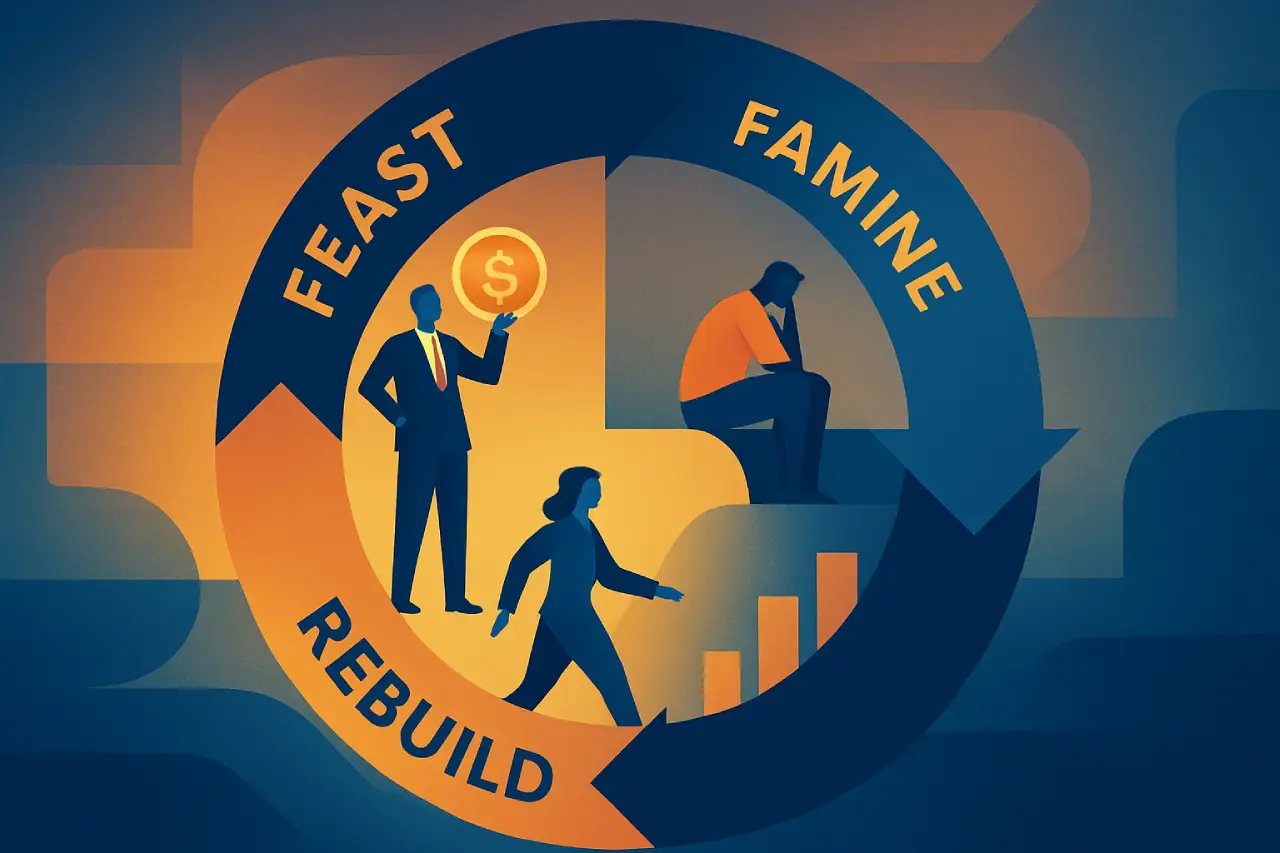
    Feast today, famine tomorrow: the freelance consulting cycle

    This article is part of the Business Insights Series, where we talk to professionals, founders, and decision-makers about what’s working, what’s challenging, and what’s next. In this edition, we look at what happens after freelance success: the pipeline gap, the risks of relying on a single big contract, and the challenge of scaling without burning out.

    When Andrew Doig launched his consultancy in 2021, the decision came suddenly, sparked by a phone call. The change gave him an unexpected pause and a chance to rethink his next steps. With three months of gardening leave and financial breathing space, he had the opportunity to focus on what he truly wanted to build. That time became the springboard for creating his own consultancy.

    Andrew’s new company, Learning Design Solutions, focuses on helping universities create effective, fully online programmes. The mission is to help institutions design and deliver high-quality, engaging digital learning strategies and full courses. His team supports universities at every stage, from initial consultancy and course design to multimedia production, faculty training, and project management. The aim is simple: to make online learning as impactful and experiential as the classroom. He draws on 30 years of experience, beginning as a teacher of English as a foreign language (TEFL) and evolving into a learning designer, executive, and finally a consultant. Along the way, he has lived in Istanbul, Australia, Korea, and Hong Kong; written CD-ROM teaching content; led teams in online programme management firms; and earned an associate professorship for his research.

    The calm before the silence

    Andrew’s consultancy had a strong start. His reputation in higher education and executive-level experience meant he was well-positioned to advise universities on moving courses online. Before starting his own company, he had spent decades building a name in both academic and corporate settings, which meant institutions were ready to listen when he offered guidance. His learning design philosophy, focused on experiential, outcome-driven courses that replicate classroom experiences, made his services stand out and gave him early momentum.

    “As long as there’s work there, it’s so much better than working in a corporate environment. I like people and I like working with people, but I don’t have to line manage people and deal with their problems anymore.”

    That first major contract validated his approach and showed that even a one-man consultancy could coordinate complex teams to deliver for a major university. He built flexible groups of subcontractors to handle large projects, calling on trusted colleagues when demand spiked. The model gave him reach without committing to permanent staff, which suited both his independence and the universities’ project-based needs.

    That first major contract was a turning point, but it also highlighted how consultancy work can decrease and flow. While the large project created a sense of stability, it also made clear the importance of building a pipeline for what comes next.

    “It started to dwindle in about August last year and by November it was finished. Now, I hadn’t worked enough on my pipeline, so I didn’t have any paid work until March again. And that was terrifying.”

    For Andrew, that pause became a lesson in resilience and preparation. Many consultants and freelancers will recognise the experience: being so focused on delivery that the next opportunity isn’t lined up. Rather than a failure, it is part of the natural rhythm of independent work, a rhythm that can be smoothed out with better systems, foresight, and planning. It is a reminder that success in freelancing includes both winning big contracts and creating continuity beyond them.

    A philosophy of learning, and of business

    Andrew draws a clear line between instructional design (content-focused) and learning design (experience-focused). Instructional design, as he explains it, means creating content for learners, what is familiar from compliance training; it might include interactive elements and quizzes, but is not principally about learner activity. Learning design is more ambitious; it considers the whole journey of the student and aims to create experiences that mirror learning processes that happen in the classroom: discussion, problem-solving, feedback, and growth. His courses are built around constructive alignment: aligning learning outcomes, activities, and assessments to create “virtuous loops” of knowledge, practice, and feedback. This approach helps universities move beyond static content to real learning experiences online, where students do not just consume information but actively apply it.

    “We’re not just designing content. We’re designing learning events… how do you get the learning experiences that a student would have in a classroom and replicate those online?”

    Andrew’s distinction between instructional and learning design reflects broader changes in the field. Recent industry surveys show that the instructional design profession is undergoing significant transformation, with nearly half of the respondents using AI daily and 30% using it weekly. However, most professionals still spend 37-39% of their time on development & implementation tasks, highlighting opportunities for the kind of strategic, experience-focused approach Andrew champions.

    For Andrew, this philosophy comes directly from his decades in education, from teaching English in Istanbul to designing MBA courses in the UK. He saw firsthand how learning sticks when people practice and use it, not just read about it. It is a principle that appeals to university leaders who want their online courses to be credible and competitive, not a digital textbook.

    That same mindset, aligning outcomes with actions, applies to business as well. Just as a course needs learning outcomes tied to activities, a consultancy needs its sales efforts tied to delivery and future planning. Without systems to align client acquisition, project delivery, and revenue planning, even the most capable freelancer can run into pipeline problems. In education, misalignment leads to poor learning; in business, it leads to dry spells between contracts.

    Scaling without staff

    Andrew consciously runs Learning Design Solutions as a flexible consultancy rather than a traditional agency. He brings in subcontractors when needed but has no permanent employees. This flexible model lets him expand his team for larger projects and then return to a leaner setup once the workload eases. It is a lightweight way of running a business, and one that gives him freedom to adapt without the fixed overhead of permanent staff.

    “None of those are my staff. They’re all subcontractors. As much as possible, people I’ve worked with previously, but not always.”

    This approach has benefits. Universities often need short bursts of intensive support, such as designing an MBA course or piloting a new online model. By pulling together temporary teams of designers, technologists, and media producers, Andrew can deliver complex projects without carrying the cost of a permanent payroll. For clients, it means they get a tailored team that matches the exact needs of the project.

    The shift towards remote work has made Andrew’s model even more viable. Research shows that over 60% of consultants benefited from the pandemic’s move to remote working, with many reporting they could maintain or even increase their fees while reducing business development costs associated with travel and face-to-face meetings. This trend supports flexible, network-based business models like Andrew’s.

    This flexibility is a strength, though it does call for careful planning. Without permanent employees, there is no standing team unless Andrew secures the projects that justify building one. It means the business thrives when contracts are well managed and momentum is maintained. 

    His experience shows how important it is for independent consultants to think ahead, investing in long-term strategy, consistent marketing, and reliable systems. These tools turn flexibility into stability and make it possible to enjoy the benefits of independence while still building a sustainable path forward. 

    Building relationships, setting up processes that generate leads, and creating predictable overlap between projects are as important as the work itself. Otherwise, the business remains fragile, no matter how impressive the portfolio looks on paper.

    Freedom and responsibility

    Andrew left the corporate world for the freedom to choose projects and focus on quality. He no longer manages full-time staff or answers to senior executives. Independence brings its own pressures. For someone who had spent years in executive positions and reporting to senior management, stepping away was both liberating and daunting. He traded security and a fixed salary for control and flexibility.

    For Andrew, this meant a chance to focus purely on the craft of learning design and the clients he chose to work with. It also meant taking on the responsibility of building his own path forward each month. 

    Independence brings both possibility and challenge, but Andrew’s story shows that with confidence in your skills and a clear plan, autonomy can be not just rewarding but empowering. Many consultants will see in his journey a reminder that stepping out alone opens space for freedom, growth, and the chance to shape work on your own terms.

    “I’d much rather be where I am now. So I’m much more comfortable being responsible for myself.”

    This comfort comes not from a lack of risk, but from acceptance of it. He has built enough trust in his skills and reputation to believe he can weather the ups and downs. Still, the lesson for other freelancers is clear: the rewards are high, but so are the risks. Without a pipeline, you don’t have a business, you have a project with an end date.

    Designing the next phase

    Andrew’s current goal is to scale Learning Design Solutions to handle concurrent, overlapping projects, reducing the risk of gaps between contracts. Having gone through a period where the pipeline dried up completely, he knows that relying on one large client at a time leaves the business exposed. By staggering projects, he can ensure continuity, avoid sudden gaps, and create breathing room for strategy rather than panic.

    He also imagines running the business remotely, perhaps from abroad, while planning for an eventual exit in his 60s. This reflects not only a business ambition but a personal vision: to design a consultancy that supports the life he and his family want to live. After years of travel as a TEFL teacher and time spent in places like Hong Kong, he has always seen work as something that should be portable. Now, he is looking at how to make that a reality for the final phase of his career.

    “I want to continue to scale. I want to get to the point where I have other people working for me, with me, who can supervise other people so I can have multiple projects going on.”

    This ambition goes beyond revenue. It is about creating a business that offers stability, freedom, and room for the next chapter of life. For other consultants, Andrew’s approach highlights the importance of aligning long-term lifestyle goals with day-to-day business design. Scaling means building a structure that reduces risk, supports flexibility, and leaves space for future choices, not only increasing income.

    A moment to act

    Andrew’s story shows the upside of saying yes to new opportunities and the risks of not planning for what comes next. Throughout his career, from TEFL teaching abroad to executive roles in online education, he always raised his hand for new challenges. That willingness created opportunities, but it also left him exposed when contracts ended and nothing was waiting in the pipeline. His experience highlights a reality many freelancers prefer to ignore: momentum can vanish quickly if systems aren’t in place.

    For consultants and small service businesses, the lesson is clear. It’s not enough to be excellent at delivery; survival depends on what you do while delivering. Building relationships, setting up processes that generate leads, and creating predictable overlap between projects are as important as the work itself. Otherwise, the business remains fragile, no matter how impressive the portfolio looks on paper.

    If you’re running your own consultancy or small service business, ask yourself:

    • What happens after your current contract ends?
    • Is your pipeline a plan or a hope?
    • Are you building something that works even when you’re busy delivering?

    If the answer feels uncertain, we should talk.Book a free discovery call with Serenichron and let’s look at how to build your pipeline, stabilise your business, and plan the next phase:

  • Coaching that works; or just feels like it?

    Coaching that works; or just feels like it?

    This article is part of the Business Insights Series, where we talk to professionals who are trying to solve big problems,cutting through the buzzwords to focus on what actually moves the needle. In this edition, we look at a question that’s quietly eating at the coaching and leadership industry: is any of it actually measurable?

    Our guest, Jonny de Mallet Morgan, is the co-founder of FROM:TODAY, a leadership and communication consultancy working with tier-one banks and FTSE 100 companies (that’s the 100 largest companies listed on the London Stock Exchange). But behind the polished client list and executive workshops lies a deeper mission: to build coaching and communication tools that feel meaningful to people,and demonstrate their value in measurable ways.

    This mission is taking shape in the form of a new AI-driven venture Jonny is building,one that promises to connect leadership development to financial performance. It’s still in early stages, but it’s already asking better questions than most CRM dashboards.

    Let’s look at what’s broken in the world of coaching, why AI might be able to help, and what leaders should be thinking about before they hire their next coach,or launch their next internal programme.

    The ROI Problem in Coaching

    Talk to any executive coach and they’ll tell you the same thing: it works. Talk to their CFO and you might get a different answer.

    “I just haven’t ever found it [email marketing] being very successful.”

    Jonny made this comment in the context of marketing challenges, but it echoes a broader issue common to coaching as well. The sentiment is familiar: lots of effort, not enough signal. Coaching, like email marketing, can feel meaningful,but when budgets tighten, stories aren’t enough.

    Research consistently shows this measurement gap creates real business problems. According to recent studies tracking coaching effectiveness across multiple organisations, whilst 86% of companies rate leadership development as urgent, only 13% believe they execute it well. This disconnect isn’t from lack of investment,it’s from lack of measurable outcomes that connect to business performance.

    In coaching, outcomes are notoriously difficult to measure. A good session might spark clarity, but how do you tie that to improved profit and loss three months later? Many leadership development programmes rely on participant surveys or generic satisfaction metrics. It’s like asking someone if they enjoyed a fire drill,useful, but not always connected to performance.

    Leadership development still operates largely on trust and feel. The value is often defined by anecdotes, not data. Organisations invest in consultants to help leaders communicate better, resolve tension, and inspire performance,but measuring whether it actually works? That part is murky.

    This creates tension for decision-makers. They believe in the value of coaching, but when procurement or finance asks for the impact statement, they’re stuck. FROM:TODAY wants to change that.

    The goal is to keep the human part central while building systems that connect it to evidence in ways that make its value clearer. That includes dashboards, but more importantly, it means designing interventions that can be traced to business outcomes without reducing them to checkboxes.

    This shift requires more than software,it asks coaching providers to rethink how success is defined. And it gives clients a chance to stop choosing between care and accountability. Done right, both can live in the same system.

    “The idea is that we can start to correlate coaching interventions with performance outcomes.”

    This quote points to a larger shift in mindset,toward accountability that doesn’t abandon empathy. In a field often driven by belief and instinct, the ability to connect human development to business impact could reshape how leaders make decisions. Data, when used carefully, won’t erase trust,it can reinforce it.

    Data Alone Doesn’t Build Trust

    It would be easy to imagine this kind of AI-driven coaching tool Jonny is developing through FROM:TODAY tech drifting into surveillance culture,an algorithm tracking every keystroke, measuring productivity by presence rather than purpose. But that’s not what Jonny’s building. His 15 years background as a stage actor before moving into leadership coaching,brings with it a unique attentiveness to human emotion, subtle communication, and the unsaid dynamics in a room.

    “I care about the person who’s not doing well in the team. That’s what I’m obsessed with.”

    This obsession with supporting the overlooked or struggling team member is at the heart of his approach. Jonny’s coaching model is centred on emotional nuance and psychological safety,values that don’t easily translate into software.

    Research on psychological safety demonstrates why this focus matters for measurable business outcomes. Teams with high psychological safety are five times more likely to be effective. When organisations use dedicated measurement tools to track psychological safety,rather than relying on general satisfaction surveys, they report up to 40% reductions in turnover rates and 30% increases in innovation.

    And yet, that’s precisely the challenge he’s tackling. FROM:TODAY’s AI tool is being designed with these human values in mind. The tool is being built to make invisible contributions visible, especially in cultures where introverted or neurodivergent employees may not be rewarded in traditional performance models. Instead of focusing on micromanagement or scoring behaviours, it aims to reflect how support and inclusion play out across a team’s performance landscape.

    When leadership conversations include phrases like “thriving” and “belonging,” they’re often seen as soft or unmeasurable. Jonny’s approach aims to bring structure to leadership conversations in a way that preserves human complexity without flattening it. The hope is that both HR professionals and finance leaders can use the same data set to understand not just what people are doing, but how well the system supports them to do their best work.

    Building the MVP: Lessons in Compliance and Care

    As with any tech tool, the challenge lies not only in writing the code but also in understanding the environment it operates in,especially when dealing with sensitive data, workplace culture, and leadership dynamics. Jonny’s team has had to learn compliance quickly, especially around data security and ethical use.

    “Compliance and data protection are at the top of our agenda,we’re building this with a serious focus on doing things properly from the start.”

    The product is currently in its MVP (minimum viable product) phase, with beta testing planned. Funding is being raised through a network of angel investors and high-net-worth individuals. But what ultimately drives the development forward is clarity,having a shared understanding of purpose, ethics, and measurable value.

    FROM:TODAY is trying to do something rare: build a tech product that strengthens human-centred coaching, rather than replace it. And that means staying close to the mission.

    “The philosophical algorithm is what drives it… the human values come first.”

    This speaks to a development mindset that’s unusual in tech,one that treats ethics as architecture instead of decoration. As FROM:TODAY moves forward, the success of this product will depend on its ability to function well while staying grounded in human-centred design. Balancing meaningful measurement with emotional intelligence will be key to its long-term relevance. That’s the real design challenge,and it sets the stage for broader questions that business leaders are already grappling with.

    What This Means for Business Leaders

    So what should you be thinking about if you’re a business owner or decision-maker?

    Don’t settle for coaching that only feels good. Ask what’s actually changing.

    It’s easy to walk out of a coaching session feeling energised, but that feeling alone doesn’t mean it worked. Businesses need to get more comfortable with asking tough questions: What specific skills improved? What behaviours shifted? What ripple effects can we observe across the team? 

    Good coaching should translate into better communication, stronger collaboration, and measurable results, not just a temporary mood boost. 

    When leaders rely solely on subjective feedback, they miss the opportunity to tie leadership growth to real business outcomes.

    Trust can be supported by data when that data is clear, consistent, and aligned with real outcomes.

    But trust doesn’t grow automatically just because a dashboard exists. It comes when teams feel that the data reflects reality, what they know to be true about their work and contributions. When metrics are fuzzy or seem disconnected from what people are actually doing, they can undermine confidence and introduce unnecessary friction. And in leadership development, that friction can undermine both adoption and impact. 

    Data is only helpful when it brings clarity to what matters,what people are doing, how they’re supported, and what outcomes are improving as a result. If the information adds layers of confusion or disconnects from day-to-day experience, its usefulness fades quickly.

    If your development programmes aren’t aligned to performance, you’re funding a PowerPoint.

    Leadership slides look great in a strategy deck. But unless the content is backed by behavioural change, those glossy frameworks become expensive decoration. Programmes need to connect clearly to performance indicators, retention, engagement, productivity, or decision quality. Otherwise, the investment becomes hard to justify. 

    Business leaders should ask: if we took this programme away, what would stop working? If the answer is “nothing,” it’s time to rethink the approach.

    The future of leadership support may depend on how clearly we can connect care to outcomes. Programmes that demonstrate both empathy and effectiveness are becoming more relevant. FROM:TODAY is working to model what that kind of integrated solution can look like.

    If you’re reading this and wondering how to apply these ideas to your own organisation, how to embed measurable leadership practices into your operations, build systems that support both performance and wellbeing, or make your internal initiatives more accountable,this is where we come in. At Serenichron, we help businesses implement digital strategies that connect human insight with real-world outcomes, without adding complexity for non-technical teams.

  • Self-coaching and AI: The future of self-development?

    Self-coaching and AI: The future of self-development?

    In this edition of the Business Insights Series, I spoke with Andrew Tallents, founder of The Tallents Partnership and creator of the “Self-Coaching for Leaders” methodology. 

    Andrew’s career story reads like a case study in anticipating change and acting on it. He began in the high-pressure world of international headhunting, working closely with senior executives and board members, before realising his real value came from guiding leaders rather than just placing them. 

    Over time, that realisation evolved into a reflective, AI-powered leadership tool designed to help individuals reconnect with purpose, align their energy, and make decisions with intention. 

    His mission is ambitious yet clear: enable millions of leaders to coach themselves daily and take ownership of their growth.

    Through The Tallents Partnership, Andrew offers a comprehensive range of leadership solutions, from executive coaching for CEOs and founders to relationship coaching for senior leadership teams, reflective leadership circles, and systemic team coaching. He also delivers specialised self-coaching programmes for individuals, teams, and entire organisations, including those supported by AI. 

    His approach blends high-performance development with a deep focus on self-awareness, equipping leaders to thrive in complex environments.

    In our discussion, we explored his career evolution, the core of his self-coaching method, and the ways technology, particularly AI, is reshaping what leadership development looks like in the years ahead.

    From Headhunting to Leadership Coaching

    Andrew began as an executive headhunter recruiting senior directors for board positions, a role that demanded both sharp judgment and the ability to quickly understand a person’s motivations and capabilities. 

    Over time, he noticed that many of his conversations went far beyond assessing qualifications, they began to probe into values, readiness for change, and personal alignment with career goals, subjects more at home in a coaching session than a recruitment interview.

    “I became aware that when I was interacting with potential candidates, my role was quietly shifting from pure assessment to genuine coaching: asking them deeper questions about their career direction, encouraging them to reflect on timing and alignment, and sometimes making the tough call to remove them from a shortlist if I felt that the position would not serve their long-term goals”

    This willingness to step away from the transactional nature of recruitment and lean into the developmental side of leadership marked a clear turning point in his career and set the stage for a new professional direction. 

    By 2017, Andrew had formalised this approach into The Tallents Partnership, a platform designed to put leadership growth at the heart of professional advancement. Four years later, he published Self-Coaching for Leaders, giving structure to his philosophy and offering a blueprint for leaders to take charge of their own development.

    His expansion into training programmes, public speaking, and scalable leadership tools was part of a deliberate strategy to make self-leadership principles accessible at scale. Influenced by Daniel Priestley’s “Key Person of Influence” framework, Andrew built his profile to reach beyond one-to-one coaching, positioning himself as a trusted voice in leadership thinking. The result is a portfolio that blends direct impact through coaching with influence at a broader level via products, a podcast, and a global associate network capable of delivering consistent results in over 40 countries.

    The Self-Coaching Methodology

    At its core, Andrew’s approach has three interconnected elements: reconnecting with a clear sense of purpose, aligning daily activities with personal energy, and developing the awareness to interrupt negative thought patterns before they shape actions. He views these as the pillars of sustainable leadership growth, not quick fixes, and emphasises that these skills compound over time rather than delivering instant gratification.

    “The only person that gets in my way of living my dream life that I design is me.”

    This philosophy is backed by research from the University of Newcastle, which found that leadership coaching boosts effectiveness by increasing authentic leadership behaviours and self-efficacy. The study showed that the biggest overall driver of improved leadership effectiveness came from gains in authentic leadership, reinforcing Andrew’s view that genuine self-awareness and authenticity, built through consistent reflection, are the cornerstones of sustainable leadership growth.

    In practice, this means leaders deliberately carve out moments in their schedule to pause, reflect, and re-centre, even when deadlines and demands are pressing. 

    Andrew often incorporates tactile grounding techniques, simple, discreet physical cues like rubbing fingertips together or feeling the texture of a surface, that anchor attention in the present moment and create a mental reset. He explains that these small interventions, repeated consistently, train the brain to recognise stress signals earlier and to respond with clarity instead of defaulting to automatic, and often unhelpful, reactions.

    Over time, this habit cultivates the discipline to respond thoughtfully instead of reacting impulsively, even in high-stakes negotiations, difficult conversations, or crisis situations. It also encourages leaders to examine whether the way they spend their time and energy genuinely aligns with their goals, helping them to say “no” to low-value activities and to invest more fully in the relationships and priorities that matter most. By treating reflection as a skill to be honed rather than a vague ideal, leaders can build a personal operating system that keeps them grounded, intentional, and resilient in the face of change.

    AI in Your Pocket: Coaching Goes Digital

    Andrew’s AI-powered app delivers daily prompts, helping users track personal patterns and reflect in real time. These prompts are intentionally crafted to encourage leaders to pause mid-flow, consider the quality of their thinking, and assess whether their current state of mind supports their goals. Over days and weeks, this builds a personal database of reflections that reveals recurring behaviours, energy shifts, and decision-making patterns.

    It came back with an observation that, while I generally present as confident, there are certain scenarios where that confidence wavers or becomes situationally fragile.”

    For many, this kind of insight is a breakthrough, highlighting subtleties they might not recognise in themselves. Because the app keeps all data private to the individual, users can be candid without fear of judgement, which strengthens the quality of their self-reflection. At the same time, the system aggregates non-attributable data to provide leadership teams with a clear view of emerging organisational trends, whether it’s a dip in confidence before big project deadlines or an increase in stress-related behaviours during restructuring phases.

    This dual benefit, deeply personal development for individuals and strategic intelligence for organisations, makes the tool a rare bridge between self-leadership and enterprise performance. Leadership teams can then use these insights to refine training, improve communication, and deploy resources where they will have the most impact, turning reflection into a driver of both individual and organisational growth.

    Rethinking Organisational Structures

    AI-enabled self-coaching could reshape organisational design in ways that extend far beyond simple headcount changes. As individuals build the capacity to guide their own performance, they require less day-to-day oversight, freeing leadership layers from a focus on micromanagement. The shift is both operational and cultural, encouraging a workplace where initiative and self-responsibility are expected norms rather than exceptional behaviours.

    “Middle managers won’t necessarily diminish, but the number of them certainly will, and their roles will change.”

    In this evolving environment, managers could become navigators of relationships, trust-builders, and stewards of organisational culture rather than enforcers of task lists. They may focus on connecting teams to purpose, ensuring alignment across complex projects, and facilitating collaboration between diverse functions. Andrew suggests that when responsibilities and expectations are made more transparent, the political manoeuvring that often thrives in hierarchical ambiguity can diminish, replaced by more straightforward, purpose-driven communication. Over time, this could lead to flatter, more agile organisations where leadership influence is measured less by positional authority and more by the ability to foster productive, human-centred relationships.

    Scaling Globally Through Partnerships

    Andrew’s vision for growth extends well beyond the borders of any single market. His work is delivered through a combination of in-house expertise and a carefully selected international network of associates who share his values and methodology. This global reach enables The Tallents Partnership to adapt programmes to local contexts while maintaining the consistency and quality of the core approach.

    “If we want to help leaders at scale, we have to meet them where they are,culturally, geographically, and in the way they prefer to learn.”

    Through collaborations with technology partners, Andrew ensures that his AI coaching tools are continually refined, secure, and scalable. These alliances provide access to innovation pipelines and specialist knowledge, allowing the business to experiment with new features, integrate the latest in AI learning design, and deliver seamless user experiences. 

    This setup also allows Andrew to keep his attention on areas where his influence has the highest impact, developing original content, building trusted relationships with clients, and exploring fresh ways to embed self-coaching into the rhythm of daily leadership.

    By aligning operational structure with the principles he teaches, clarity of purpose, intelligent use of resources, and sustained focus on high-impact work, Andrew has created a growth model that is both agile and resilient. It blends the reach of global networks with the personal touch of customised support, resulting in a platform capable of serving leaders across diverse industries and cultures while maintaining meaningful, measurable impact.

    Conclusion: Leading Ourselves in the Age of AI

    Andrew’s vision blends human self-awareness with technology, offering leaders a practical, scalable way to build reflection into their daily lives. The focus is not on overhauling entire routines overnight, but on creating consistent, intentional pauses that lead to better decision-making, stronger relationships, and greater resilience in the face of challenges. His advice for starting is refreshingly simple:

    “15 minutes every single day around getting into the habit of reflection is what people need to start with…”

    Andrew’s recommendation of just 15 minutes daily finds strong scientific backing. Research from FranklinCovey shows that spending only 15 minutes a day reflecting on work can significantly boost job performance and confidence. Harvard Business School found that employees who spent 15 minutes journaling at the end of their workday performed 22.8% better than those who did not. The real power lies in the consistency, small, regular moments of reflection that accumulate into lasting improvements in clarity, decision-making, and leadership presence.

    Those 15 minutes can be the difference between reacting on autopilot and responding with clarity. Over weeks and months, they become the foundation for a leadership style that is calmer, more strategic, and better attuned to both personal and organisational goals. In an era where distractions are constant and pressure is high, this kind of deliberate self-leadership is not just valuable, but it’s essential for long-term success.

    If you’d like to experience Andrew’s approach first-hand or discuss how self-coaching might work in your own organisation, you can schedule a session with him here:

    👉 Book a call with Andrew Tallents

    If you’d like to explore how AI and self-coaching could strengthen leadership within your business, you can also connect directly with us here:

  • Building careers while studying abroad

    Building careers while studying abroad

    This article is part of the Business Insights Series, where we explore the strategies, realities, and roadblocks shaping business today. We spoke with Ankitashri Tripathi, co-founder of LLM Wizards.

    LLM Wizards offers application advisory services to students and professionals seeking admission to top-tier universities across the UK, US, and other global destinations. Their mission is to provide personalised, high-quality mentorship that helps candidates not only meet admission requirements but also position themselves strategically within competitive academic and professional systems.

    At the heart of our discussion is a question often left unanswered: what happens after acceptance? Ankitashri’s experience spans law, policy, and international education, and she brings sharp insight into the invisible barriers that many international students face. 

    This interview explores the real challenges students face. It looks at unpaid emotional labour in mentorship. It also touches on the stress of unclear visa policies. And it addresses the false belief that a prestigious degree guarantees employment. Together, these issues show how different systems intersect, and often fail to support real outcomes.

    We talk through the mechanics of mentorship at LLM Wizards, the structure of application coaching, the reasoning behind selective admissions, and how the team balances premium and pro bono work. We also look at her new initiative in the UK, designed to train students for employment before graduation, a gap she argues is overlooked by most universities and commercial services.

    This story focuses on structural imbalance. It looks at how people work within and around the systems already in place. Also, it explores how small changes, rather than headline innovation, can make space for new outcomes.

    Higher education abroad is not a finish line

    For international students, a postgraduate degree in the UK or US is often seen as a long-term investment. However, the link between education and employment is far from guaranteed. While some assume that a degree from a top institution is a passport to a secure career, the reality for many is far more uncertain. The job market is crowded, competitive, and unfamiliar. Visa conditions shift. Hiring practices are opaque. In this context, the challenge involves more than just securing employment. It includes understanding how the system works and making timely, informed decisions that shape outcomes.

    These degrees are fine,you graduate from top universities,but when you look at jurisdictions like the UK or the US, you spend so much money and still don’t have jobs afterward. Ankitashri said.

    This gap between promise and outcome is what prompted her to develop a new business initiative. Focused initially on the UK, her project aims to prepare students for employment while they are still in university, not after. The logic is straightforward: if you wait until graduation to start planning your career, you’re already behind.

    They should be trained while they are still at university so that once they graduate, they are able to get jobs..

    The approach is meant to anticipate obstacles before they materialise. The program goes beyond traditional career coaching. It addresses structural gaps in a system that often assumes students can decode complexity on their own. Her program aims to embed practical skill-building, application development, and job market insight early into the academic journey, when students still have time to shape outcomes. 

    University services exist, but they often don’t meet the urgent, practical needs of international students. Many students are navigating unfamiliar systems under strict time limits and financial pressure, and the support available doesn’t always reflect that reality.

    Research by the Higher Education Policy Institute (HEPI) confirms this gap. Their 2021 report found that only around half (52%) think their institution is doing well at satisfying the careers support needs of international students. The research also revealed that careers support (82%) and employability skills (92%) were ‘important’ or ‘very important’ when choosing their university, yet institutions are falling short of these expectations.

    Mentorship is not a done-for-you service

    LLM Wizards, founded in 2019, was created to support students from smaller or non-premier universities who often lack institutional support when applying to top-tier international programmes. These are students with potential, but without the social capital or institutional frameworks that help others navigate the application process with ease. Since then, the consultancy has grown into a structured team with experienced consultants, a selective intake model, and a reputation for high standards and personalised attention.

    SOP(Statement of Purpose) is all about emotion, which operates on a deeper level of conversation,” she said. “So when we work on it, we get on calls with clients and ask:Why did you think like that? Why do you think you felt like this when you read this concept?

    The Statement of Purpose is not treated as a formality. It’s where identity, ambition, and academic positioning converge. That requires trust, and time. Ankitashri approaches the SOP process as a series of reflective conversations that help the student build the case for who they are becoming, rather than treating it as a service to be outsourced. The emotional depth is central to the process. It’s a necessary part of helping students engage with their own stories and ambitions.

    However, this model often clashes with client expectations, especially when students or their families expect turnkey solutions. The industry is filled with agents who offer shortcuts. That sets the tone for misunderstanding, where high fees are assumed to cover not just support but deliverables.

    If students are confused or unhappy with something, you don’t want them working with that mindset. So I make it a point to sit with them, explain the concept, and resolve their issues. It’s a learning process.

    These conversations are part of the mentorship too. The process is slow, not by accident, but by design. Clients don’t always come to understand that. But by the end, they often leave with more than an offer letter, they leave with a clearer understanding of how to navigate their own stories in future systems that may not make space for them by default.

    Working backwards from opportunity

    Ankitashri noted that many students target prestigious universities not out of preference for prestige, but due to practical needs. In many cases, the name of the institution acts as a proxy for access to networks, visa options, and job opportunities. The educational value matters, but so does what the degree symbolises to employers and immigration systems.

    If I’m going to a university abroad, I’m spending a significant amount as an international student. So if I have to take a loan or mortgage my house, it must be for a top-tier university,otherwise, it isn’t worth it.

    In this framing, the decision to study abroad is less about exploration and more about survival strategy. The costs, financial, emotional, and logistical, are high, and the stakes are uneven. A student might be investing years of savings or mortgaging family assets based on the assumed return of a better future. But prestige is not a guarantee. A top-tier name on a CV may open doors, but it does not eliminate the need for planning, experience, or ongoing support.

    To manage this complexity, Ankitashri has introduced a three-tier system for university selection: ambitious, compatible, and backup. The purpose is to ground aspirations in strategy and ensure they are approached with clarity. Each tier serves a different role. Ambitious applications aim high, compatible ones provide a strong likelihood of admission, and backups act as safety nets. The framework is a way of making the unpredictable more manageable, by distributing risk and encouraging focus before commitments are made.

    There are rules, and then there is timing

    Immigration processes and employment regulations add complexity to post-graduation planning. In the UK, students can apply for a graduate visa allowing them to remain and work for 18–24 months. While this window offers a chance to gain work experience, it comes with its own limitations: short timelines, shifting policies, and employer hesitation around visa sponsorship.

    After graduation, you can apply for a Graduate Visa (also called the PSW), which allows you to work in the UK for 24 months (currently 18 months). You don’t need a Skilled Worker visa during this period, and it gives you the foundation to begin your career in the UK.

    The opportunity exists, but it’s poorly communicated. Most students only find out what they’re eligible for after graduating. In many cases, the support systems they rely on: career services, international student offices, are built for general guidance, not for navigating policy nuances or strategically planning around visa structures.

    The primary objective of universities is teaching, not career services. Skill assessment and guidance cannot be their main priority.”

    That mismatch creates a planning gap during the most crucial time. Students with the right information could use the graduate visa period to secure employment, gain local experience, and transition to longer-term residency routes like the Skilled Worker visa. But those who miss that window may find themselves forced to return home, regardless of qualifications.

    Ankitashri’s upcoming company is designed to work within that window, offering structure where universities often cannot. The focus extends beyond writing CVs or polishing cover letters. It includes teaching students how to interpret job market signals, how to communicate in contextually appropriate ways, and how to translate their academic profile into something employers in the UK will actually understand and value.

    When mentoring is access

    While LLM Wizards operates on a premium model, Ankitashri also handles a category of pro bono cases. These are not exceptions but a conscious part of her model, built around recognising systemic inequalities in who gets access to opportunity. The typical pro bono candidate is highly qualified, often already accepted into a top-tier institution, but held back by financial constraints. In some instances, the only thing separating them from a life-altering opportunity is a missing scholarship or an unapproved loan.

    One of the students I worked with had secured an offer for public policy at Cambridge, but she only had around £15–20k available to cover the costs. Cases like this affect me deeply as a working professional,she said.

    Her response to such cases is direct and personal. The pro bono category is separate from the core LLM Wizards operation, and she manages it herself without delegating to the wider team. This approach is not designed for scale. It is a deliberate choice to keep the work personal and manageable. She treats this work as part of her broader responsibility. It extends beyond consultancy into her active involvement in shaping policy and systems.

    There is a separate category for that as well. The pro bono category.

    Beyond reviewing documents, she often advocates for students, writing letters to ministries, contacting international organisations, and trying to unlock institutional pathways that might make attendance possible. This dual role, professional consultant and policy advocate, adds another layer to her work. Her work goes beyond helping students access education. It confronts gaps in the system and uses the resources available to create openings where none existed.

    Closing thoughts and next steps

    The experience of international students stretches far beyond the moment of admission. It starts months earlier, with planning, emotional labour, and decision-making that often happens without full visibility of the consequences. These decisions have ripple effects: financial commitments that last years, visa timelines that cut short opportunities, and systems that expect fluency in rules never explicitly taught.

    Timing, mentorship, and access to informal networks all influence the likelihood of success. The processes may appear meritocratic, but they often rely on tacit knowledge, how to frame an SOP, when to apply for a visa, which internships convert to jobs. This knowledge is rarely written down, and almost never evenly distributed.

    The work Ankitashri is doing makes some of that knowledge visible. Her mentorship and employment-readiness initiatives give structure to a journey that otherwise requires students to make high-stakes choices with limited support. Her work acknowledges the system’s unfairness and builds scaffolding to help students survive it.

    The impact of such structured support is significant. Research shows that students who feel their courses have not covered employability skills are twice as likely to say that, in hindsight, they would pick a different institution to do the same course (18% versus 8%). This emphasises the importance of proactive career preparation and the value of services like those Ankitashri provides.

    If your business also operates in complex or high-stakes environments, where timing, clarity, and access make the difference. Serenichron can help you design systems that guide clients through uncertainty with confidence.

  • Talent and technology: Building smarter growth engines in the age of AI

    Talent and technology: Building smarter growth engines in the age of AI

    Before building AI systems for business development, Vijayender Nalla spent nearly a decade in education, then transitioned into the food processing sector in the Netherlands. It was there that he noticed a consistent challenge: a gap in talent, especially in agribusiness. This observation led him to create Agribusiness Academy, a digital learning platform that served learners across more than 50 countries, particularly in Africa. 

    Now based in the UK and operating as a Dutch entrepreneur of Indian origin, his work blends decades of cross-sector experience,from education to systems thinking,to help small and mid-sized businesses rethink growth through AI-powered tools. Agribusiness Academy, the platform he founded, offers digital programmes focused on sustainable food supply chains, value chain development, and agrifood innovation. 

    With offerings like the Mini MBA in Sustainable Food Supply Chains and targeted training for early-career professionals, the Academy equips learners across the globe with practical knowledge designed for real-world impact. Its mission is to connect people with the expertise and tools needed to create a more resilient and sustainable agribusiness sector. His latest focus is on turning business development into something scalable, testable, and repeatable,without overwhelming teams or stretching resources thin.

    For companies looking to grow, the landscape of business development is evolving rapidly. Conversations are shifting from tactics to transformation,especially as AI reshapes what’s possible. In this edition of the Business Insights Series, we explore how organisations can use AI to scale smarter, without multiplying headcount unnecessarily.

    Technology is opening new doors, and with it comes the challenge of applying tools in ways that genuinely solve business problems. Knowing how to match solutions to the right use cases is becoming the real differentiator. In business development, those problems often look the same: finding the right leads, creating meaningful outreach, and doing all of it with limited time and energy. Even the most seasoned founders and teams know how heavy that can feel.

    But what if we could approach it differently? What if the goal shifted from simply doing more to doing what matters most,more effectively, more clearly, and with better outcomes? That’s where AI-powered systems begin to make sense, not as flashy replacements for human work, but as smart extensions of it.

    Most of my challenges in business have come down to business development.

    That reflection shows awareness of what consistently blocks momentum in a growing business. And more importantly, it’s about the search for better tools and better systems. That search led to the use of AI agents,tools developed to support business growth with precision and speed, while working alongside human capabilities.

    Lead generation is taking on a new form

    From building a digital academy serving learners in over 50 countries to developing AI tools for lead generation, his work spans continents,including India, the Netherlands, Africa, and the UK. Vijayender’s journey reflects a broader shift in how businesses approach growth: through more structured and intentional systems. His current work explores what it takes to build scalable, intelligent processes for business development that reduce inefficiencies and unlock new kinds of leverage.

    Business development still keeps most founders up at night. Leads that go nowhere. Outreach that feels like shouting into the void. Teams that can’t scale fast enough to meet demand. Vijayender’s insight? That these are surface symptoms. The deeper constraint lies elsewhere.

    He’s spent years exploring how to fix that,initially through education, then through productising expertise, and now through AI agents that he calls multipliers. The idea is simple: let machines do the heavy lifting where scale and speed matter most.

    Vijayender refers to one of their agents as the “Holy Grail” of their work: an AI that scrapes the web, identifies relevant leads, and delivers them in real time, based on fine-tuned targeting commands issued through a Telegram interface.

    So one is content marketing. The other one is lead generation and approach outreach agent. So that’s the most powerful part of the whole business development multiplier (BDM).

    He gave it a test. It returned results,fast. Results he wouldn’t have found in 15 years of global networking. He had strong networks and plenty of experience, yet the agent surfaced opportunities that traditional search methods simply could not reach.

    It gave me 100 results… it’s impossible for me to get that all by myself.

    These agents leverage multiple AI LLMs and APIs to search the internet with precision. But there’s a catch. This isn’t for everyone. If your targeting is vague or your business isn’t committed to building a business development (BD) system that runs consistently, no agent can save you.

    If you are not giving it sharp instructions, if you don’t know your targeting very well, then no one can help you. AI cannot help, no one can help.

    Research from McKinsey’s 2025 State of AI survey confirms this point,successful AI implementation requires precise targeting and clear strategic frameworks. Companies that define specific use cases and sharp targeting parameters see significantly higher success rates than those attempting broad, unfocused implementations.

    This should raise a question for any founder: how precise is your understanding of who you want to reach?

    Talent as the true lever for growth

    When discussing what consistently limits growth in organisations, Vijayender points to one thing above all: talent. Growth challenges are rarely just about effort, products, or capital. The real driver is people,their fit, their motivation, and their ability to keep developing with the company’s direction.

    “There is no bigger power than talent and there is no bigger weakness than talent.”

    He describes talent as both the fuel and the safeguard of growth. In his view, AI doesn’t replace this. Instead, he sees it functioning as an amplifier of whatever qualities a team already has. If people are aligned and capable, AI extends their reach. If they aren’t, the technology simply magnifies the gaps.

    This perspective reframes the conversation around business development tools. The central question is whether your team has the skills and clarity to apply the systems you adopt effectively. Vijayender’s own path illustrates this: it took him years to bring together a small core group of people he could fully rely on, and that alignment changed how far his ideas could travel.

    This aligns with findings from IBM’s research on AI-powered workforce development, which shows that organizations using AI to identify and develop talent can reduce the time to fill critical roles by 40%. The key insight: AI amplifies existing capabilities rather than creating them from scratch.

    There’s value in hearing this from someone who has built across multiple industries. It reminds us that technology can accelerate the pace, but talent sets the direction. The sharper the team, the more the systems deliver.

    Moving from curiosity to capacity

    The interest in AI is almost universal at this point, and businesses in every sector are experimenting with it. But as Vijayender points out, interest alone doesn’t build systems. What matters is intentional design,deciding clearly what problems need solving and how technology should serve those goals. 

    Harvard Business Review’s 2025 research reveals that success with AI means investing intelligently across build, buy, blend, and partner strategies. Only 13% of IT leaders plan to build AI models from scratch, while 53% intend to start with pretrained models and augment them with enterprise data. This strategic approach reflects the maturity that’s developing in the market.

    The work of AI-powered business development, in his view, is about aligning intent with action. These agents are designed to multiply meaningful efforts, support real conversations, and uncover opportunities that manual methods might miss. Automation on its own is limited; leverage comes from how well it is designed and applied.

    He stresses that teams need to think carefully about design questions: What outcomes are we aiming for? How do these tools integrate with existing processes? Who on the team will own and guide them? Without those answers, AI can become another unused resource rather than a growth engine.

    This framing raises critical questions for any team:

    • Are we clear on the core constraints in our business development?
    • Do we have the systems,and the people,to act on them?
    • Are we testing growth strategies in a way that lets us adapt quickly?
    • Who is responsible for learning from these experiments and applying the lessons back into the business?

    Final thoughts

    This conversation with Vijayender makes it clear: business development is undergoing a redesign. What used to rely heavily on hours and outreach is now shaped by algorithms, interfaces, and decision-making frameworks that demand focus. The challenge today involves more than setting up automations,it requires understanding precisely what they should achieve, who they should serve, and how they integrate into broader business goals.

    His journey,across education, entrepreneurship, and system design,illustrates the type of experimentation that will guide successful companies in the years ahead. The organisations most likely to thrive will be those that cultivate curiosity, commit to strengthening their talent, and put structures in place that allow them to test, learn, and grow without exhausting resources.

    Instead of focusing solely on acquiring better tools, the real opportunity lies in becoming builders who design smarter systems, stronger teams, and more adaptive strategies.

    Questions to take forward:

    • What part of your business development process could be productized or systematized?
    • How sharp is your targeting,and could AI help you refine it?
    • Are you using your time and team for tasks that require human strength, or things machines could handle?
    • If you had to double your revenue without hiring more people, what would need to change first?

    These questions act as prompts to rethink how growth is designed and sustained. Businesses that wrestle with them often uncover blind spots, hidden opportunities, and ways to get more from the resources they already have.

    Think about it: how would your sales conversations change if your targeting became sharper? What possibilities would open up if your team’s time shifted from repetitive tasks to higher‑value work? And what strategies would you put in place if doubling revenue without adding headcount was non‑negotiable?

    These questions are practical checkpoints for leaders who want to adapt, stay relevant, and scale with intention.

    Want to explore how your team can turn these insights into action? Let’s talk about it.

  • Operational excellence in motion: How agencies grow up

    Operational excellence in motion: How agencies grow up

    What does it really take to grow a digital agency into a 130-person powerhouse over nearly two decades? That’s the question I explored with Parth Pandya, founder of KrishaWeb Technologies, during a deep and energizing conversation that I’m still thinking about days later.

    Parth is a veteran of the IT space with a track record of navigating market shifts and digital transformation, consistently leading his agency through evolving challenges with a proactive, hands-on approach. KrishaWeb is a full-service agency with offerings that span from SaaS product development and UI/UX design to performance marketing and 3D animation. 

    Their mission is to revolutionize the digital experience through what they call their ‘6D approach’: Discover, Design, Develop, Deploy, Distribute, and Delight. Each phase is rooted in structured, client-centric workflows that align strategy with execution and aim to deliver measurable impact. They’ve been serving SMEs and enterprise clients for over 17 years, and the scope of their operation is both broad and impressively integrated.

    What stood out to me most during our conversation was Parth’s mindset. His focus is on strategic investment: refining frameworks, improving processes, exploring AI capabilities, and strengthening team efficiency. He’s asking the tough questions: What are we doing well? Where are we winging it? How can we run this business more intelligently?

    We dug into how KrishaWeb is balancing structure and creativity, scaling without losing quality, and preparing their systems for the future. From how they evaluate blog ROI to how they manage rising labor costs, Parth opened up about the operational challenges many leaders are quietly dealing with.

    This conversation is part of an ongoing effort to understand how real business leaders think, solve, and grow. Parth’s insights align with many of the themes we explore in the Business Insights Series: how to scale without breaking, how to turn complexity into clarity, and how to lead with both heart and structure.

    These are grounded, honest exchanges that go beyond surface-level wins and into the real work of building and evolving: the mindset shifts, the system upgrades, the tough calls, and the quiet wins that shape resilient businesses. With a few laughs, some shared wisdom, and a whole lot of practical insight along the way.

    Finding stability in complexity

    KrishaWeb isn’t your typical niche agency. With services covering everything from frontend development to complex video production and digital marketing, it’s a one-stop shop for businesses seeking full-spectrum digital solutions. Their clients range from SMEs to large enterprises, and they’ve built the internal capacity to handle everything in-house.

    “We are a single window service… helping our customers from brainstorming to delivery. We have a business analysis team, marketing, video production, everything in-house.”

    This approach goes beyond operational ease. It’s part of a deliberate strategy to integrate departments and streamline delivery across functions. Keeping all departments under one roof allows KrishaWeb to maintain tighter integration between planning and execution, reduce miscommunication, and deliver on complex scopes faster. But with this scope comes complexity. And Parth is clear-eyed about that challenge.

    “We are doing everything maybe at 70, 80, 85%. We need to establish SOPs in the form of good frameworks… not gut-feel based decisions.”

    That number, 70 to 85%, might seem high, but it’s actually an honest reflection of the challenge in maintaining operational consistency at scale. Whether it’s marketing, development, or client communications, they’re constantly looking for ways to eliminate ambiguity and improve repeatability.

    One of the thoughts that came up during our chat is that managing beyond 15 people already requires abstraction and systematization. He’s managing over 130. Managing a team of over 130 requires a sophisticated operations engine humming in the background. And Parth is actively building and refining that infrastructure to support KrishaWeb’s scale.

    A framework-first mindset

    Framework-first thinking is one of the core pillars of scalable operations. Companies  with standardized processes are 40% more likely to hit their performance goals. This approach focuses on creating repeatable excellence across the board, emphasizing structure and clarity without unnecessary complexity.

    Standardized processes unlock multiple advantages: they reduce onboarding time, improve accuracy, and make growth more sustainable. In fact, companies with strong performance management systems see a 24% higher profit margin than those without.

    The benefits of this approach reach across multiple areas:

    • Consistency and repeatability: SOPs provide clear, step-by-step instructions so teams can execute consistently, no matter who is doing the work.
    • Reduced training time: New team members get up to speed faster with documented workflows, reducing the burden on senior staff.
    • Fewer errors: A structured approach lowers the chances of mistakes and increases team accountability.
    • Scalability: When your processes are repeatable, it becomes easier to scale up without reinventing the wheel.

    A key topic was how KrishaWeb is creating frameworks for everything: marketing, task time estimation, content performance, and more. Instead of relying on instinct, they are turning to documented playbooks, which I believe is one of the most underrated levers for scalable execution. Their vision is to remove guesswork from execution and replace it with clarity, consistency, and data-backed decision-making.

    “We want to identify the time tracking also… what is the implication of that blog? We need to identify how powerful this blog is and how many leads it generated.”

    This is where I resonated the most. Having SOPs isn’t enough. You need systems that measure their impact, analyze performance, and help you refine your processes over time. That’s what turns documentation into insight.

    The focus is on collecting data with purpose and using it to guide smarter, more effective action. For KrishaWeb, that means tracking everything from average blog production times to how content correlates with qualified leads, and using those metrics to identify what works and where the bottlenecks live. They’re aiming to build a feedback loop that turns real-world execution into process improvement.

    This area of performance analysis is something we often explore with growing companies. From time tracking to content marketing metrics, there’s value in setting up systems that not only collect data but make it meaningful. If and when it’s helpful, this is something Serenichron could support, offering perspective from similar projects we’ve worked on and helping shape the right tools to fit KrishaWeb’s evolving needs.

    The efficiency equation

    KrishaWeb’s ongoing growth brings with it an exciting opportunity: to keep refining how time, talent, and tools come together to deliver value. In a landscape where compensation and expectations evolve quickly, their leadership team is leaning into operational clarity and smart metrics.

    “We need to increase our per-hour revenue from say X to 1.2X or 1.5X because we have salary increments every year.”

    Rather than view this as a constraint, Parth sees it as a motivation to improve; not by cutting corners, but by improving systems. The team is actively tracking billable versus non-billable hours, looking at the return on effort from internal and external projects, and identifying areas where more value can be delivered without overextending resources.

    KrishaWeb is building a culture of continuous refinement, one where benchmarks are clear, performance is transparent, and strategic decisions are informed by real data. The focus is on working with intention, aligning effort with purpose, and using clarity and systems to drive value without unnecessary strain.

    As we discussed, this kind of momentum is something we love to support at Serenichron. When teams are already making thoughtful moves, a well-timed audit or toolkit can help take those systems further, scaling what works and shaping what’s next.

    AI: Useful but not magic (yet)

    When I asked Parth about automation and agentic decision-making, he was enthusiastic but pragmatic. KrishaWeb is actively testing tools like GitHub Copilot and Cursor AI, but they’re taking it slow.

    “We are generating code through AI… but now that code is not 100% accurate. So our team is working on learning how to use it better.”

    He knows what many overlook: AI delivers the best results when supported by a team that understands how to use it thoughtfully and contextually. Parth’s developers are still testing workflows, watching for hallucinations, and figuring out how to make AI truly augment (not just automate) their work.

    This points to another opportunity: shaping a more structured AI integration strategy. By focusing on repeatable tasks and aligning automation with daily workflows, KrishaWeb can further elevate the reliability and impact of its AI initiatives.

    Learning through mentors and real experience

    Parth’s learning style is also worth noting. He values mentorship but doesn’t outsource decision-making. Instead, he adapts frameworks based on what fits KrishaWeb’s actual day-to-day operations. For him, frameworks serve as flexible starting points, meant to be tested, refined, and aligned with the company’s unique culture and workflows.

    “You need to identify the framework that is more suitable for your ecosystem and then implement it with the help of a mentor.”

    That’s a powerful insight. Frameworks are great, but only when they meet you where you are. Not every expert knows your internal dynamics, and not every playbook is plug-and-play. Parth approaches success as a matter of adapting ideas into practical systems that match his team’s workflows, people, and goals, transforming external insights into something truly actionable for KrishaWeb.

    He joined YouGurus specifically for this reason: to learn frameworks, not blindly copy them. He treats every insight as modular and sees implementation as an iterative process rather than a one-time rollout.

    “Honestly, you know, my experience till today is you need to identify the framework… then connect that with your system, test for a month or two, and slowly implement across the company.”

    And as YouGurus begins to wind down, Parth is now navigating how to maintain that learning momentum. His next challenge will be identifying alternative mentorship communities, evaluating new frameworks, and continuing this adaptive learning model internally with his senior leadership team. This self-driven approach to growth is exactly what makes his company agile and prepared for the future.

    Conclusion: A company that builds itself better

    Parth and the KrishaWeb team continue to grow while consistently improving how they operate and deliver value. They’re improving their own systems while building better ones for clients. This kind of inside-out transformation is what keeps agencies relevant and successful in a fast-changing market. Offering more services is only part of the equation, what truly sets KrishaWeb apart is how those services are delivered: with clarity, precision, and a commitment to continuous improvement.

    Throughout our conversation, it became clear that KrishaWeb is a company that sees every challenge as an invitation to evolve. From AI experimentation to operations audits, from client communication frameworks to internal time tracking, they’re building a business that is designed to adapt. That’s a rare thing.

    “If there’s ever an opportunity to support each other or collaborate, that’s how both our companies can move forward and grow together.”

    That’s the spirit of this series: shared growth, transparent conversations, and ongoing collaboration. When two companies that prioritize growth and continuous learning connect, meaningful collaboration often starts with finding shared goals and aligned opportunities.

    And if you’re reading this thinking, “We’ve been facing similar challenges,” you’re not alone. The need to streamline, scale, and standardize while still staying creative and human-centered is something many teams are struggling with right now.

    Want help turning frameworks into outcomes? Let’s talk.

  • When AI becomes a thought partner, not a tool

    When AI becomes a thought partner, not a tool

    In this Business Insights Series article, I sat down with Kevin Watson, a coach, facilitator, and business consultant with over two decades of experience helping individuals and teams navigate complexity. Kevin’s journey, from leading operations at Selfridges to founding three businesses, reveals how diverse experiences can converge into one clear goal: helping people see their options more clearly and act on them with confidence.

    Kevin runs three interlinked ventures. My Own Coach is a self-serve coaching platform packed with guides, e-books, and goal-setting tools. It includes a 5-day challenge, coaching templates, and downloadable resources designed to help people move from hesitation to action. 

    Facilitators Cafe is a thriving online community for facilitators who want to learn, share, and experiment together. The platform offers curated facilitation tools, virtual sessions, and collaborative spaces where members explore how AI can support deeper engagement and more dynamic experiences. And Acema supports small businesses in automating customer engagement using AI, while preserving human connection.

    In our conversation, Kevin offered a series of grounded insights, drawn from years of listening, poking at assumptions, and inviting people to think for themselves. His focus leaned away from polished frameworks and toward surfacing the real questions that drive change. This article covers five themes that emerged from that conversation: seeing the whole system, finding energy in variety, using AI to sharpen awareness, honouring belief without dogma, and coaching through genuine dialogue.

    Integration as practice

    Kevin’s way of working spans three initiatives, but he doesn’t see them as separate.

    “I see them as quite connected in many ways.”

    To him, coaching, facilitation, and automation all support the same goal: helping people get unstuck. These initiatives extend beyond standard service lines, creating conditions where people can choose how to engage and grow. 

    My Own Coach offers a structured environment where individuals can develop direction through self-guided resources: mini courses, templates, and exercises designed to move them from stuckness to momentum. Rather than simply focusing on skill-building, the emphasis is on designing structures that cultivate rhythm, reflection, and self-directed growth in tandem. The platform blends self-paced learning with practical templates that encourage discernment through action. 

    Facilitators Cafe functions as more than a hub for knowledge exchange; it cultivates a culture of experimentation. Whether it’s a live session or a curated resource drop, the focus is always on designing more meaningful group interactions. And Acema complements both by ensuring that the systems supporting those interactions: like customer onboarding or ongoing engagement, don’t undermine the human element but enhance it. Each initiative reflects Kevin’s conviction that structure, when paired with presence, can be liberating.

    Each initiative flows from the same underlying practice: meeting people where they are and supporting meaningful movement forward.

    While others try to label him as “coach,” “consultant,” “facilitator,” he focuses instead on offering what the situation needs. One week he may lean into one area, the next week another. His work is sustained by a consistent thread of intention that weaves through diverse modes of practice, allowing coherence without demanding uniformity.

    The challenge, he admits, is messaging. People want a clear label. But real work often resists easy categories. That’s something we’ve also seen at Serenichron: when businesses operate across systems (tech, people, strategy), they need flexible, not formulaic, support. Kevin’s approach reinforces that lesson: integration often matters more than identity.

    Kevin’s multidisciplinary approach echoes findings from systemic coaching research, which show that “a systemically integrated approach to systemic coaching combines multiple approaches and seeks to engage a system in a more direct way.” This insight supports Kevin’s perspective that his work doesn’t live in silos but it exists as a cohesive, living practice that adapts to the needs of the whole.

    Clarity in the midst of variety

    Kevin thrives on variety. He finds that doing only coaching or only facilitation would leave him restless. The energy comes from how the work overlaps and feeds itself. Each day offers a different kind of challenge: from a 1:1 coaching call to designing automation workflows, to leading a dialogue at the Facilitators Cafe. It’s that interplay between modes of working: solo reflection, group engagement, and systems thinking that keeps things fresh.

    “If I could only do coaching, that would bore me silly after a while.”

    Kevin’s wide-ranging focus generates a steady cross-pollination of ideas, offering insight and agility across his work. Insights that emerge during a coaching session often evolve into structured tools for My Own Coach. Patterns noticed during a Facilitators Cafe session can inform how he builds automation for clients through Acema. He’s constantly cycling between immediate human experience and broader systems design.

    This back-and-forth flow sharpens his sensitivity to context. Coaching helps him understand individual blockers. Facilitation reveals group dynamics. Automation shows him what scale and consistency require. That integrated awareness helps him choose when to go deep, when to go wide, and when to step back altogether.

    And he resists the urge to package himself too neatly. That freedom allows for evolution, but it also complicates visibility. Kevin isn’t building a traditional business empire. He’s not seeking scale for its own sake. What he’s cultivating are relationships, conversations, and moments of insight, one by one, and always in real time.

    AI as a mirror, not a machine

    Before we dive deeper into Kevin’s personal approach, it’s worth noting a relevant insight from Stanford research on reflective practices: AI tools can prompt deeper reflection by encouraging users to externalize their thinking and engage in conversational exploration. These tools help articulate inner reasoning rather than just deliver output; an approach that mirrors how Kevin integrates AI into his work: as a partner in inquiry, not just a processor of tasks.

    Kevin doesn’t use AI to automate everything. He uses it to think more clearly and to think more deeply.

    “The better I get at prompting, the more I think more consciously about the questions I may ask someone.”

    Kevin views AI as a reflective surface: one that reveals gaps in thinking and invites deeper awareness, rather than merely serving as a machine to execute tasks. It reflects the gaps in our reasoning, the deletions in our sentences, the assumptions embedded in our thoughts. He draws from his NLP training and notes how much we leave out in everyday speech, deletions that AI can expose if used with care. This opens up new possibilities, refining prompts, deepening mental discernment, and nurturing more intentional reflective practices.

    Kevin describes using AI as a conversation partner in philosophical exploration, once using it to reflect on the concept of infinity after watching a documentary. That dialogue prompted new insights into time, mortality, and presence, ideas that eventually shaped the way he works with clients.

    Kevin approaches AI as a tool to uncover the often-overlooked patterns in our thinking,shaping a practice of reflection that enhances, rather than shortcuts, awareness. It becomes a mirror reflecting our blind spots,a tool for self-awareness rather than mere output. He doesn’t frame it as a shortcut, but as a slow, steady method for tuning into our own cognitive habits. What assumptions are hiding in your questions? Where are your words quietly distorting your thoughts? Can a well-crafted prompt become the start of a better inquiry?

    These are the questions that animate Kevin’s use of AI. His experience, rooted in decades of coaching and facilitation, allows him to spot patterns others might miss. Kevin’s use of AI centers on cultivating sharper awareness,employing it as a reflective partner in deepening thought, not as a path to predetermined answers. For him, the value of AI lies in its ability to challenge, not confirm. In Kevin’s hands, AI becomes a collaborator in inquiry,a resource that nudges thinking forward by revealing what’s left unsaid, unexplored, or unquestioned.

    Belief, ritual, and trust

    Kevin’s approach to coaching and healing modalities is both curious and detached. Kevin doesn’t limit himself to a single doctrine or methodology. He moves fluidly among frameworks,energy healing, NLP, hypnotherapy,because they offer practical entry points that resonate with the people he works with. His aim is to meet individuals within their own belief systems, using methods that are meaningful to them, regardless of their universal validity.

    “I don’t need to believe in it. I need to believe that you believe in it,and that it has power for you.”

    To Kevin, these approaches function more like expressive forms,languages people speak as they navigate change. Rather than rigid instructions, these methods serve as adaptable tools,responding to the unique context and evolving needs of each person. 

    They’re practical methods that land differently depending on who’s using them and why. He sees techniques as rituals that help people orient themselves, anchor their intentions, and move through change. What gives a ritual its impact is how deeply it connects with the person using it,how well it aligns with their beliefs, emotions, and context. This view allows him to engage with spiritual, cognitive, and somatic tools without being bound by them.

    He emphasizes that transformation often depends less on the tool itself and more on the quality of relationship,the trust, intention, and presence that frames its use. “If the intention is aligned, the rest is just ritual,” he says. And it’s in this space,where ritual meets relationship,that change becomes possible.

    This attitude does more than allow for flexibility. It challenges the common binary of belief versus skepticism. Kevin invites a third path: trust without dogma, presence without performance. In an age increasingly drawn to rigid systems and identities, his way of working feels both uncommon and quietly subversive.

    Coaching through dialogue, not performance

    Kevin resists the idea of being an expert. He prefers being present, being curious, and holding space for people to navigate their own thinking with more focus and intention. His approach is not rooted in authority, but in attentive facilitation,responding in real time to what people bring into the room.

    “Coaching, you can pretty much do coaching if you know these four words: it’s not about you.”

    That phrase,it’s not about you,shapes Kevin’s approach to coaching. It reflects his preference for listening over leading and underscores a commitment to creating space for others to explore their own direction. Also, it guides his listening, shapes his presence, and defines the way he holds space for others to find their own direction. 

    It defines how Kevin listens, how he questions, and how he intervenes. He avoids centering himself,not because he lacks expertise, but because he trusts that real transformation comes when people feel heard, not managed.

    His approach to selling centers on honest dialogue. In facilitation, he draws out insight through inquiry rather than applying fixed frameworks. His connections are grounded in presence, not performance. As one client told him, “You put yourself in uncomfortable situations just to stretch yourself and connect with others.”

    Kevin’s method challenges the standard performance model of coaching,the one where confidence is often confused with control. His style is deliberately vulnerable, deliberately relational. Surface-level polish doesn’t drive Kevin’s work,authenticity does. And in that realness, something rare becomes possible: change that starts from the inside, not from external pressure.

    Conversation creates clarity

    How would your business change if you focused less on perfecting your message and more on sparking better conversations? Could growth emerge not from predictable funnels, but from an ongoing exchange shaped by meaning? And instead of viewing clarity as something to hand over, what if it emerged through shared inquiry,one thoughtful question at a time?

    Kevin Watson’s work points in that direction. He doesn’t reduce complexity to a slogan,he meets it with presence. Through platforms like My Own Coach and Facilitators Cafe, he helps people see more of what’s possible without having to pretend they have all the answers. He trusts that the space between question and response is where the most honest kind of work happens.

    Perhaps the challenge has less to do with strategy and more to do with showing up,being present, open, and responsive to what people actually need. More curious. and more grounded. That’s where trust starts. That’s how real insight starts to take shape.

    If that sounds like the kind of clarity you’d like to build into your own work, let’s talk.

  • Designing a business around what matters now

    Designing a business around what matters now

    Carlos Saba has spent over a decade supporting people who walk away from conventional business paths. At the Happy Startup School, he and his team run a variety of programs designed to support purpose-driven entrepreneurs. These include in-person retreats in nature, an annual community festival that blends business and wellbeing, and the Vision 2020 group coaching program: a structured, yet personal approach to building businesses that align with who you are. 

    Their offerings blend personal development with business thinking, always grounded in real relationships and shared values. Through the Happy Startup School, which he co-founded, Carlos helps professionals at a crossroads, often in midlife, shift from burnout or boredom toward something more purposeful. Instead of focusing on rapid growth or exit strategies, the Happy Startup School promotes a slower, values-led model that reflects its founders’ own journey.

    This article is part of the Business Insights Series, where we explore what it really takes to build a business that feels aligned. We’re not chasing big headlines or billion-dollar valuations. We’re more interested in the everyday realities: What drives people to change direction? How do they build something meaningful and financially sustainable? And what happens when you try to build a business that feels good, not just looks good on paper?

    In this piece, we look at how the Happy Startup School has become a home for what Carlos calls “restartups”: entrepreneurs leaving behind the first mountain of traditional success in search of something more grounded, more human, and more fulfilling.

    What a startup looks like the second time around

    Carlos doesn’t work with the kind of startups that chase venture capital and scale fast. Instead, he calls his clients “restartups”: people in midlife, often coming from corporate or traditional business environments, who want to build something that aligns with who they are now, not who they were when they started out. Many of them are stepping away from careers that once seemed successful but no longer feel fulfilling. What many are looking for is a new kind of fulfillment: something that brings meaning, supports autonomy, and fosters connection.

    “Most of these people are entrepreneurs and professionals on a midlife pivot… moving away from business plans and corporate structures to something more driven by freedom, meaning, purpose.”

    The Happy Startup School provides a landing space for these shifts. Rather than pushing a fixed path, it offers a framework for exploring what business could look like when built from the inside out. The format is flexible: a mix of online courses, in-person retreats, live events, and peer-led coaching. Instead of following a set of instructions, participants are encouraged to reflect, experiment, and explore: what would you create if you let go of the expectations?

    The heart of their approach is through community. The School doesn’t position itself as an authority with all the answers. Instead, it facilitates relationships between people asking similar questions, each trying to build something more honest. This community-focused approach aligns with research showing that community-based business models can create sustainable value through shared resources, peer collaboration, and mutual support. Perfection isn’t the focus. The work is guided by alignment, making sure what you’re building feels honest and right for where you are now.

    Business as a personal journey

    Carlos sees entrepreneurship as both a way to serve others and an opportunity to better understand yourself. Starting a business becomes a way to face the things many people spend their lives avoiding: limiting beliefs, old habits, inherited expectations. That kind of work isn’t always visible in traditional business metrics, yet it often determines whether a venture becomes sustainable or collapses under hidden pressure.

    “It’s a journey of personal growth. What often comes up are questions around money, self-worth, purpose, and what truly matters to the individual.”

    His clients often arrive at a point where something in their work no longer fits. They’ve followed the steps: education, promotions, success; but it no longer feels like theirs. They’re not necessarily inexperienced. What’s new is the desire to create something with personal meaning, something that resonates beyond what’s expected in traditional business logic.

    The School uses a framework based on four quadrants of success: happy money, intentional time, authentic connection, and effortless impact. These function as reflective prompts that invite individuals to explore what truly resonates with their current values and aspirations. Happy money might mean financial simplicity that reduces stress. Intentional time could mean choosing how to spend each day with more agency. Authentic connection recognises the value of being seen and understood, relationships that go beyond networking and support a sense of belonging. Effortless impact might be the quiet ripple effect of doing work that truly resonates. Together, these areas invite people to approach work with clarity, consistency, and a deeper awareness of how their choices shape their experience.

    The shift from agency to community

    Carlos didn’t start out this way. His early path followed the blueprint many professionals are told to pursue: get the grades, gain expertise, move up the ladder. With a PhD in physics and years spent leading a digital agency, he ticked the traditional boxes of success. But somewhere along the way, the excitement faded.

    “More headcount meant more salaries. More salaries meant more cashflow pressure. And then you’re stuck doing things you don’t enjoy just to feed the beast.”

    Despite running a respected agency, the work began to feel mechanical, focused more on maintaining momentum than creating value that felt meaningful. At the same time, Carlos and his co-founder began to notice a pattern in the clients they served. Many wanted to launch digital products but had rigid expectations and limited openness to experimentation.

    This tension sparked a shift. They began to question what it really means to build something worthwhile: how people build, why they choose to build, and what kind of work feels truly fulfilling. That led to the creation of a manifesto they called the “happifesto”, a call to rethink the role of business in our lives.

    Thousands of people signed up. It didn’t follow a typical business plan format. Instead, it acted as a signal that something in their message resonated deeply with others. There were others out there who felt the same. That validation gave Carlos and his co-founder the courage to close a successful agency and pour their energy into something far less certain, but far more aligned: the Happy Startup School.

    What people actually want from work

    The Happy Startup School has hosted thousands of participants through retreats, festivals, and coaching programs since its founding. These events are carefully designed experiences that invite people to pause, reflect, and reconnect with what they actually want from their work and life. They avoid a standardised approach, allowing space for personal exploration and realignment. 

    Each year, the School runs key events that have become pillars in its ecosystem: the Summercamp in September, which combines fireside chats with practical workshops; the Alptitude Retreat in June, focused on deeper, more personal reflection; and the Vision 20/20 coaching program, now in its fifth year, which brings small groups together for shared growth over time.

    Carlos references The Second Mountain by David Brooks as a helpful metaphor for what many of these participants are navigating. The first mountain is about career achievement, status, and proving yourself. The second is about meaning, contribution, and alignment.

    “People get to the top of that first mountain and realise something’s still missing. We work with the people in the valley, between the mountains.”

    Brooks’ framework has particular relevance in today’s business environment. As described in research on his work, the second mountain is characterised by commitment and community, where individuals shift from ego-obsessed, individualist culture to lives defined by deeper relationships and service to others. This transition often involves what Brooks calls moving from asking “What do I want from my life?” to “What is life asking of me?

    This “valley” is a space where ambition shifts from external validation to internal clarity. Participants often come from industries where burnout is common: tech, finance, marketing, and arrive feeling disconnected from their work. Some have taken sabbaticals. 

    Others are in the midst of a career change. The Happy Startup School gives them language, tools, and community to reframe their careers. The goal is to create businesses that evolve alongside their founders, ventures that are informed by lived experience, personal growth, and a changing sense of purpose.

    Evolving from values into practice

    Turning ideas into something real took time. Carlos and his team began with a shared set of values and a strong desire to connect with like-minded people. Their direction emerged gradually through real conversations, honest feedback, and the willingness to explore new ways of building together. What came next was shaped by listening, experimenting, and staying close to what felt right.

    “We started with what mattered to us: values like connection, creativity, and integrity. Over time, we shaped offerings around those principles that people were genuinely excited to be part of.”

    Their early gatherings focused on small retreats that invited honest conversation, fresh thinking, and deep human connection. These moments became the heart of the Happy Startup School. From there, they developed group coaching programs, including the Vision 20/20 initiative, a collaborative journey that supports entrepreneurs in building something aligned with their lives.

    Another standout event is their annual Summercamp, what they affectionately call a “business hippie festival”. Rather than centring on big-name speakers or rigid agendas, these gatherings prioritise connection, reflection, and learning in a way that feels alive and genuinely human.

    Their approach has continued to evolve in thoughtful ways. Rather than chasing visibility or volume, the team prioritises presence, community, and shared intention. This helps the work remain meaningful, not just to their participants, but to themselves.

    Philosophy over pressure

    Carlos distinguishes between what he calls the “material” and “spiritual” approaches to business. The material path is grounded in striving: chasing metrics, expanding for the sake of it, and measuring success by what others can see. It’s a mindset shaped by performance, productivity, and comparison. The spiritual path, by contrast, asks different questions: What do I want? What feels true? What would it look like to work with life instead of against it?

    “We respond without trying to fight it, and that’s how we actually find, like water, the least effortful way forward.”

    This philosophy challenges the dominant business narrative that equates struggle with virtue. For Carlos, clarity in direction and values is what helps move the work forward. When you’re clear about your values, your needs, and your direction, the next steps often become obvious. That doesn’t mean things are easy, but the energy is different. You’re no longer pushing against something, but flowing with it.

    He sees entrepreneurship not as a race to win or a puzzle to solve, but as an evolving relationship: with yourself, your work, and the people you serve. That shift, from effort to ease, from external pressure to internal focus, is what keeps him and his team motivated. It’s also what makes their work resonant for others who are tired of pushing and ready to listen instead.

    It’s still hard but it’s better

    Running a purpose-driven business doesn’t remove the everyday complexities, it reshapes how they’re experienced. The Happy Startup School still navigates shifting trends, evolving technologies, and the logistics of staying operational. But underneath the daily effort is something steadier: a sense of clarity about why the work matters.

    “We’re still in the grind. It’s just less suffering within the grind.”

    This distinction is crucial. Research on workplace wellbeing shows that when employees feel connected to purpose and meaning in their work, they experience significantly lower levels of stress and burnout, even when facing similar workloads. The study mentioned found that five key elements drive wellbeing: mental and emotional support, sense of purpose, personal support, financial health, and strong workplace relationships.

    Could it be that challenge, when chosen, feels different from struggle? What if the friction we feel at work isn’t always a sign to quit, but an invitation to realign?

    Rather than rushing to meet external expectations, the team at the Happy Startup School leans into focus and intentional pace. Decisions are made with presence instead of pressure. When uncertainty shows up (as it inevitably does) they return to the foundations: rapport, curiosity, and care. How does this next step feel? Does it support what we want to grow?

    This rhythm has helped them sustain momentum without burning out. Their work isn’t defined by urgency but by honesty. And that honesty resonates. People who are asking similar questions: about purpose, meaning, and alignment; are drawn to that energy. The way challenges are approached makes a difference: when they’re acknowledged with confidence and intention, they can feel more manageable and meaningful.

    Entrepreneurship here involves staying connected to what matters, while applying practical thinking to bring those values to life. It’s a space where showing up consistently, through change, doubt, and growth, becomes its own form of progress, grounded in awareness and perseverance.

    What if your business was built to feel good?

    Carlos’s story reflects the reality many entrepreneurs face, recognising when something isn’t working and choosing to explore what might be possible instead. Along the way, we’ve learned that growth doesn’t always follow a straight line, and success can take many forms.

    Entrepreneurship often invites deeper questions: What does fulfilment look like now? How can work reflect personal values without sacrificing stability? Is it possible to build something meaningful that also works in the long term? The experience at the Happy Startup School suggests it is and that community, patience, and reflection are key parts of that process.

    The journey of building a business can be uncertain, but it doesn’t need to be isolating. When people are supported to listen inward, connect outward, and act with awareness, the path ahead can feel less rigid and more alive.

    If you’re exploring what a different kind of work might look like, this could be a supportive place to begin.

  • Teaching confidence, one published book at a time

    Teaching confidence, one published book at a time

    What happens when a burnt-out educator finds herself called back into the world she thought she’d left behind, only to reshape it entirely on her own terms? That’s the story Clare Ford shared with me.

    It’s exactly the kind of story we love to unpack in the Business Insights Series: real journeys from professionals, entrepreneurs, and educators who are quietly reshaping the world around them. Clare is the founder of Switched On Academy, an educator and coach with over 20 years of experience who has taken a deeply personal journey and turned it into a blueprint for change. 

    On her website, Clare showcases the global impact of her work, where every child’s development contributes to larger global goals. Through Switched On Academy, students participate in projects tied to the UN’s Sustainable Development Goals, including clean water access, mental health support, and environmental care. The platform shares how student-led efforts link education with purpose, showing how learning can ripple outward to change communities.

    Clare’s approach through Switched On Academy is built as a living, evolving environment, one where young people develop into confident, articulate, and capable individuals. It’s a space shaped by tools, coaching, purpose-driven learning, and a deep respect for each learner’s growth journey. 

    She equips them with the tools to become published authors, delivers deep mindset coaching through her Teen Success Codes, and bridges personal growth with global awareness. At the heart of her work is a belief that when children feel heard, they rise. The academy fosters literacy, confidence, and leadership, while anchoring all of it in real-world impact.

    Research consistently demonstrates that high levels of student engagement are linked to better academic performance, improved social-emotional skills, and lower dropout rates.

    Our conversation went deep into how young people learn, how their curiosity can be protected or stifled, and what kind of future we’re preparing them for. As a parent myself, with a curious seven-year-old at home, this was both a professional and personal eye-opener.

    Clare’s journey into entrepreneurship began with a deeply personal transformation, and the systems she’s built since then are now changing lives. From burnout to breakthrough, from solo educator to business strategist, Clare’s story is a lesson in reinvention and impact.

    From breakdown to breakthrough

    Clare’s journey unfolded from a period of deep burnout; an experience that prompted her to reevaluate everything about her relationship with education and her role within it. She shared how teaching in the traditional system led her to burnout and depression, eventually pushing her away from education entirely. That is, until the pandemic hit.

    “I ended up burnt out, depressed. I thought I’m going to leave education… and then I got this second kind of nudge, which is almost like shaking me saying, come on, you know, tell people that you are a top educator.”

    At first, she resisted. Clare hesitated, unsure if re-entering the education space would reignite old patterns of burnout and overwhelm. But the inner calling grew louder. The moment of shift came during one of her daily walks, when that intuitive voice refused to be ignored. Clare decided to act. With the world in chaos and schools closed, she launched a Facebook group, just to help struggling parents get through the day.

    That simple act grew fast. Her resources, ideas, and strategies began to spread, because they worked. And what started as a support hub during lockdown soon evolved into something much more structured and visionary: Switched On Academy.

    Clare re-entered education on her own terms, with clarity and commitment. Clare focused her return to education on reigniting a love of learning. Her journey from personal breakdown to professional rebirth became the foundation for a mission-led movement.

    What I found inspiring is how she turned personal pain into a solution for others. It’s one of those rare moments where healing and leadership overlap. Clare’s path is one of transformation, and it’s lighting the way for hundreds of families and students who need that same spark.

    Publishing books and nurturing self-belief

    One of the most unique things Clare has created is a method that helps children as young as six write and publish their own books in just one week. No prior writing skills needed. No perfect grammar required. Just imagination, structure, and a bit of support.

    “Whether children are dyslexic, dyspraxic, ADHD, English as a second language, ability doesn’t matter. We’ve helped over 100 children write and publish their own books in a week.”

    Clare sees this as a powerful opportunity for children to discover that their ideas have value and can take tangible form. The experience of publishing a book gives them a clear, lasting sense of agency. It’s a process that builds confidence through action, reinforcing the belief that effort leads to meaningful outcomes.

    “They’re holding their book. Something that was an idea in their mind has become a physical object.”

    That kind of experience at age six or thirteen? It changes how you see yourself. It gives proof that effort creates outcomes. Clare’s method not only improves literacy skills: it transforms self-esteem and lays a foundation for future goal-setting.

    The ripple effect of this approach is profound. Children who go through Clare’s book publishing process often come away with a stronger sense of self. The act of turning an idea into a tangible book becomes a turning point, one that helps them recognise their voice, capability, and the value of their imagination. Parents often share how their children begin to take more initiative, speak up with more assurance, and show genuine excitement about learning. For many of them, it’s the first time they’ve felt seen and heard for their ideas.

    These projects become a badge of honour. Some students go on to share their books in class or at local events, inspiring their peers. Others use them to explore personal stories, cultural identity, or big dreams for the future. It’s literacy with purpose, tailored to the child instead of the system.

    Teen Success Codes: growing inner strength

    Clare’s impact doesn’t stop at book publishing. She’s developed what she calls the Teen Success Codes, a coaching programme for young people to build mindset, resilience, and self-belief. The programme brings together years of Clare’s experience in education, life coaching, and youth empowerment. It offers teenagers a structured way to understand themselves better, build personal leadership, and respond to life’s challenges with confidence.

    “It’s mindset work, self-belief, understanding that failure is just feedback… you can do, be and have whatever you want if you put your mind to it.”

    What impressed me was how Clare weaves together confidence-building and communication skills. She sees language not only as a school subject, but as a tool for life: a tool that can shape careers, relationships, and personal identity.

    “It’s about understanding how our words are powerful tools… to navigate relationships, resolve conflicts and build meaningful connections.”

    In her sessions, teens learn how to speak up for themselves, explore who they want to become, and reflect on the kind of impact they want to make in the world. The Teen Success Codes encourage real conversations around emotions, goals, and the practical habits that build resilience. Teens who go through this programme often leave with stronger communication skills, more grounded self-awareness, and a greater sense of possibility.

    This programme fills a gap left by traditional education. It supports youth development with real-world skills: resilience, decision-making, and belief in their ability to influence outcomes. This is the kind of preparation young people need to handle a rapidly changing world and Clare is giving them a head start.

    Communication is a tool and a responsibility

    Our conversation shifted toward the bigger picture of communication: its uses, its power, and how early education can shape our ability to use it wisely.

    “The way we communicate with others and ourselves ultimately determines the quality of our lives.”

    We talked about how communication spans from simply expressing your needs to influencing ideas and leading others. Clare pointed out how even ancient philosophers recognised the power of words.

    “Even going far back as Plato and Aristotle… they would stand there and just start talking about their philosophies.”

    This historical grounding in the power of speech highlights how long communication has been central to shaping thought, influence, and community.

    “Communication is a weapon, as well as a tool.” That was something I felt very strongly about during our exchange. Communication plays a central role in shaping how ideas spread, how people connect, and how leadership is exercised. It threads through both personal interactions and societal structures, influencing everything from grassroots change to global movements.

    “We all need to be absolutely aware of the role that communication plays in dominance.” I said this because I’ve seen it unfold in the way certain voices get amplified and others silenced. Teaching children to wield language ethically and powerfully helps them develop a sense of responsibility and agency with their words. It becomes a foundation for respectful influence, thoughtful expression, and meaningful participation in society.

    Studies show that “language proficiency and literacy offer individuals a framework for self-expression, which is essential for self-confidence at any age”. Moreover, “creative writing stretches kids’ imaginations like a muscle. Build their confidence to clearly communicate their point of view, their thoughts, and their feelings”.

    What we both agreed on is this: communication plays an essential role in both personal and professional development. Its effectiveness grows with use, shaping how individuals express ideas, collaborate, and lead. Whether you’re trying to share an idea or lead a nation, how you speak matters. Teaching children this from a young age sets the stage for more empowered, responsible adults.

    Clare also stressed that we’re living in an age where the volume of communication is increasing, but the depth is not. With young people consuming bite-sized content and spending hours on social platforms, it’s even more important to help them develop intentional communication, not just reactive replies. She encourages practices like active listening, reflective journaling, and structured debates in her programmes to help build these lifelong tools.

    Clare views communication as a force that shapes personal insight, political awareness, and philosophical reflection. It can be a powerful vehicle for transformation at every level of human experience. When children understand how to shape a message, they begin to shape their influence. That can start with asking for help, and evolve into advocating for change. Clare is teaching the next generation that words are not just to be spoken, they’re to be owned.

    Questioning is thinking

    As we explored how students are taught today, Clare raised a point that hit close to home. Critical thinking and curiosity are often casualties of time-strapped education systems, where learning is measured by deadlines and standardised tests rather than exploration and reflection.

    “What is being lost in school, simply because of time constraints, is encouraging young people to ask questions.”

    She shared a story of a gifted child who lost interest in a project after a teacher dismissed his question. That one moment, Clare said, flipped his mindset from excited to indifferent.

    “He said, I can’t be bothered to learn any new things. I already think I know as much as I need to know.”

    The insight here isn’t to blame teachers, but to reflect on how fragile curiosity can be. Clare’s coaching intentionally nurtures that curiosity. She encourages children to see questions as a sign of intelligence, not inconvenience. Her sessions often involve exploring the why behind a subject, not just the what. In her words, curiosity is a muscle. If we don’t stretch it, it withers.

    When children are encouraged to ask, they begin to own their learning journey. They become thinkers, not just listeners. This shift builds long-term engagement, especially in a world where information is abundant but understanding is rare. Clare is making sure young minds stay curious because questions are how we grow.

    This, to me, is the heart of education: not just to fill minds, but to spark them.

    Building a business while shaping young lives

    We also touched on how Clare is navigating the business side of Switched On Academy.

    “I’m treating it like a startup, but of course, I’ve got all the knowledge of the mistakes that I made before.”

    Clare spoke openly about her lessons from earlier ventures and how those experiences now shape her mindset toward growth. While details of her strategy are still evolving, one theme is clear: she’s aiming to build something sustainable, without letting complexity overshadow the mission. That involves thinking carefully about where to spend her time and how to offer opportunities for young collaborators.

    One standout example was her first intern. After learning through hands-on experience, this young person went on to create her own digital media agency, with Clare becoming her first client.

    “I became her first client… she set up her own digital media agency, having done an internship with me.”

    This kind of mentorship-in-action points to the broader values that underpin Clare’s work: building confidence, creating space for initiative, and supporting young people as they grow into their own paths. Clare reflected on the challenge of knowing when and what to delegate, and how stepping back can often open space for others to step forward.

    “You have to know what you’re actually delegating. In order to do that, you have to take a step back and think, what are the needle movers and what are the time-wasting things?”

    We discussed the value of building processes not just for efficiency, but to allow the mission to scale with intention. That’s where thoughtful leadership meets long-term vision.

    Conclusion: Empowering the next generation, one question at a time

    Clare’s work highlights how education extends beyond instruction. It’s equally about cultivating confidence, curiosity, and resilience in young learners. And the belief that your voice matters. Her impact echoes far beyond the classroom, touching the way young people view themselves and their role in the world.

    “Looking back, I often wished there had been a way for me to challenge myself and see a meaningful outcome; something I could truly build on and return to with excitement.” I shared this with Clare because her work made me reflect on my own school years. I was often bored, disengaged, and discouraged, despite being bright. What she’s building would have been a game-changer for kids like me.

    In a time where educational systems often feel stretched, standardised, or outdated, Clare is building an alternative: one that honours each child’s individuality while also giving them tools to thrive in a modern, complex world. From creating young authors to coaching teen leaders, she’s offering an education that feels relevant, human, and deeply needed.

    What I appreciated most in our conversation was the balance Clare brings. She’s got systems, but she’s also deeply human. She coaches, but she also listens. And whether it’s publishing a book or building a pipeline, she’s teaching children and teens to see their ideas through and believe that those ideas matter.

    Authentic student engagement is the on-going, collaborative and meaningful involvement of students in their learning process, decision-making, and school experiences which impacts the learning environment.

    The future belongs to those who are empowered early. If we want future leaders to be thoughtful, confident and capable: it starts here.