Category: Practical Advice

  • How to build and sustain strong client relationships (B2B & B2C)

    How to build and sustain strong client relationships (B2B & B2C)

    Introduction

    Behind every successful business is a strong relationship—with the people who choose to work with you. Whether you’re helping another company grow (B2B) or serving individual customers (B2C), keeping that relationship healthy is what keeps your business strong.

    Think about it. A good product or service might bring someone through the door, but it’s the relationship that keeps them coming back. So how do we build that connection? How do we make people feel seen, supported, and appreciated—especially in a fast-paced, digital world?

    Let’s explore how to build and maintain strong relationships that help your business thrive, one happy client at a time.


    📌 1. Start with understanding

    Every great relationship starts with understanding. It’s true in life, and it’s true in business.

    For B2B clients, this means learning about their goals, their challenges, and what success looks like for them. They want a partner who understands their business—not just someone selling a service.

    For B2C clients, emotions play a big role. People want to feel good about their choices. They care about the experience, the connection, and the convenience.

    So how can you understand your clients better?

    • Ask for feedback—don’t guess what they need, ask.
    • Use simple tools (like CRM systems) to remember their preferences and history.
    • Create short profiles or “personas” to keep your team focused on what matters to each client type.

    When people feel understood, they’re more likely to trust you—and that’s the first step to loyalty.


    💬 2. Communicate with care

    You’ve probably heard this before: communication is key. And it’s true—but it’s not just about talking. It’s about listening, responding, and showing that you care.

    Imagine a client has a question. Do they get a quick, clear answer—or do they wait days and feel ignored? That one interaction can shape how they see your whole business.

    Here’s how to keep communication strong:

    • Listen first. Whether it’s an email or a call, take time to really hear what they’re saying.
    • Be personal. Use their name. Remember details. Make it feel human.
    • Offer options. Not everyone wants a phone call—some prefer chat or email. Let them choose what’s easiest.

    Whether you’re B2B or B2C, good communication builds trust. And trust builds loyalty.


    🤝 3. Make them feel valued

    People don’t stay loyal to businesses—they stay loyal to how those businesses make them feel. If you want clients to stick around, show them they matter.

    For B2B clients, this might mean checking in regularly, sharing helpful insights, or offering faster support.

    For B2C clients, it could be a personal discount, a “thank you” note, or even just a fun experience they remember.

    Simple ways to show appreciation:

    • Send a quick thank-you email—or a handwritten card, if you really want to stand out.
    • Offer early access to new services or features.
    • Celebrate moments—like their anniversary with you or a recent success.

    Small gestures can create big feelings. And those feelings? They’re what make clients stay.


    🔄 4. Keep the relationship alive

    Starting a relationship is one thing—but keeping it going? That takes intention.

    Think of it like a garden. If you only water it once, it won’t grow. But regular care—even just a little—can make a big difference.

    For B2B, regular check-ins and sharing industry updates can keep the partnership strong.

    For B2C, consistent engagement—like friendly emails or social media posts—keeps your brand top of mind.

    Try this:

    • Host short webinars or “Ask Me Anything” sessions.
    • Send follow-up messages with useful tips or updates.
    • Don’t wait for a problem—check in even when everything’s fine.

    Staying in touch shows you care beyond the sale.


    ⚠️ 5. Handle problems with heart

    Let’s be real—mistakes happen. Things go wrong. But here’s the good news: how you handle those moments can actually make the relationship stronger.

    Clients don’t expect you to be perfect. They expect you to be honest.

    So when something doesn’t go as planned:

    • Acknowledge the issue. Don’t hide or make excuses.
    • Be clear. Let them know how you’re fixing it.
    • Follow up. Once the problem is solved, check in to make sure they’re truly satisfied.

    Handled well, a bad situation can turn into a story your client tells others—about how you went above and beyond.


    🤖 6. Use technology to help, not replace

    Technology should make your relationships easier—not colder. Used well, it helps you stay organized and personal.

    Think of tools like:

    • CRM systems that track who your clients are and what they need.
    • AI chatbots that answer quick questions when you’re offline.
    • Analytics that show what your clients like—and what they don’t.

    These tools aren’t here to replace human connection. They’re here to support it, so you can spend more time on the parts that matter most.


    📈 7. Grow together

    Once you’ve built the relationship, don’t stop there. A happy client can turn into a loyal customer, a brand ambassador, and even a friend.

    Growth doesn’t just mean more money. It means deeper trust, better feedback, and stronger partnerships.

    Ways to grow together:

    • Suggest new services that match their needs (without being pushy).
    • Ask for testimonials or referrals—if they love working with you, they’ll be glad to help.
    • Take their feedback seriously. When clients see you act on their input, they feel invested.

    Loyal clients aren’t just worth more—they make your business more meaningful.


    Final thought

    Client relationships are not transactions. They’re human connections. Whether you’re working with a big company or an individual buyer, it’s the same at the core: people want to feel understood, respected and appreciated.

    So don’t wait for the perfect moment to improve your client relationships. Pick one thing from this article and start today.

    Because the businesses that build real relationships are the ones that last.
  • How to turn your free content into a lead-generating machine?

    How to turn your free content into a lead-generating machine?

    The biggest missed opportunity in digital marketing

    Many businesses spend hours (and sometimes thousands of dollars) creating valuable resources—ebooks, templates, whitepapers, and industry reports—yet some end up giving them away without tracking or follow-up.

    No tracking. No opt-in. No follow-up.

    This is a massive wasted opportunity. Free resources should not just be “gifts”—they should be strategic lead magnets that capture and nurture potential customers. If you’re offering valuable content without an opt-in, you’re leaving money on the table.

    This article will show you how to:

    ✅ Identify free resources you’re giving away without capturing leads.
    ✅ Turn them into high-converting lead magnets with minimal effort.
    ✅ Compare different opt-in strategies to maximize conversion rates.

    The wasted goldmine – free resources that aren’t used for lead acquisition

    Think about it—how many times have you downloaded a free guide from a website and never heard from that company again? Now, think about how many times you’ve forgotten where you got that guide from in the first place.

    Some businesses make these mistakes frequently:

    ❌ Offering PDFs with no opt-in form (free for all, but no lead capture).
    ❌ Uploading resources to Google Drive without tracking downloads.
    ❌ Allowing unlimited access to templates, checklists, or reports with no follow-up.
    ❌ Hiding free resources behind too many clicks—users may leave before even seeing them.

    The result?

    • You don’t know who’s interested in your content.
    • You can’t nurture potential leads.
    • You’re missing an easy way to grow your email list.

    Real-World Shift: We’ve seen companies go from 0 leads per month to 500+ just by adding a simple opt-in form to their resources.

    🔹 Quality matters! – A free resource is only valuable if it is well-made and genuinely useful. Low-quality materials won’t make an impact, and people will lose trust in your brand. Make sure your resources are professionally designed, well-structured, and filled with practical insights.

    🔹 Useful content wins – The more useful and in-demand your free resource is, the better your opt-in rate. Research what your audience actually needs and craft a guide that solves a problem they face.

    🔹 Make your free resources easy to find – Some websites bury their free guides in deep menus or require too many clicks to access. Your lead magnets should be clearly visible and easy to download. Consider adding them to your homepage, blog posts, and sidebar to maximize visibility.

    🔹 Leads opt-in voluntarily – Unlike paid traffic, where users may click on an ad without real interest, leads who opt in for your free resource do so voluntarily. This makes them more valuable because they are already interested in what you’re offering. Since they care about the content, nurturing them into customers becomes much easier.

    The simple fix – forms, landing pages, and CRM integration

    Turning your free content into a lead-generating machine doesn’t require a complete website overhaul. A few simple tweaks can make all the difference:

    ✅ Create a landing page for each resource

    • Clear headline explaining the benefit.
    • A short bullet list of what they’ll learn.
    • A simple opt-in form (name, email, and one segmentation field).
    • A visual preview of the resource.

    ✅ Automate delivery and follow-up

    • Use tools like ConvertKit, HubSpot, or ActiveCampaign to deliver the content instantly.
    • Set up a nurture sequence (a few emails that guide them on using the resource effectively).

    ✅ Track & Optimize

    • A/B test different headlines and CTAs.
    • Monitor which lead magnets perform best.

    Quick Start: If you’re overwhelmed, start by getting one high-value resource behind an opt-in form and track the results for a month.

    Funneling Traffic to Your Opt-In Pages. Even the best lead magnet won’t work if people don’t see it. To drive high-quality traffic to your landing pages, consider a mix of:

    Organic Traffic:

    • Add links to your lead magnet in blog posts.
    • Share it in LinkedIn articles and social media posts.
    • Mention it in relevant YouTube videos or podcasts.

    Paid Traffic:

    • Run Facebook and Instagram ads targeting your ideal audience.
    • Use Google Ads to capture search intent.
    • Retarget website visitors who didn’t opt in the first time.

    Proven Results: One of our clients achieved conversion rates of up to 80% by optimizing their traffic funnel. When you bring the right audience to the right offer, results can be game-changing.

    Opt-in battle: which one converts best?

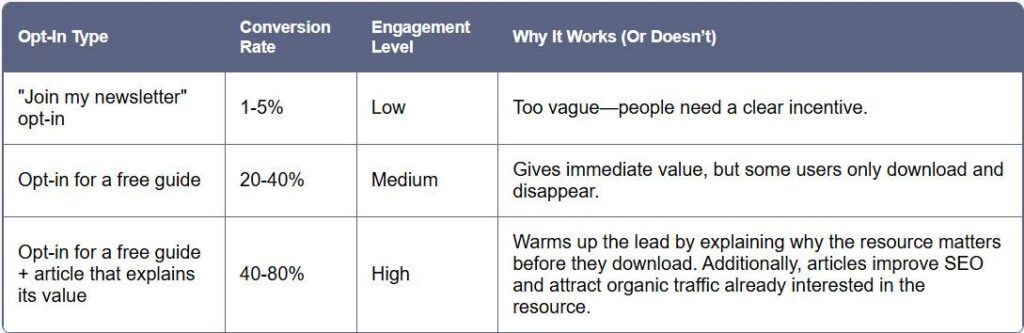
    Let’s compare three types of opt-ins and see which performs best in real-world scenarios:

    💡 Key Takeaways:

    • A generic newsletter opt-in rarely works.
    • A direct lead magnet opt-in works much better.
    • An article that pre-sells the resource (before the opt-in) performs best.

    Advanced strategies to boost your lead magnet’s impact

    If you want even higher conversions, try these next-level tactics:

    🎥 Add a video teaser – A 30-second video explaining what they’ll get can increase conversions by 30% or more.

    📲 Use retargeting ads – Show ads to people who visited your lead magnet page but didn’t opt-in.

    📢 Leverage social proof – Add testimonials from people who used the resource and saw results.

    💬 Use AI to engage leads proactively – Leverage well-trained AI chat-bots (PM me for a free consultation) that have access to your business documentation and engage leads as soon as they land on your site.

    Conclusion: make your free resources work for you

    If you’re giving away valuable content, make sure you get something in return—leads you can nurture into customers.

    Even small changes—like adding an opt-in form—can double or triple your conversions. The best part? It’s a one-time setup that keeps generating leads on autopilot.

    Take Action Now:

    1️⃣ Choose one free resource you’re currently giving away.
    2️⃣ Create a simple opt-in landing page for it.
    3️⃣ Set up an email follow-up sequence to nurture your new leads.